After giving the speech of a lifetime about facing the threat of Huntington’s disease, I need to recharge my batteries.
As readers of this blog know, it's been an intense few weeks. On February 7, I told a meeting of some 250 HD researchers and supporters of the search for a cure that I am gene-positive for the cruel and deadly brain disease that took my mother’s life in 2006.
I had finally gone public after 15 years of hiding my situation. I'd feared genetic discrimination in the workplace and the insurance and healthcare systems.
I still have such fears, but they've diminished somewhat, thanks to the passage of the Genetic Information Nondiscrimination Act in 2008 and the healthcare legislation of 2010, which by 2014 will prohibit denial of coverage to people with pre-existing conditions.
And, because I’m in a race against time as I await an effective treatment, I’ve committed to a bolder stance
Less than a week after my speech, I posted a video of it on this blog. I followed up a week later with an extensive article about the meeting, the “Super Bowl” of HD drug discovery, including videos of my interviews with two leading HD researchers.
In preparing the presentation, I kept thinking of how I was “writing my life.” From mid-December, when I began the speech, until now, I’ve revisited the many memories of my parents and my fears of HD. And I’ve braced myself for the emotional and social impact of leaving the HD closet.
Now I’m taking stock of the whole experience. But it’s not easy to process so many difficult thoughts while handling the many responsibilities of work, family, and community. And there is no “right” or “wrong” way of handling an exit from a closet, especially when in the case of a little-known yet highly stigmatized brain disease like HD. So I don’t yet have any clear conclusions.
In these last few days I did know one thing for sure: I needed to rest up for the next stage of my activism in support of greater public awareness about HD and the need to find treatments and a cure.
Adrenalin mixed with worry
Sharing my story with the scientists who hold my future in their hands left me exhilarated. My keynote speech moved many in the audience to tears.
A number of the scientists later came up to me during the four-day meeting in Palm Springs, California, and said the speech had brought home the reality of HD and inspired them to redouble their efforts.
Later I was interviewed on camera for a forthcoming video about the urgent need for the HD community to participate in clinical and observational trials. Without such help scientists will lack the data they need to develop effective drugs.
I was interviewed by Charles Sabine, a former NBC-TV foreign correspondent and now the international spokesperson for the HD movement. Charles is also HD-positive.
The online video of my keynote speech drew an unusually high number of visits to this blog. People expressed thanks and support.
The speech and my coverage of the meeting brought an adrenaline rush, but also worry about the possible long-term consequences of coming out. I couldn’t point to anything specific, but felt exposed and a bit defenseless. The day after I put the speech online, the emotional overload gave me heartburn.
Translating the science
I had little time to think about the impact of the speech, because I immediately had to shift my focus to comprehending the new research data presented by the scientists. I dedicated each minute of my free time on the weekend of February 19-20 to the update on the meeting.
Although my speech marked a personal milestone, translating the science into language understandable for the HD community presented an equally significant challenge. It is the scientists who will find the solution to HD. The HD movement has become my life’s work, and a big part of that involves informing people of the scientific progress and inspiring them to get involved.
To produce that article I had to get into my special writing zone. It’s a huge challenge to write on HD research, because I was trained in history, not science. The scientists speak in their own highly technical language, and I had to get the translation just right. So I imagined myself somehow fine-tuning my brain for the task.
I relish the challenge, because that kind of stimulus could partially protect my brain against HD’s attack on my mental abilities, including my great passion for writing.
But reporting on the search for treatments also makes me painfully aware of how the disease harms the brain years and even decades before the classic symptoms kick in. It's painful to look at scanning images that illustrate how HD shrinks the brain by causing neurons to die.
In these last few weeks I’ve often felt as if I’m in a daze.The need to deny the reality of HD sometimes makes me feel as if it’s all unreal, as if I’m floating above myself, my predicament, and the scientists and am looking down at it all.
Coming down from coming out
Every beat of the heart requires a rest, so I’ve also spent time more time than usual decompressing.
At one of the dinners for the scientists, the host hotel, the Parker Palm Springs, served a fantastically good wine. Or was it my exhilaration that made the wine taste better? I copied the label information on a napkin: “Hangtime. 2008 Pinot Noir. Arroyo Seco. Force Canyon Vineyard.”
“Hangtime” refers to the period the grapes remain on the vine. It also refers to enjoying the company of good friends and good wine.
I couldn’t find the 2008 vintage of Hangtime in San Diego, but I bought a few bottles of the 2009 vintage to share with my wife and friends.
Each sip reminded me of the speech and the commingling of my hopes with the scientists’ efforts to find a cure. I want so badly for those feelings of hope – and feelings of freedom from HD forever – to hang endlessly in time.
I’m going to track down a bottle of that 2008 vintage and keep it as a remembrance of the meeting. I’ll uncork it the day the scientists have found an effective treatment that saves everybody in the HD community from its devastating symptoms.
Keeping a balanced life
As many readers of this blog may have concluded, I’m a workaholic. That keeps me focused. But sometimes I let my activism consume me. Then I must remind myself that, no matter the circumstances, life requires balance.
A few weeks ago our “miracle baby,” who was born HD-negative in 2000 after we had her tested in the womb, lamented the fact that I had not taught her how to throw a ball properly.
After work one afternoon, I stopped at Target to choose a cushy ball the size of a softball. I took my daughter to the park, and we practiced tossing it back and forth. When it was time to go, I made her throw it to me and catch it three consecutive times without a miss before we could leave.
In the days that followed, thinking of the ball became the antidote to my workaholism.
It’s also a reminder that my daughter needs me.
Keeping the balance is a huge challenge, because for me to be with my family in the long run, I must spend time away from them in the short run working for the cause. However, although scientists are increasingly optimistic about a treatment, nobody can predict exactly how or when they will find one.
Looking ahead
So now it’s time to recharge my mental, emotional, and physical batteries for the next wave of activism. The keynote speech is already creating new opportunities for me to contribute to the cause.
Tomorrow evening, February 28, I will speak to the local HD support group on my coping strategies.
In early May I will make a similar presentation to the annual convention of the Northern California chapter of the Huntington’s Disease Society of America.
I’m also planning a trip to Cambridge, Massachusetts, to visit the headquarters of Alnylam Pharmaceuticals, which is getting ready to apply for permission from the federal government to conduct human trials for its potentially revolutionary remedy, an RNA interference drug, to stop HD at its genetic roots. I will write about Alnylam in future articles.
As I step up my public advocacy, I’m embarking on a new phase in my life. More than ever, I’m going to need large quantities of positive energy.
Sunday, February 27, 2011


Monday, February 21, 2011
‘Drug hunters’ bring hope to Huntington’s families
Scientists and pharmaceutical companies are making steady progress in the search for treatments for Huntington’s disease, increasing the hope that this generation of HD-affected families will finally get long-awaited relief from its devastating, ultimately deadly symptoms.
This was the message of the Sixth Annual HD Therapeutics Conference, sponsored by the CHDI Foundation, Inc., from February 7-10, 2011, at the Parker Palm Springs hotel in Palm Springs, California.
After delivering the keynote address to about 250 prominent scientists, physicians, pharmaceutical representatives, and supporters of the HD cause on the evening of February 7, I spent the next three days observing scientists speak on the latest advances in HD research and their plans for finding treatments.
This was a conference of “drug hunters,” the people in the trenches of university, corporate, government, and foundation labs who are working as quickly as possible to develop a myriad of ways to stop HD.
Informally known as the “cure Huntington’s disease initiative,” CHDI invited researchers to outline progress in four main areas, which I describe below after the following overview interview with Robert Pacifici, Ph.D., CHDI’s chief scientific officer.
Overview video and summaries
Click “play” on the video below to see my interview with Dr. Pacifici. In addition to outlining the main points of the conference, Dr. Pacifici urged the HD community to participate in trials that will assist scientists in their quest for treatments.
You can also read a daily summary of the conference at the excellent new science website http://www.hdbuzz.net/.
Area 1: Decreasing huntingtin
The first and most promising area involves the attempt to attack HD at its genetic roots. This approach is called “lowering huntingtin,” the protein produced in our cells by the huntingtin gene. HD people have a mutated gene, and that mutation produces a faulty huntingtin protein, which compromises the health of brain cells.
As a result, they have two kinds of this protein. There is the “good,” or normal, huntingtin, which is produced by the gene inherited from the non-HD parent. And there is “bad,” or abnormal or defective huntingtin, which is produced by the gene from the parent with HD.
“In my six years at CHDI, we’ve seen (potential drug) targets come and go,” said Douglas Macdonald, Ph.D., CHDI’s director of drug discovery. “Only one has continued: huntingtin.”
 Above, Dr. Macdonald addresses the conference. Below, a slide from his presentation pointing out the need to lower huntingtin before symptoms begin (photos by Gene Veritas).
It also helps keep the brain as a whole stable.
Dr. Zeitlin also pointed out that huntingtin is important in the development of an embryo. Too little huntingtin in a mouse embryo, for example, causes the animal to be born deformed.
Other views on lowering huntingtin
Providing the example of protein regulation in another disease, Dr. Karen Chen of the Spinal Muscular Atrophy (SMA) Foundation demonstrated how an Isis compound has improved the health of mice afflicted with SMA. Adjusting huntingtin could work similarly in HD, she suggested.
In his presentation, Dr. Andreas Weiss of the Novartis Institute for Biomedical Research discussed the methods and technologies used to track the presence of normal and abnormal huntingtin in cells and brains. Data from these observations will help in the design and dosing of treatments – including, once again, the question of how much to lower huntingtin.
(For an informed outlook on lowering huntingtin and controlling HD, watch my interview with Dr. Hayden in the video below. Dr. Hayden’s lab collaborates with Isis on attempts to lower huntingtin. In this interview Dr. Hayden also recounts his journey from working as a young doctor in South Africa to conducting research in North America, and he discusses the increased number of HD patients and the deep discrimination faced by HD-affected families everywhere. For additional background on Dr. Hayden, read this article.)
Gene Veritas interviews Huntington's disease expert Michael Hayden from Gene Veritas on Vimeo.
Area 2: saving brain cells
The second main area for researchers involves the problem of dysfunctional brain cells and how to save them early enough to prevent the disease from advancing.
This portion of the conference focused on such key problems as synaptic dysfunction, the misfiring the synapses, where the signals between brain cells are carried. The deficit in brain cell activity was also examined. Researchers also addressed the problem of “excitatory cell death”, in which dying cells release chemicals that, in turn, overstimulate and cause damage to other cells.
Dr. Michael Orth of the University of Ulm, Germany, discussed transcranial magnetic stimulation (sending of weak electrical currents into the brain), a method he has used to measure brain activity in pre-symptomatic, gene-positive individuals like me. He observed abnormal activity in the motor cortex portion of the brain, the area responsible for movement. Chorea, or the shaking and trembling of the body, is one of the primary symptoms of HD.
Dr. Vahri Beaumont of CHDI outlined the organization’s programs for combating synaptic dysfunction, which is primarily the problem of miscommunication between neurons. She noted that such dysfunction can occur as early as two decades before a person has noticeable symptoms. A couple of compounds currently used in clinical trials for other diseases could be beneficial for HD patients, she suggested.
Along these lines, Dr. Pacifici noted that large pharmaceutical companies have shown great interest in this area of brain health and have developed many compounds. These compounds can be “repurposed” quickly and moved into HD trials in the near future.
Area 3: bioenergetics and HD
The third group of presentations focused on a well-known problem caused by HD: an individual’s extremely high usage of energy, which causes patients to lose weight. Scientists are examining the causes of this problem at the cellular level and seeking remedies.
This characteristic of HD has led patients and asymptomatic gene-positive individuals to take supplements such as coenzyme Q-10, creatine, and trehalose. These might increase cellular energy. These substances are under study by HD researchers.
This session of the conference included discussion of dysfunction in the mitochondria, the powerhouses of the cell, and possible drug targets.
Dr. Pacifici that scientists are seeking to understand the specific causes of the energy deficit in HD and match them up with possible drug molecules.
Area 4: fertilizers for the brain
The final portion of the conference focused on “neurotrophic factors” (growth factors), which help maintain brain cells and the brain’s functions.
In Dr. Pacifici’s words, neurotrophic factors are like “fertilizers” for the brain. With HD, there is a shortage of certain molecules – the fertilizer – which must be put back into the brain to make it grow new cells and stay healthy.
Dr. João Siffert of Ceregene described his company’s implementation of a Phase II human clinical trial for CERE-120, a drug that is intended to increase the growth factor neurturin in the brains of Parkinson’s disease patients. Ceregene is conducting pre-clinical research on CERE-120 for use in HD.
The protein BDNF
One of the most frequently mentioned growth factors in HD research is BDNF, a protein known as brain-derived neurotrophic factor. As stated by Dr. Jordi Alberch of the University of Barcelona, BDNF is a potent protector of neurons in the striatum, one of the areas of the brain most affected in HD. The level of BDNF decreases in HD patients.
In his presentation on brain receptors that link up with BDNF, Dr. Moses Chao of the New York University School of Medicine noted that the lack of the substance is a cause of the neuropsychiatric symptoms of HD (such as depression).

This year’s winner was a poster by Dr. Ray Truant of McMaster University in Hamilton, Ontario, and his graduate students Nicholas Caron and Randy Atwal. It was titled “Measuring Flourescence Lifetime in Living Cells Reveals Huntingtin Exon1 Structure at Nanometer Resolution.” It was subtitled “N17 ‘Loop-back’ Model is Affected by Phosphorylation and Polyglutamine Expansion.”
As explained to me by Caron, the experiment involved the use of an extremely powerful laser microscope to examine the real time workings of live mouse cells. They observed actual protein-to-protein interactions.
The normal huntingtin protein has a kind of hinge, but the abnormal protein becomes too long and too rigid and thus makes this hinge less flexible.
The team concluded that they can use this technique to screen for small molecules that can influence the disease process within the cells. The goal is to find ways to reduce toxicity within cells.
Their research builds on the 2009 discovery of a “molecular switch” that might be used to stop part of the disease process in Huntington’s.
 Ph.D. student Nick Caron (above) with the winning poster, and Dr. Ray Truant (below) explaining the team's project to the conference participants (photos by Gene Veritas).

This was the message of the Sixth Annual HD Therapeutics Conference, sponsored by the CHDI Foundation, Inc., from February 7-10, 2011, at the Parker Palm Springs hotel in Palm Springs, California.
After delivering the keynote address to about 250 prominent scientists, physicians, pharmaceutical representatives, and supporters of the HD cause on the evening of February 7, I spent the next three days observing scientists speak on the latest advances in HD research and their plans for finding treatments.
This was a conference of “drug hunters,” the people in the trenches of university, corporate, government, and foundation labs who are working as quickly as possible to develop a myriad of ways to stop HD.
Informally known as the “cure Huntington’s disease initiative,” CHDI invited researchers to outline progress in four main areas, which I describe below after the following overview interview with Robert Pacifici, Ph.D., CHDI’s chief scientific officer.
Overview video and summaries
Click “play” on the video below to see my interview with Dr. Pacifici. In addition to outlining the main points of the conference, Dr. Pacifici urged the HD community to participate in trials that will assist scientists in their quest for treatments.
You can also read a daily summary of the conference at the excellent new science website http://www.hdbuzz.net/.
Gene Veritas interviews CHDI chief researcher Robert Pacifici from Gene Veritas on Vimeo.
Area 1: Decreasing huntingtin
The first and most promising area involves the attempt to attack HD at its genetic roots. This approach is called “lowering huntingtin,” the protein produced in our cells by the huntingtin gene. HD people have a mutated gene, and that mutation produces a faulty huntingtin protein, which compromises the health of brain cells.
As a result, they have two kinds of this protein. There is the “good,” or normal, huntingtin, which is produced by the gene inherited from the non-HD parent. And there is “bad,” or abnormal or defective huntingtin, which is produced by the gene from the parent with HD.
“In my six years at CHDI, we’ve seen (potential drug) targets come and go,” said Douglas Macdonald, Ph.D., CHDI’s director of drug discovery. “Only one has continued: huntingtin.”
 Above, Dr. Macdonald addresses the conference. Below, a slide from his presentation pointing out the need to lower huntingtin before symptoms begin (photos by Gene Veritas).
CHDI’s current budget stands at approximately $100 million, a substantial sum compared to the amounts available just a decade ago in the world of HD research. CHDI intends to spend about half of the drug development portion of its budget in the area of huntingtin lowering. This approach appears to come closest to the idea of a “cure,” although most scientists believe that HD will be merely controlled like diabetes or high cholesterol, and then only with a cocktail of drugs.
On this front CHDI has partnered with a number of firms and labs: Isis Pharmaceuticals, Inc. (click here to read more); Alnylam Pharmaceuticals; Evotec; Dr. Neil Aronin of the University of Massachusetts School of Medicine; Dr. Paul Patterson of the California Institute of Technology; Dr. Edvard Smith of the Karolinska Institutet in Stockholm, Sweden; and Dr. Robert M. Friedlander of the University of Pittsburgh School of Medicine. Novartis, one of the world’s largest pharmaceutical companies, is also engaged in this area of research.
Both Isis and Alnylam are very close to applying for permission from the Food and Drug Administration to begin human clinical trials with their potential drugs.
Challenges
While potentially very effective for those with HD, lowering huntingtin also poses several huge challenges for scientists, Dr. Macdonald pointed out.
What should be targeted, good or bad huntingtin or both? How much should the protein be lowered? What part of the brain should be treated? And at what stage of the disease should a drug be given to a patient or non-symptomatic, gene-positive individual such as myself?
After all, the huntingtin protein is needed for the development of the cell. Even defective huntingtin does some good, Dr. Macdonald explained.
Unfortunately, so far the potential drugs for lowering huntingtin do not distinguish between the good and the bad, so reducing the bad decreases the good by the same percentage. (I’ll be writing soon on how Isis is attempting to find a way to keep the good while lowering the bad.)
In an interview, world-renowned HD specialist Dr. Michael Hayden, of the University of British Columbia, told me that beyond decreasing the defective huntingtin, another solution would be to increase the supply of the good.
Huntingtin’s job
For a long time, scientists had no idea about the function of huntingtin. In the last few years, however, they have made a number of discoveries.
Huntingtin is like the spider at the middle of a web of cellular functions, explained Scott Zeitlin, Ph.D., of the University of Virginia School of Medicine. If you reduce its capabilities, you reduce the strands in the web, in other words, the things the cell can do. And if you remove it, you sever the strands, that is, you completely turn off important processes. Dr. Scott Zeitlin explains the functions of the huntingtin protein (photo by Gene Veritas).
It also helps keep the brain as a whole stable.
Dr. Zeitlin also pointed out that huntingtin is important in the development of an embryo. Too little huntingtin in a mouse embryo, for example, causes the animal to be born deformed.
Other views on lowering huntingtin
Providing the example of protein regulation in another disease, Dr. Karen Chen of the Spinal Muscular Atrophy (SMA) Foundation demonstrated how an Isis compound has improved the health of mice afflicted with SMA. Adjusting huntingtin could work similarly in HD, she suggested.
In his presentation, Dr. Andreas Weiss of the Novartis Institute for Biomedical Research discussed the methods and technologies used to track the presence of normal and abnormal huntingtin in cells and brains. Data from these observations will help in the design and dosing of treatments – including, once again, the question of how much to lower huntingtin.
(For an informed outlook on lowering huntingtin and controlling HD, watch my interview with Dr. Hayden in the video below. Dr. Hayden’s lab collaborates with Isis on attempts to lower huntingtin. In this interview Dr. Hayden also recounts his journey from working as a young doctor in South Africa to conducting research in North America, and he discusses the increased number of HD patients and the deep discrimination faced by HD-affected families everywhere. For additional background on Dr. Hayden, read this article.)
Gene Veritas interviews Huntington's disease expert Michael Hayden from Gene Veritas on Vimeo.
Area 2: saving brain cells
The second main area for researchers involves the problem of dysfunctional brain cells and how to save them early enough to prevent the disease from advancing.
This portion of the conference focused on such key problems as synaptic dysfunction, the misfiring the synapses, where the signals between brain cells are carried. The deficit in brain cell activity was also examined. Researchers also addressed the problem of “excitatory cell death”, in which dying cells release chemicals that, in turn, overstimulate and cause damage to other cells.
Dr. Michael Orth of the University of Ulm, Germany, discussed transcranial magnetic stimulation (sending of weak electrical currents into the brain), a method he has used to measure brain activity in pre-symptomatic, gene-positive individuals like me. He observed abnormal activity in the motor cortex portion of the brain, the area responsible for movement. Chorea, or the shaking and trembling of the body, is one of the primary symptoms of HD.
Dr. Vahri Beaumont of CHDI outlined the organization’s programs for combating synaptic dysfunction, which is primarily the problem of miscommunication between neurons. She noted that such dysfunction can occur as early as two decades before a person has noticeable symptoms. A couple of compounds currently used in clinical trials for other diseases could be beneficial for HD patients, she suggested.
Along these lines, Dr. Pacifici noted that large pharmaceutical companies have shown great interest in this area of brain health and have developed many compounds. These compounds can be “repurposed” quickly and moved into HD trials in the near future.
Area 3: bioenergetics and HD
The third group of presentations focused on a well-known problem caused by HD: an individual’s extremely high usage of energy, which causes patients to lose weight. Scientists are examining the causes of this problem at the cellular level and seeking remedies.
This characteristic of HD has led patients and asymptomatic gene-positive individuals to take supplements such as coenzyme Q-10, creatine, and trehalose. These might increase cellular energy. These substances are under study by HD researchers.
This session of the conference included discussion of dysfunction in the mitochondria, the powerhouses of the cell, and possible drug targets.
Dr. Pacifici that scientists are seeking to understand the specific causes of the energy deficit in HD and match them up with possible drug molecules.
Area 4: fertilizers for the brain
The final portion of the conference focused on “neurotrophic factors” (growth factors), which help maintain brain cells and the brain’s functions.
In Dr. Pacifici’s words, neurotrophic factors are like “fertilizers” for the brain. With HD, there is a shortage of certain molecules – the fertilizer – which must be put back into the brain to make it grow new cells and stay healthy.
Dr. João Siffert of Ceregene described his company’s implementation of a Phase II human clinical trial for CERE-120, a drug that is intended to increase the growth factor neurturin in the brains of Parkinson’s disease patients. Ceregene is conducting pre-clinical research on CERE-120 for use in HD.
The protein BDNF
One of the most frequently mentioned growth factors in HD research is BDNF, a protein known as brain-derived neurotrophic factor. As stated by Dr. Jordi Alberch of the University of Barcelona, BDNF is a potent protector of neurons in the striatum, one of the areas of the brain most affected in HD. The level of BDNF decreases in HD patients.
In his presentation on brain receptors that link up with BDNF, Dr. Moses Chao of the New York University School of Medicine noted that the lack of the substance is a cause of the neuropsychiatric symptoms of HD (such as depression).

Dr. Moses Chao speaks on BDNF (photo by Gene Veritas).
BDNF, he observed, contributes to a number of important activities in the brain, including the development of the cytoskeleton (the skeleton of the cell) and the ability of the synapses to adjust their strength. BDNF also helps cells survive.
As Dr. Chao pointed out, scientists first thought it might be possible to inject BDNF directly into the brain to help patients. However, in their experiments they encountered difficulties in delivering the BDNF, and it proved to be very “sticky,” meaning that it did not move easily in the brain. There were also negative side effects.
More recently, Dr. Chao explained, scientists have sought ways to bypass these problems. That research has focused on the BDNF receptors, molecules in the brain that link to BDNF so that it can carry out its tasks. Scientists are also examining substances that can bind to the receptors and act as a substitute for BDNF.
Evidence has also shown for quite some time that certain chronic antidepressants increase BDNF levels.
Scientists have long known that exercise stimulates the production of BDNF. Therefore, Dr. Allan Tobin of CHDI has conducted a workshop to investigate the use of molecules that could mimic the effect of exercise on the brain and therefore increase BDNF levels.
In his presentation, Dr. Alex Kiselyov of CHDI reviewed several “paths” that might be followed in solving the BDNF deficit problem.
Visiting the poster session
As with most scientific conferences, the CHDI event included an area where scientists could present posters summarizing their research.
The collection of posters was like an ultra-advanced science fair. Authors gave short oral presentations to other scientists circulating through the area, and a panel of three judges chose the three top posters. After hearing formal presentations, the conference participants selected a winner.
(In the video below you can watch the scientists as they examine and discuss the posters.)
Huntington's disease drug hunters view posters at 2011 research conference from Gene Veritas on Vimeo.
BDNF, he observed, contributes to a number of important activities in the brain, including the development of the cytoskeleton (the skeleton of the cell) and the ability of the synapses to adjust their strength. BDNF also helps cells survive.
As Dr. Chao pointed out, scientists first thought it might be possible to inject BDNF directly into the brain to help patients. However, in their experiments they encountered difficulties in delivering the BDNF, and it proved to be very “sticky,” meaning that it did not move easily in the brain. There were also negative side effects.
More recently, Dr. Chao explained, scientists have sought ways to bypass these problems. That research has focused on the BDNF receptors, molecules in the brain that link to BDNF so that it can carry out its tasks. Scientists are also examining substances that can bind to the receptors and act as a substitute for BDNF.
Evidence has also shown for quite some time that certain chronic antidepressants increase BDNF levels.
Scientists have long known that exercise stimulates the production of BDNF. Therefore, Dr. Allan Tobin of CHDI has conducted a workshop to investigate the use of molecules that could mimic the effect of exercise on the brain and therefore increase BDNF levels.
In his presentation, Dr. Alex Kiselyov of CHDI reviewed several “paths” that might be followed in solving the BDNF deficit problem.
Visiting the poster session
As with most scientific conferences, the CHDI event included an area where scientists could present posters summarizing their research.
The collection of posters was like an ultra-advanced science fair. Authors gave short oral presentations to other scientists circulating through the area, and a panel of three judges chose the three top posters. After hearing formal presentations, the conference participants selected a winner.
(In the video below you can watch the scientists as they examine and discuss the posters.)
Huntington's disease drug hunters view posters at 2011 research conference from Gene Veritas on Vimeo.
This year’s winner was a poster by Dr. Ray Truant of McMaster University in Hamilton, Ontario, and his graduate students Nicholas Caron and Randy Atwal. It was titled “Measuring Flourescence Lifetime in Living Cells Reveals Huntingtin Exon1 Structure at Nanometer Resolution.” It was subtitled “N17 ‘Loop-back’ Model is Affected by Phosphorylation and Polyglutamine Expansion.”
As explained to me by Caron, the experiment involved the use of an extremely powerful laser microscope to examine the real time workings of live mouse cells. They observed actual protein-to-protein interactions.
The normal huntingtin protein has a kind of hinge, but the abnormal protein becomes too long and too rigid and thus makes this hinge less flexible.
The team concluded that they can use this technique to screen for small molecules that can influence the disease process within the cells. The goal is to find ways to reduce toxicity within cells.
Their research builds on the 2009 discovery of a “molecular switch” that might be used to stop part of the disease process in Huntington’s.
 Ph.D. student Nick Caron (above) with the winning poster, and Dr. Ray Truant (below) explaining the team's project to the conference participants (photos by Gene Veritas).
Another piece of the puzzle
The featured speaker of the conference was the eminent neuroscientist Dr. Solomon H. Snyder of the University of Johns Hopkins Medical School.
Dr. Snyder provided a look back at the last five decades of discoveries about the brain, its receptors, and the many important kinds of drugs resulting from this research.
In 2009, he and other scientists in his lab reported a key new finding about HD involving a protein called Rhes. Located only in the striatum, Rhes binds to the huntingtin protein. When it binds with abnormal huntingtin, it causes cell death.
As Dr. Synder stated, the limited presence of Rhes in the striatum could help explain why that area of the brain suffers more damage than others.
Researchers are now looking for ways to stop the harmful effects of Rhes. Dr. Snyder stated that a Rhes drug might be safe, because its use would be required only in the brain, not all over the body.
CHDI’s key role
In the final session of the conference, Dr. Pacifici and two lead CHDI researchers summarized CHDI’s work in developing completely new compounds that might be able to treat other problems that occur in HD-afflicted brains. Dr. Ignacio Muñoz-Sanjuan, the vice president for biology, and Dr. Celia Dominguez, the vice president for chemistry, detailed the efforts to prepare two of these compounds for testing in animals.
(Watch the video below for a part of Dr. Muñoz-Sanjuan’s talk and to get a view of the scientists at work in the main conference room.)
The development of these and other CHDI compounds reveals how the organization has assumed an ever more important leadership role in the search for treatments and a cure. As a virtual biotech company, CHDI not only contracts with other firms and labs to carry out research and testing, but pioneers in new areas. CHDI is determined to explore as many remedies as possible.
At this conference CHDI’s importance was further reflected by the record number of attendees and posters. In fact, this year the organizers needed to add a couple of extra rows of seats to accommodate attendees.
“At any time, CHDI is working full-speed on about ten different drug development projects,” noted Dr. Jeff Carroll (click here to read more), an HD researcher and, like me, gene-positive for the disease. “For a sense of scale, that’s more programs than most large pharmaceutical companies have in all areas of brain research, including much more common diseases like Alzheimer’s or Parkinson’s disease. CHDI is changing the pace and scope of HD drug development.”
Reasons for optimism
Dr. Pacifici concluded that HD families can “have hope.”
“There are an incredible number of shots on goal,” he said. “We’re doing this as quickly and as rationally as possible, and I think that there’s really good reason to be optimistic that within the next period of time we’re going to start seeing the creation of new chemical entities, new drugs that were specifically designed with Huntington’s in mind.”
“I can see that we’re getting to the final stretch. It’s been a long marathon,” said Dr. Hayden. “And I’m optimistic. I’ve been in this field for 34 years. We did the first predictive test 25 years ago in Vancouver in 1986. So we’ve watched the whole development.
“So for me the opportunity to work with many of these companies, keep them focused on the issues, and help to provide the reagents and resources to get this done is just an incredible privilege and an exciting time.
“We know that for families listening to this, every day counts.”
The featured speaker of the conference was the eminent neuroscientist Dr. Solomon H. Snyder of the University of Johns Hopkins Medical School.
Dr. Snyder provided a look back at the last five decades of discoveries about the brain, its receptors, and the many important kinds of drugs resulting from this research.
In 2009, he and other scientists in his lab reported a key new finding about HD involving a protein called Rhes. Located only in the striatum, Rhes binds to the huntingtin protein. When it binds with abnormal huntingtin, it causes cell death.
As Dr. Synder stated, the limited presence of Rhes in the striatum could help explain why that area of the brain suffers more damage than others.
Researchers are now looking for ways to stop the harmful effects of Rhes. Dr. Snyder stated that a Rhes drug might be safe, because its use would be required only in the brain, not all over the body.
CHDI’s key role
In the final session of the conference, Dr. Pacifici and two lead CHDI researchers summarized CHDI’s work in developing completely new compounds that might be able to treat other problems that occur in HD-afflicted brains. Dr. Ignacio Muñoz-Sanjuan, the vice president for biology, and Dr. Celia Dominguez, the vice president for chemistry, detailed the efforts to prepare two of these compounds for testing in animals.
(Watch the video below for a part of Dr. Muñoz-Sanjuan’s talk and to get a view of the scientists at work in the main conference room.)
Drug hunters at work at 2011 Huntington's disease meeting from Gene Veritas on Vimeo.
The development of these and other CHDI compounds reveals how the organization has assumed an ever more important leadership role in the search for treatments and a cure. As a virtual biotech company, CHDI not only contracts with other firms and labs to carry out research and testing, but pioneers in new areas. CHDI is determined to explore as many remedies as possible.
At this conference CHDI’s importance was further reflected by the record number of attendees and posters. In fact, this year the organizers needed to add a couple of extra rows of seats to accommodate attendees.
“At any time, CHDI is working full-speed on about ten different drug development projects,” noted Dr. Jeff Carroll (click here to read more), an HD researcher and, like me, gene-positive for the disease. “For a sense of scale, that’s more programs than most large pharmaceutical companies have in all areas of brain research, including much more common diseases like Alzheimer’s or Parkinson’s disease. CHDI is changing the pace and scope of HD drug development.”
Reasons for optimism
Dr. Pacifici concluded that HD families can “have hope.”
“There are an incredible number of shots on goal,” he said. “We’re doing this as quickly and as rationally as possible, and I think that there’s really good reason to be optimistic that within the next period of time we’re going to start seeing the creation of new chemical entities, new drugs that were specifically designed with Huntington’s in mind.”
“I can see that we’re getting to the final stretch. It’s been a long marathon,” said Dr. Hayden. “And I’m optimistic. I’ve been in this field for 34 years. We did the first predictive test 25 years ago in Vancouver in 1986. So we’ve watched the whole development.
“So for me the opportunity to work with many of these companies, keep them focused on the issues, and help to provide the reagents and resources to get this done is just an incredible privilege and an exciting time.
“We know that for families listening to this, every day counts.”
Sunday, February 13, 2011
Unmasking Gene Veritas: a Huntington's disease activist goes public
After 15 long and often painful years, I have taken off the mask that led me to use the name “Gene Veritas.”
I have left the darkness surrounding Huntington’s disease.
At 5 p.m. on February 7, 2011, I gave the keynote address at the Sixth Annual HD Therapeutics Conference, sponsored by the CHDI Foundation, Inc., informally known as the “cure Huntington’s disease initiative.”
About 250 prominent scientists, physicians, drug company representatives, and others listened to my speech, which was titled “Blog Entry 85 … Unmasking the World of Gene Veritas: An Activist Copes with the Threat of Huntington’s Disease.”
I was introduced by Robi Blumenstein, the president of CHDI Management, Inc., the organization that implements the foundation’s goal of finding treatments and a cure for HD. The meeting took place at the Parker Palm Springs hotel in Palm Springs, CA, from February 7-10.
Vanquishing disease
I revealed my real name. I described my family’s struggles with HD, my personal challenge to live a healthy, balanced life under severe pressure, and how, while maintaining a career and family, I have dedicated my life to ending the threat of this cruel disease.
And I saluted the scientists in the room and around the world working hard to find treatments and a cure. I urged them to redouble their efforts.
“You and I – the HD-positive man and the community of HD researchers – you and I stand on the cutting edge of science and of history,” I declared. “Because, in conquering HD, you are going to hold out the hope of a world in which disease is vanquished.”
At the end of this article I have posted a home video of my speech. (A professionally edited version of the video will become available in the near future.)
A liberating feeling
I have stepped decisively out of the HD closet.
But “Gene Veritas” will still live on in cyberspace. That powerful name – the “truth in the genes” – has become my trademark. Through its anonymity and universality, it symbolizes the common struggles of families threatened by HD and numerous other neurological and genetic diseases.
In my speech, I spoke of the need for HD activists to liberate the entire community from the darkness and stigma surrounding HD. Before my speech, I wrote that I felt like an “alien” because of that stigma (click here to read more).
Now, however, I feel liberated.
Not time to rest yet
To say the least, it was a momentous week for me.
For now, I just wanted to share with you the speech.
Soon I will post another article exploring the impact of the speech and its implications for my future. I will post other articles and videos about the CHDI meeting, the “Super Bowl” of Huntington’s disease research.
The speech was a milestone. But the task of treating and curing HD still remains.
Scientists have made great progress, but we cannot rest until we reach our goal. For so many of us, time is short.
I have left the darkness surrounding Huntington’s disease.
At 5 p.m. on February 7, 2011, I gave the keynote address at the Sixth Annual HD Therapeutics Conference, sponsored by the CHDI Foundation, Inc., informally known as the “cure Huntington’s disease initiative.”
About 250 prominent scientists, physicians, drug company representatives, and others listened to my speech, which was titled “Blog Entry 85 … Unmasking the World of Gene Veritas: An Activist Copes with the Threat of Huntington’s Disease.”
I was introduced by Robi Blumenstein, the president of CHDI Management, Inc., the organization that implements the foundation’s goal of finding treatments and a cure for HD. The meeting took place at the Parker Palm Springs hotel in Palm Springs, CA, from February 7-10.
Vanquishing disease
I revealed my real name. I described my family’s struggles with HD, my personal challenge to live a healthy, balanced life under severe pressure, and how, while maintaining a career and family, I have dedicated my life to ending the threat of this cruel disease.
And I saluted the scientists in the room and around the world working hard to find treatments and a cure. I urged them to redouble their efforts.
“You and I – the HD-positive man and the community of HD researchers – you and I stand on the cutting edge of science and of history,” I declared. “Because, in conquering HD, you are going to hold out the hope of a world in which disease is vanquished.”
At the end of this article I have posted a home video of my speech. (A professionally edited version of the video will become available in the near future.)
A liberating feeling
I have stepped decisively out of the HD closet.
But “Gene Veritas” will still live on in cyberspace. That powerful name – the “truth in the genes” – has become my trademark. Through its anonymity and universality, it symbolizes the common struggles of families threatened by HD and numerous other neurological and genetic diseases.
In my speech, I spoke of the need for HD activists to liberate the entire community from the darkness and stigma surrounding HD. Before my speech, I wrote that I felt like an “alien” because of that stigma (click here to read more).
Now, however, I feel liberated.
Not time to rest yet
To say the least, it was a momentous week for me.
For now, I just wanted to share with you the speech.
Soon I will post another article exploring the impact of the speech and its implications for my future. I will post other articles and videos about the CHDI meeting, the “Super Bowl” of Huntington’s disease research.
The speech was a milestone. But the task of treating and curing HD still remains.
Scientists have made great progress, but we cannot rest until we reach our goal. For so many of us, time is short.
Unmasking Gene Veritas: a Huntington's disease activist goes public from Gene Veritas on Vimeo.
Monday, January 31, 2011
Feeling like an alien: going public about Huntington's
How do you overcome the stigma and fear of discrimination associated with a brain disease that could leave you horribly disabled?
I’ve struggled with this question constantly since my mother’s diagnosis for Huntington’s disease in 1995. HD caused her body to move uncontrollably and robbed her of the ability to speak, eat, and think. She died in February 2006.
My fear of HD and discrimination increased exponentially after I tested positive for the disease in 1999.
But in 2010 I started to come out of the HD closet. After turning 50 and putting in twelve years as an activist for the Huntington’s Disease Society of America (HDSA), I believed it was time to speak out. I also felt encouraged by the passage of the Genetic Information Nondiscrimination Act of 2008 and last year’s new healthcare legislation, which will ban the exclusion of people with pre-existing conditions from health coverage.
I took two very big steps last year. In June I revealed my gene-positive status in public for the very first time, and in September I gave a presentation on my family’s struggle with HD at Vertex Pharmaceuticals.
Going fully public
Now I am preparing to go fully public. On February 7, I will deliver the keynote address to Huntington’s researchers from around the world at CHDI’s 6th Annual HD Therapeutics Conference at the Parker Palm Springs hotel in Palm Springs, CA.
Starting the day after Super Sunday, this event is the “Super Bowl” of HD research. The CHDI Foundation, Inc., informally known as the “cure Huntington’s disease initiative,” is the largest private sponsor of HD research.
CHDI is going to record my speech and very likely place it on the web.
For the first time, the greater HD community – and anybody else who watches the video – will know my real identity.
New burdens
So I’m scared!
Living in the closet was comfortable. It allowed me to deny the “truth in my genes” to both myself and my friends and acquaintances.
But after February 7, I’ll take on new burdens, including the deep misunderstanding many people will likely have about an unknown, complex, genetic, and deadly disease.
For years I’ve played through my mind all kinds of scenarios about coming out and people’s reactions to it.
Starting next week, I’ll be dealing with the reality of coming out.
Dual identities
To help me get ready for the CHDI speech, I read the graphic novel It’s a Bird …, written by Steven T. Seagle and illustrated by Teddy Kristiansen. The 2010 CHDI keynoter, Seagle is from a family affected by HD.
Seagle’s story about a man’s fear of HD, which afflicted the main character’s grandmother, strikingly resembles parts of my own family’s story – and that of so many other families struggling with the stigma of HD.
Steve, the main character and a comic-book writer, is like Clark Kent/Superman: he has two identities, one public and one secret.
But while many people identify with Superman, Steve hates him. The dual identity painfully reminds him of Huntington’s disease as he struggles to come to terms with his own at-risk status and his parents’ cover-up of the disease. This predicament sometimes leaves Steve downright miserable and unable to share his feelings with his girlfriend or anybody else.
I, too, live with a painful dual identity – my HD world and non-HD world.
HD ‘aliens’
Steve narrates the story of the day he visits his aunt, who lies gaunt and twisted in bed as she goes through the final stages of HD (boldface in original):
You can shield a child’s eyes from this, but as an adult, there is no looking away.
What you see, immediately… What you know… Is that there’s no good thing to hope for a Huntington’s patient. If you hope they’re fine except for their body – you’re condemning them to a life sentence lived out inside a useless shell.
If you hope they’re vegetative and mentally gone – then you’ve damned them to a meaningless living death.
And the concerns compound when you own up to the fact that in another twenty years … this could possibly be you…
With your kids looking down at your twisting, writhing body and wondering the same thing about you …
… And themselves…
… Because this is not a condition you could hide like a rash, or a tumor secreted on the inside.
This disease sets you apart, marks you as different …
… Alien.
Superman is an alien.
I feel like an alien with my HD-positive status.
How are people going to react? Will people at work question my ability to perform? Will people make discriminatory comments? Will my 10-year-old daughter hear jokes at school?
And how will I react to people’s reactions?
Seeking support
On January 24 I participated for the first time in several years in the local HD support group’s breakout session for at-risk individuals.
My HDSA activism began through support group in the late 1990s, and, last year, I decided to return to my roots in the organization by resigning from the board of directors and dedicating more volunteer time to support.
In the past I gained much from this group. Now I want to give back.
At first I felt strange sitting with the two facilitators and two other at-risk individuals.
But I also opened up about my deep fears about going public.
I was once again struck by the undeniable reality of HD.
As I take the fight against HD public, I’ll need more support than ever.
I’ve struggled with this question constantly since my mother’s diagnosis for Huntington’s disease in 1995. HD caused her body to move uncontrollably and robbed her of the ability to speak, eat, and think. She died in February 2006.
My fear of HD and discrimination increased exponentially after I tested positive for the disease in 1999.
But in 2010 I started to come out of the HD closet. After turning 50 and putting in twelve years as an activist for the Huntington’s Disease Society of America (HDSA), I believed it was time to speak out. I also felt encouraged by the passage of the Genetic Information Nondiscrimination Act of 2008 and last year’s new healthcare legislation, which will ban the exclusion of people with pre-existing conditions from health coverage.
I took two very big steps last year. In June I revealed my gene-positive status in public for the very first time, and in September I gave a presentation on my family’s struggle with HD at Vertex Pharmaceuticals.
Going fully public
Now I am preparing to go fully public. On February 7, I will deliver the keynote address to Huntington’s researchers from around the world at CHDI’s 6th Annual HD Therapeutics Conference at the Parker Palm Springs hotel in Palm Springs, CA.
Starting the day after Super Sunday, this event is the “Super Bowl” of HD research. The CHDI Foundation, Inc., informally known as the “cure Huntington’s disease initiative,” is the largest private sponsor of HD research.
CHDI is going to record my speech and very likely place it on the web.
For the first time, the greater HD community – and anybody else who watches the video – will know my real identity.
New burdens
So I’m scared!
Living in the closet was comfortable. It allowed me to deny the “truth in my genes” to both myself and my friends and acquaintances.
But after February 7, I’ll take on new burdens, including the deep misunderstanding many people will likely have about an unknown, complex, genetic, and deadly disease.
For years I’ve played through my mind all kinds of scenarios about coming out and people’s reactions to it.
Starting next week, I’ll be dealing with the reality of coming out.
Dual identities
To help me get ready for the CHDI speech, I read the graphic novel It’s a Bird …, written by Steven T. Seagle and illustrated by Teddy Kristiansen. The 2010 CHDI keynoter, Seagle is from a family affected by HD.
Seagle’s story about a man’s fear of HD, which afflicted the main character’s grandmother, strikingly resembles parts of my own family’s story – and that of so many other families struggling with the stigma of HD.
Steve, the main character and a comic-book writer, is like Clark Kent/Superman: he has two identities, one public and one secret.
But while many people identify with Superman, Steve hates him. The dual identity painfully reminds him of Huntington’s disease as he struggles to come to terms with his own at-risk status and his parents’ cover-up of the disease. This predicament sometimes leaves Steve downright miserable and unable to share his feelings with his girlfriend or anybody else.
I, too, live with a painful dual identity – my HD world and non-HD world.
HD ‘aliens’
Steve narrates the story of the day he visits his aunt, who lies gaunt and twisted in bed as she goes through the final stages of HD (boldface in original):
You can shield a child’s eyes from this, but as an adult, there is no looking away.
What you see, immediately… What you know… Is that there’s no good thing to hope for a Huntington’s patient. If you hope they’re fine except for their body – you’re condemning them to a life sentence lived out inside a useless shell.
If you hope they’re vegetative and mentally gone – then you’ve damned them to a meaningless living death.
And the concerns compound when you own up to the fact that in another twenty years … this could possibly be you…
With your kids looking down at your twisting, writhing body and wondering the same thing about you …
… And themselves…
… Because this is not a condition you could hide like a rash, or a tumor secreted on the inside.
This disease sets you apart, marks you as different …
… Alien.
Superman is an alien.
I feel like an alien with my HD-positive status.
How are people going to react? Will people at work question my ability to perform? Will people make discriminatory comments? Will my 10-year-old daughter hear jokes at school?
And how will I react to people’s reactions?
Seeking support
On January 24 I participated for the first time in several years in the local HD support group’s breakout session for at-risk individuals.
My HDSA activism began through support group in the late 1990s, and, last year, I decided to return to my roots in the organization by resigning from the board of directors and dedicating more volunteer time to support.
In the past I gained much from this group. Now I want to give back.
At first I felt strange sitting with the two facilitators and two other at-risk individuals.
But I also opened up about my deep fears about going public.
I was once again struck by the undeniable reality of HD.
As I take the fight against HD public, I’ll need more support than ever.
Monday, January 10, 2011
Memories of the DNA car
We all measure life by milestones: the first steps, graduating from high school, the big raise, sending a child off to college.
For many Americans, cars symbolize important stages in life, from practicing in one for the driver’s license test to buying that first shiny new one to driving the family on summer vacations.
We spend so much time in cars that they seem like members of the family.
For me, gene-positive for Huntington’s disease, my 1999 Corolla CE took on a very special meaning. Like a quiet but supportive partner, it literally carried me through many crucial moments.
Buying an Altima
With a deep tinge of nostalgia, I parted with my Corolla on January 7. In 2009, thanks to President Barack Obama’s efforts to get the economy moving, my wife and I refinanced our mortgage and included in the package a new swimming pool, aka the “Obama stimulus pool." As 2010 came to a close, my wife urged me to take advantage of the auto companies’ big sales, designed to put some pep into that sluggish industry.
I hesitated, but the moment seemed too good to pass up. So, on December 30, the day before my 51st birthday and just four days before the big sales expired, we took the plunge and bought a 2011 Nissan Altima 2.5 S. We got a great deal on the car and the loan.
I felt great driving the car home, especially because the Altima checked in as the top-rated family sedan in the Consumer Reports car ratings.
The Corolla, my first new car
After the holidays, I got to work on getting the Corolla ready for sale.

Important memories flooded into my mind, beginning with the night my wife and I bought the car on a Friday night in fall 1998.
The Corolla was my very first new car, which we financed with an auto loan.
Prior to that, I had a long history with used vehicles.
Used cars, family, and HD
My very first car was a 1970 Volkswagen Beetle that I bought in high school for $500. In 1982, I received a 1977 Oldsmobile Cutlass S as a gift from my maternal grandparents after graduating from Yale.
My grandfather and I had spent many an hour driving around the Cleveland area in the several Cutlasses that he owned. I couldn’t have imagined a better graduation gift.
Eight years after my grandfather died of heart failure at age 79, my mother received her diagnosis of Huntington’s disease.
I could only conclude that Gramps had carried the genetic defect at a low level of impact and, in one of the strange twists when the male is the HD carrier, passed it on to my mother in a more pronounced form, dooming her to more than 15 years of symptoms and ultimately death at age 68 in 2006. My grandmother, who died at age 87, also of heart failure, remained sharp until almost the very end. She never displayed any HD symptoms.
In 1991 I bought my next car, a 1987 Dodge Shadow, from my father. Soon thereafter he became the “HD warrior” who cared for my mother until she had to enter a nursing home in mid-2005. The Shadow was the car my wife and I shared at the time of Mom’s diagnosis in 1995.
A painful scrape
I’m not at all superstitious, but the Corolla came with an almost prophetic message attached. Its California license plate was “4DNA921.” DNA was playing a bigger and bigger role in my life as my mother deteriorated and I worried about my own at-risk status.
Not long after the purchase, in June 1999, I decided to get tested for HD. We needed to know my status to plan for avoiding the disease in the child that we had just conceived.
As I have described in other blog entries (click here to read more), the news of my positive result left me disoriented.
As I attempted to maneuver the still new-looking Corolla out of the space in the office building’s parking garage, I turned the wheel too sharply. The car pulled too far to the right, causing the right front fender to scrape against a column.
I was able to rub out most of the mark. Nobody ever noticed, in fact. But I knew exactly where the scratches were. For many years, just looking at the car brought painful memories of that fateful moment and the feelings of confusion and anger that followed.
License tag 4DNA921
By then, “4DNA921” had taken on an entirely new meaning. The car constantly reminded me that I was HD-positive.
But the tag was also like a badge that I displayed to other members of the HD cause as I became ever more active in the San Diego chapter of the Huntington’s Disease Society of America (HDSA-San Diego). The Corolla was my DNA-powered, anti-HD car.

For many Americans, cars symbolize important stages in life, from practicing in one for the driver’s license test to buying that first shiny new one to driving the family on summer vacations.
We spend so much time in cars that they seem like members of the family.
For me, gene-positive for Huntington’s disease, my 1999 Corolla CE took on a very special meaning. Like a quiet but supportive partner, it literally carried me through many crucial moments.
Buying an Altima
With a deep tinge of nostalgia, I parted with my Corolla on January 7. In 2009, thanks to President Barack Obama’s efforts to get the economy moving, my wife and I refinanced our mortgage and included in the package a new swimming pool, aka the “Obama stimulus pool." As 2010 came to a close, my wife urged me to take advantage of the auto companies’ big sales, designed to put some pep into that sluggish industry.
I hesitated, but the moment seemed too good to pass up. So, on December 30, the day before my 51st birthday and just four days before the big sales expired, we took the plunge and bought a 2011 Nissan Altima 2.5 S. We got a great deal on the car and the loan.
I felt great driving the car home, especially because the Altima checked in as the top-rated family sedan in the Consumer Reports car ratings.
The Corolla, my first new car
After the holidays, I got to work on getting the Corolla ready for sale.

My 1999 Corolla CE
Important memories flooded into my mind, beginning with the night my wife and I bought the car on a Friday night in fall 1998.
The Corolla was my very first new car, which we financed with an auto loan.
Prior to that, I had a long history with used vehicles.
Used cars, family, and HD
My very first car was a 1970 Volkswagen Beetle that I bought in high school for $500. In 1982, I received a 1977 Oldsmobile Cutlass S as a gift from my maternal grandparents after graduating from Yale.
My grandfather and I had spent many an hour driving around the Cleveland area in the several Cutlasses that he owned. I couldn’t have imagined a better graduation gift.
Eight years after my grandfather died of heart failure at age 79, my mother received her diagnosis of Huntington’s disease.
I could only conclude that Gramps had carried the genetic defect at a low level of impact and, in one of the strange twists when the male is the HD carrier, passed it on to my mother in a more pronounced form, dooming her to more than 15 years of symptoms and ultimately death at age 68 in 2006. My grandmother, who died at age 87, also of heart failure, remained sharp until almost the very end. She never displayed any HD symptoms.
In 1991 I bought my next car, a 1987 Dodge Shadow, from my father. Soon thereafter he became the “HD warrior” who cared for my mother until she had to enter a nursing home in mid-2005. The Shadow was the car my wife and I shared at the time of Mom’s diagnosis in 1995.
A painful scrape
I’m not at all superstitious, but the Corolla came with an almost prophetic message attached. Its California license plate was “4DNA921.” DNA was playing a bigger and bigger role in my life as my mother deteriorated and I worried about my own at-risk status.
Not long after the purchase, in June 1999, I decided to get tested for HD. We needed to know my status to plan for avoiding the disease in the child that we had just conceived.
As I have described in other blog entries (click here to read more), the news of my positive result left me disoriented.
As I attempted to maneuver the still new-looking Corolla out of the space in the office building’s parking garage, I turned the wheel too sharply. The car pulled too far to the right, causing the right front fender to scrape against a column.
I was able to rub out most of the mark. Nobody ever noticed, in fact. But I knew exactly where the scratches were. For many years, just looking at the car brought painful memories of that fateful moment and the feelings of confusion and anger that followed.
License tag 4DNA921
By then, “4DNA921” had taken on an entirely new meaning. The car constantly reminded me that I was HD-positive.
But the tag was also like a badge that I displayed to other members of the HD cause as I became ever more active in the San Diego chapter of the Huntington’s Disease Society of America (HDSA-San Diego). The Corolla was my DNA-powered, anti-HD car.

“Wow, now that’s an interesting license plate,” an HD caregiver remarked to me one time.
Our first pregnancy ended in a miscarriage, but in October 1999 we conceived again. In January 2000, we received the news that our daughter-to-be had tested negative in the womb for HD. That was one of the happiest moments of our lives – to be matched only by the day in June 2000 when we drove our “miracle baby” home from the hospital in the faithful Corolla.
Over the next decade I took the Corolla on countless assignments for HDSA-San Diego. I drove to board meetings at the San Diego Chargers headquarters, where board member Bill Johnston, the team’s PR director, arranged for us to meet. The Corolla seemed puny and insignificant next to the top-of-the-line Mercedes Benzes and other super-luxurious cars in the Chargers’ parking lot. But I didn’t mind. I had the DNA on my side.
I drove the Corolla to Celebration of Hope Galas, HD support group meetings, interviews with members of the HD community, and meetings of the California state stem-cell agency’s oversight committee. The Corolla transported thousands of copies of the HDSA-San Diego newsletter, which I edited and published from 2001 to 2007.
Last February I drove the Corolla to the Parker Palm Springs hotel for the fifth annual international research conference of the CHDI Foundation, Inc., informally known as the “cure Huntington’s disease initiative.” At such a tony resort the Corolla once again seemed out of place, but it steadfastly carried me to my destination and back.
Balancing frugality and safety
For the longest time, I vowed to myself to keep the Corolla – and the DNA plates that came with it – until researchers found a cure for Huntington’s.
At the time of the sale, it had only 83,000 miles. I wanted to avoid sinking $25,000 into the new Altima because, like so many HD families, we need to budget conservatively. I will inevitably develop HD symptoms, and that will mean a dramatic loss in income and long-term financial security for my family. I also very much liked the fact that the Corolla got 29 miles per gallon in the city and 40 mpg on extended trips.
But my wife pointed out that the Corolla was starting to have problems. Indeed, although the engine could last much longer – I have a friend who drives a 1978 Corolla! – last year I had to spend several hundred dollars on a new visor and repair work on the starter.
My wife also frequently reminds me of the way an SUV blind-sided the Corolla in May 2009, sending me to the hospital and causing more than $3,000 in damage to the vehicle. Since then, she has become ever more worried that another accident could seriously harm or even kill me or our daughter, whom I drive to school and other activities practically every day. Recently, she started saying she would forbid me to take our daughter in the Corolla!
The 1999 Corolla has just a driver’s and passenger air bag, whereas the new Altima has six, along with many other features that make it safer. The Altima is also a much bigger car.
No matter how serious a financial crisis HD might bring for our family, I could not risk our safety on the road.
Opting for some comfort
On the more optimistic side, my wife convinced me that it was time to move up from the Corolla and treat myself with some comfort and enjoyment while driving.
The Corolla is a starter car, she pointed out. At age 51 and with perhaps not much time left before symptoms start, I deserved to drive something better.
At the dealership we could have gotten the base model Altima for $5,000 less than we spent.
“The $5,000 we’d save could go into our daughter’s education fund,” I told my wife.
But, after thinking about how my wife and I would have to manually adjust the driver’s seat with a clumsy system, I opted for the more comfortable S model. I also added such conveniences as a power seat and Bluetooth cell phone system.
The S model includes a leather steering wheel with radio controls accessible to the fingertips. This last feature is especially important, because my daughter constantly asks me to switch stations while I’m driving.
Compared to other cars in the market, the Altima is far from luxurious. But it’s definitely a big step up from the Corolla.
A new car, a new era in HD research
I’ll receive the plates for this car in the next month or two.
I’m wondering: what letters will I get this time?
The Corolla symbolized frugality, worry about HD, and my intense activism for the cause.
What will the Altima symbolize in 2011 and beyond?
In part, I purchased the car because just before Christmas I received a clean bill of health from my doctor at the local HD clinic. Because my mother most likely became symptomatic in her late forties, every moment that I live free of symptoms is a bonus (click here to read more).
When we bought the Corolla in 1998, only five years had passed since scientists had discovered the HD gene. Relatively little hope existed for my generation of gene-positive individuals.
In contrast, in late 2010 we could feel far more optimistic as scientists sought ways to turn some of the 700-plus potential treatment targets into actual medicines.
There has never been a more exciting time for HD research. Although there is no guarantee of treatments or a cure, for the first time our community can feel some confidence that help is on the way.
The upcoming drive to Palm Springs
My own confidence has grown in the last few years as I have observed CHDI pursue such revolutionary projects as its collaboration with Isis Pharmaceuticals, Inc., to stop HD at its genetic roots.
As I’ve written recently, I will deliver the keynote address at the next CHDI conference in Palm Springs on February 7.
With the Altima, I’ll drive to Palm Springs much more comfortably and confidently.
Let’s all hope that this new confidence will bring a major research breakthrough in 2011.
Our first pregnancy ended in a miscarriage, but in October 1999 we conceived again. In January 2000, we received the news that our daughter-to-be had tested negative in the womb for HD. That was one of the happiest moments of our lives – to be matched only by the day in June 2000 when we drove our “miracle baby” home from the hospital in the faithful Corolla.
Over the next decade I took the Corolla on countless assignments for HDSA-San Diego. I drove to board meetings at the San Diego Chargers headquarters, where board member Bill Johnston, the team’s PR director, arranged for us to meet. The Corolla seemed puny and insignificant next to the top-of-the-line Mercedes Benzes and other super-luxurious cars in the Chargers’ parking lot. But I didn’t mind. I had the DNA on my side.
I drove the Corolla to Celebration of Hope Galas, HD support group meetings, interviews with members of the HD community, and meetings of the California state stem-cell agency’s oversight committee. The Corolla transported thousands of copies of the HDSA-San Diego newsletter, which I edited and published from 2001 to 2007.
Last February I drove the Corolla to the Parker Palm Springs hotel for the fifth annual international research conference of the CHDI Foundation, Inc., informally known as the “cure Huntington’s disease initiative.” At such a tony resort the Corolla once again seemed out of place, but it steadfastly carried me to my destination and back.
Balancing frugality and safety
For the longest time, I vowed to myself to keep the Corolla – and the DNA plates that came with it – until researchers found a cure for Huntington’s.
At the time of the sale, it had only 83,000 miles. I wanted to avoid sinking $25,000 into the new Altima because, like so many HD families, we need to budget conservatively. I will inevitably develop HD symptoms, and that will mean a dramatic loss in income and long-term financial security for my family. I also very much liked the fact that the Corolla got 29 miles per gallon in the city and 40 mpg on extended trips.
But my wife pointed out that the Corolla was starting to have problems. Indeed, although the engine could last much longer – I have a friend who drives a 1978 Corolla! – last year I had to spend several hundred dollars on a new visor and repair work on the starter.
My wife also frequently reminds me of the way an SUV blind-sided the Corolla in May 2009, sending me to the hospital and causing more than $3,000 in damage to the vehicle. Since then, she has become ever more worried that another accident could seriously harm or even kill me or our daughter, whom I drive to school and other activities practically every day. Recently, she started saying she would forbid me to take our daughter in the Corolla!
The 1999 Corolla has just a driver’s and passenger air bag, whereas the new Altima has six, along with many other features that make it safer. The Altima is also a much bigger car.
No matter how serious a financial crisis HD might bring for our family, I could not risk our safety on the road.
Opting for some comfort
On the more optimistic side, my wife convinced me that it was time to move up from the Corolla and treat myself with some comfort and enjoyment while driving.
The Corolla is a starter car, she pointed out. At age 51 and with perhaps not much time left before symptoms start, I deserved to drive something better.
At the dealership we could have gotten the base model Altima for $5,000 less than we spent.
“The $5,000 we’d save could go into our daughter’s education fund,” I told my wife.
But, after thinking about how my wife and I would have to manually adjust the driver’s seat with a clumsy system, I opted for the more comfortable S model. I also added such conveniences as a power seat and Bluetooth cell phone system.
The S model includes a leather steering wheel with radio controls accessible to the fingertips. This last feature is especially important, because my daughter constantly asks me to switch stations while I’m driving.
Compared to other cars in the market, the Altima is far from luxurious. But it’s definitely a big step up from the Corolla.
A new car, a new era in HD research
I’ll receive the plates for this car in the next month or two.
I’m wondering: what letters will I get this time?
The Corolla symbolized frugality, worry about HD, and my intense activism for the cause.
What will the Altima symbolize in 2011 and beyond?
In part, I purchased the car because just before Christmas I received a clean bill of health from my doctor at the local HD clinic. Because my mother most likely became symptomatic in her late forties, every moment that I live free of symptoms is a bonus (click here to read more).
When we bought the Corolla in 1998, only five years had passed since scientists had discovered the HD gene. Relatively little hope existed for my generation of gene-positive individuals.
In contrast, in late 2010 we could feel far more optimistic as scientists sought ways to turn some of the 700-plus potential treatment targets into actual medicines.
There has never been a more exciting time for HD research. Although there is no guarantee of treatments or a cure, for the first time our community can feel some confidence that help is on the way.
The upcoming drive to Palm Springs
My own confidence has grown in the last few years as I have observed CHDI pursue such revolutionary projects as its collaboration with Isis Pharmaceuticals, Inc., to stop HD at its genetic roots.
As I’ve written recently, I will deliver the keynote address at the next CHDI conference in Palm Springs on February 7.
With the Altima, I’ll drive to Palm Springs much more comfortably and confidently.
Let’s all hope that this new confidence will bring a major research breakthrough in 2011.
Friday, December 24, 2010
The best Christmas gift of all
This week I received the best Christmas gift of all: a clean bill of health during my annual visit to the local Huntington’s disease clinic.
I tested positive for the HD gene in 1999, and my mother died of the disease in early 2006 at the age of 68. I don’t know exactly when her symptoms began, but, as I look back, it seems that classic early signs such as mood swings and depression began in her late 40s.
I turn 51 on December 31, and I’m getting closer to the point at which my mother started having chorea, or the trembling of the limbs, one of the major symptoms of Huntington’s.
In order to monitor my health and strategize on ways to avoid onset of the disease, each year I undergo an examination at the Huntington’s Disease Society of America’s Center of Excellence for Family Services and Research at the University of California, San Diego. On December 14, I went through an intensive, two-hour battery of cognitive testing at the center. This past Tuesday, December 21, I was examined by one of the center’s physicians.
He found no evidence of chorea, and he informed me that my 2010 cognitive results matched the 2009 tests.
So I remain stable!
Bonus time
I felt enormously relieved.
The visits are extremely stressful, because there are no treatments for the root causes of HD. Symptoms eventually appear in all gene-positive individuals.
Onset would mean that I would begin a steady decline towards death. My mother’s symptoms got steadily worse. During the 15 years (or more) of the disease, she lost the ability to walk, talk, think, and swallow. She was only a faint shadow of herself when she died in a nursing home.
So I realized once again that every extra moment of good health is a bonus.
A winning team
The doctor recommended that I maintain my routine.
Since 2004 I have taken the main supplements recommended by the Huntington’s Disease Drug Works (HDDW) program: trehalose, creatine, coenzyme Q-10, omega-3 fish oil pills, and blueberry concentrate pills. Although there is some evidence suggesting these substances could affect HD, at this point there’s no way to prove that they have actually helped me.
But, the doctor said, they might be helping me to remain stable.
HDDW used to cover the cost of the supplements but is no longer doing so. I will have to shell out two or three thousand dollars annually to pay for them. Because they’re not officially approved remedies, insurance won’t cover them.
Nevertheless, the doctor said the cost is justified.
I agree. There’s a saying I learned in following Brazilian soccer: you don’t mess with a winning team.
In my case, the team includes far more than the supplements: pills to avoid depression and anxiety, psychotherapy, exercise, dedication to my family, the nurturing of my faith and spirituality, and sharing my journey as an HD-positive person through this blog.
The need for hope
In writing this, I must admit that part of me feels enormously guilty.
So many others in the HD community already experience terrible symptoms. Young, at-risk people struggle with the news of their parents’ diagnoses and decisions about genetic testing, and newly tested individuals who are gene-positive suddenly fear a dark future.
Will my desire to celebrate a symptom-free Christmas and New Year’s Eve make others in the community feel even more frustrated with their helpless predicaments?
Probably not. People in our community are generally very understanding and sympathetic with a whole range of situations. But I feel so badly for others – and want even more badly for a cure to come soon.
We in the HD community we all need hope – especially at this time of year.
I may never know why in the year 2010 I did not have symptoms. In 2011 they very well could start.
But my lack of symptoms could very well serve as a piece of evidence in the mystery of HD and the search for treatments and a cure. That, after all, is a big reason why the results of my cognitive testing go to the researchers.
And I want to help others.
A gift of health and time
On the brighter side, my current state of stable health will permit me to continue the fight for greater awareness about Huntington’s disease and the quest to end it.
As I noted in my previous entry, on February 7, 2011, I will represent the HD community as I give the keynote speech before scores of scientists at the “Super Bowl” of Huntington’s research.
More than ever before, I’ll be putting myself in the public eye and calling fervently for a cure.
Thanks to this year’s best Christmas present of all, I can carry out that mission with a strong and clear voice.
I tested positive for the HD gene in 1999, and my mother died of the disease in early 2006 at the age of 68. I don’t know exactly when her symptoms began, but, as I look back, it seems that classic early signs such as mood swings and depression began in her late 40s.
I turn 51 on December 31, and I’m getting closer to the point at which my mother started having chorea, or the trembling of the limbs, one of the major symptoms of Huntington’s.
In order to monitor my health and strategize on ways to avoid onset of the disease, each year I undergo an examination at the Huntington’s Disease Society of America’s Center of Excellence for Family Services and Research at the University of California, San Diego. On December 14, I went through an intensive, two-hour battery of cognitive testing at the center. This past Tuesday, December 21, I was examined by one of the center’s physicians.
He found no evidence of chorea, and he informed me that my 2010 cognitive results matched the 2009 tests.
So I remain stable!
Bonus time
I felt enormously relieved.
The visits are extremely stressful, because there are no treatments for the root causes of HD. Symptoms eventually appear in all gene-positive individuals.
Onset would mean that I would begin a steady decline towards death. My mother’s symptoms got steadily worse. During the 15 years (or more) of the disease, she lost the ability to walk, talk, think, and swallow. She was only a faint shadow of herself when she died in a nursing home.
So I realized once again that every extra moment of good health is a bonus.
A winning team
The doctor recommended that I maintain my routine.
Since 2004 I have taken the main supplements recommended by the Huntington’s Disease Drug Works (HDDW) program: trehalose, creatine, coenzyme Q-10, omega-3 fish oil pills, and blueberry concentrate pills. Although there is some evidence suggesting these substances could affect HD, at this point there’s no way to prove that they have actually helped me.
But, the doctor said, they might be helping me to remain stable.
HDDW used to cover the cost of the supplements but is no longer doing so. I will have to shell out two or three thousand dollars annually to pay for them. Because they’re not officially approved remedies, insurance won’t cover them.
Nevertheless, the doctor said the cost is justified.
I agree. There’s a saying I learned in following Brazilian soccer: you don’t mess with a winning team.
In my case, the team includes far more than the supplements: pills to avoid depression and anxiety, psychotherapy, exercise, dedication to my family, the nurturing of my faith and spirituality, and sharing my journey as an HD-positive person through this blog.
The need for hope
In writing this, I must admit that part of me feels enormously guilty.
So many others in the HD community already experience terrible symptoms. Young, at-risk people struggle with the news of their parents’ diagnoses and decisions about genetic testing, and newly tested individuals who are gene-positive suddenly fear a dark future.
Will my desire to celebrate a symptom-free Christmas and New Year’s Eve make others in the community feel even more frustrated with their helpless predicaments?
Probably not. People in our community are generally very understanding and sympathetic with a whole range of situations. But I feel so badly for others – and want even more badly for a cure to come soon.
We in the HD community we all need hope – especially at this time of year.
I may never know why in the year 2010 I did not have symptoms. In 2011 they very well could start.
But my lack of symptoms could very well serve as a piece of evidence in the mystery of HD and the search for treatments and a cure. That, after all, is a big reason why the results of my cognitive testing go to the researchers.
And I want to help others.
A gift of health and time
On the brighter side, my current state of stable health will permit me to continue the fight for greater awareness about Huntington’s disease and the quest to end it.
As I noted in my previous entry, on February 7, 2011, I will represent the HD community as I give the keynote speech before scores of scientists at the “Super Bowl” of Huntington’s research.
More than ever before, I’ll be putting myself in the public eye and calling fervently for a cure.
Thanks to this year’s best Christmas present of all, I can carry out that mission with a strong and clear voice.
Thursday, December 16, 2010
The mission of a lifetime
How can people affected or threatened by a cruel and incurable disease help inspire the world of science to work for treatments and a cure?
I will humbly but purposefully attempt to meet this challenge when I give the keynote speech to Huntington’s disease researchers from around the world at CHDI’s 6th Annual HD Therapeutics Conference at the Parker Palm Springs hotel in Palm Springs, CA, on February 7, 2011.
I recently received the formal invitation to speak from Robi Blumenstein, the president of CHDI Management, Inc., which implements the goals of the CHDI Foundation, Inc., informally known as the “cure Huntington’s disease initiative.” Funded by an anonymous donor who has put tens of millions of dollars into the project, CHDI functions as a virtual biotech company and is the leading private source of HD research funds.
The conference will begin with my speech on the night of February 7. Taking place one day after professional football’s Super Sunday, the four-day CHDI conference serves as the “Super Bowl” of Huntington’s research.
At last year’s 5th annual conference, which I attended (click here to read more), several hundred scientists participated. Dozens gave presentations regarding the latest breakthroughs in understanding HD and finding drugs to stop it. Representatives of the Huntington’s Disease Society of America (HDSA) and the HD associations of other countries, as well as individuals from affected families and pharmaceutical companies, participated in the meeting. Another turnout of several hundred is expected for 2011.
An energizing task
Robi first mentioned the possibility of me as a keynoter during the 2010 conference. Robi, a regular reader of this blog, and I had met in July 2009, when I spent a day at CHDI’s research headquarters in Los Angeles (click here to read more). Since then, we have periodically exchanged ideas about the HD cause.
The idea of taking on such an important task energized much of my Huntington’s disease advocacy this year. I have been thinking intensely about the speech ever since. I’ve written most of this year’s blog entries with an eye to garnering ideas for the keynote.
It’s a huge responsibility, because, for 60 minutes, I will be representing the HD community. It’s now abundantly clear that HD-affected families and the scientists are inextricably linked. The families need the scientists to stop HD, and the scientists need the families to confirm their research through clinical and observational trials.
Just this past Tuesday, December 14, I did my annual battery of cognitive testing at the HDSA Center of Excellence for Family Services and Research at the University of California, San Diego. For two hours, under the guidance of a volunteer pre-med student, I performed such exercises as repeating series of numbers forward and backwards, creating lists of words beginning with a particular letter, and discerning patterns of diagrams.
These tests help measure whether symptoms such as dementia have begun, and they provide raw data to researchers studying brain imaging and other aspects of HD.
Finding a new dimension
In my speech, I will need to illustrate the many common challenges faced by HD families. This year I’ve become especially attuned to the suffering of affected and gene-positive individuals by spending many hours reading the stories they have posted through Facebook HD groups such as “Ri Hdsa” and “hd family.”
As I write my speech, I’ve followed the fate of a child hospitalized with severe juvenile HD and read the messages of a young, affected woman fearful that she’ll never be loved and be able to have children. There are many other stories like these.
I also must prepare a speech that brings the human side of the disease home to the researchers who are accustomed to focusing on their lab work. Building on past keynote speakers such as the HD-positive former NBC correspondent Charles Sabine, I must discover a new dimension of the presymptomatic HD person and provide the scientists with some new insight into the disease and their goal of eliminating it.
Exiting the HD closet
At the keynote, I will take my biggest step ever out of the HD closet. I long remained in that closet for fear of discrimination at work, on insurance questions, and in the health care system.
As I did in Brazil in June and at Vertex Pharmaceuticals in September, I will speak in public using my real name. The first two speeches didn’t receive any outside publicity beyond my blog, but my CHDI presentation will be seen by people from around the world and likely generate comments on the web. I am also mulling whether to post a video of the keynote on the web.
I made the 2010 talks and other forms of more public advocacy a trial run for the CHDI talk and the likely greater impact it will have. In the coming days I also will consult trusted friends and professional colleagues on the question of exactly how to become more public and how to deal with the effects, both positive and negative.
So far, speaking out publicly has helped make more people aware of HD, but it has also caused me stress as I worry about long-term, as yet unforeseeable consequences on my family, my job, and my psyche.
A pivotal moment
At this moment, three important points in my life are converging: the end of an extremely busy and productive year on the HD front (for me personally and for the cause as a whole); the holidays and my 51st birthday on December 31; and my preparation to kick off the CHDI Super Bowl.
The holidays will be especially poignant because this December 26 marks the 15th anniversary of the day I received the news of my mother’s diagnosis. February 13 – one week after the CHDI meeting – will mark the fifth anniversary of my mother’s death.
The CHDI keynote will be a pivotal moment. In many respects it marks the culmination of those 15 years of my personal battle to avoid Huntington’s disease and to build support for the cure.
My life’s mission
This speech symbolizes my life’s mission: a personal struggle against a cruel and fatal disease that cut short my mother’s life at age 68 and likely will similarly inflict itself on me – and, somehow, a joining of hands with the researchers pioneering the newest frontiers of science in order to unlock the mysteries of Huntington’s and by extension other brain diseases.
The aftermath will open a new phase in my life as I seek to become a more effective advocate. This will involve the big effects of becoming ever more open about my HD-positive status, but also the small effects of action in one-on-one conversations, in venues such as the local HD support group, and in writing about the scientific work that I fervently hope could save me and thousands more from the ravages of Huntington’s.
I will humbly but purposefully attempt to meet this challenge when I give the keynote speech to Huntington’s disease researchers from around the world at CHDI’s 6th Annual HD Therapeutics Conference at the Parker Palm Springs hotel in Palm Springs, CA, on February 7, 2011.
I recently received the formal invitation to speak from Robi Blumenstein, the president of CHDI Management, Inc., which implements the goals of the CHDI Foundation, Inc., informally known as the “cure Huntington’s disease initiative.” Funded by an anonymous donor who has put tens of millions of dollars into the project, CHDI functions as a virtual biotech company and is the leading private source of HD research funds.
The conference will begin with my speech on the night of February 7. Taking place one day after professional football’s Super Sunday, the four-day CHDI conference serves as the “Super Bowl” of Huntington’s research.
At last year’s 5th annual conference, which I attended (click here to read more), several hundred scientists participated. Dozens gave presentations regarding the latest breakthroughs in understanding HD and finding drugs to stop it. Representatives of the Huntington’s Disease Society of America (HDSA) and the HD associations of other countries, as well as individuals from affected families and pharmaceutical companies, participated in the meeting. Another turnout of several hundred is expected for 2011.
An energizing task
Robi first mentioned the possibility of me as a keynoter during the 2010 conference. Robi, a regular reader of this blog, and I had met in July 2009, when I spent a day at CHDI’s research headquarters in Los Angeles (click here to read more). Since then, we have periodically exchanged ideas about the HD cause.
The idea of taking on such an important task energized much of my Huntington’s disease advocacy this year. I have been thinking intensely about the speech ever since. I’ve written most of this year’s blog entries with an eye to garnering ideas for the keynote.
It’s a huge responsibility, because, for 60 minutes, I will be representing the HD community. It’s now abundantly clear that HD-affected families and the scientists are inextricably linked. The families need the scientists to stop HD, and the scientists need the families to confirm their research through clinical and observational trials.
Just this past Tuesday, December 14, I did my annual battery of cognitive testing at the HDSA Center of Excellence for Family Services and Research at the University of California, San Diego. For two hours, under the guidance of a volunteer pre-med student, I performed such exercises as repeating series of numbers forward and backwards, creating lists of words beginning with a particular letter, and discerning patterns of diagrams.
These tests help measure whether symptoms such as dementia have begun, and they provide raw data to researchers studying brain imaging and other aspects of HD.
Finding a new dimension
In my speech, I will need to illustrate the many common challenges faced by HD families. This year I’ve become especially attuned to the suffering of affected and gene-positive individuals by spending many hours reading the stories they have posted through Facebook HD groups such as “Ri Hdsa” and “hd family.”
As I write my speech, I’ve followed the fate of a child hospitalized with severe juvenile HD and read the messages of a young, affected woman fearful that she’ll never be loved and be able to have children. There are many other stories like these.
I also must prepare a speech that brings the human side of the disease home to the researchers who are accustomed to focusing on their lab work. Building on past keynote speakers such as the HD-positive former NBC correspondent Charles Sabine, I must discover a new dimension of the presymptomatic HD person and provide the scientists with some new insight into the disease and their goal of eliminating it.
Exiting the HD closet
At the keynote, I will take my biggest step ever out of the HD closet. I long remained in that closet for fear of discrimination at work, on insurance questions, and in the health care system.
As I did in Brazil in June and at Vertex Pharmaceuticals in September, I will speak in public using my real name. The first two speeches didn’t receive any outside publicity beyond my blog, but my CHDI presentation will be seen by people from around the world and likely generate comments on the web. I am also mulling whether to post a video of the keynote on the web.
I made the 2010 talks and other forms of more public advocacy a trial run for the CHDI talk and the likely greater impact it will have. In the coming days I also will consult trusted friends and professional colleagues on the question of exactly how to become more public and how to deal with the effects, both positive and negative.
So far, speaking out publicly has helped make more people aware of HD, but it has also caused me stress as I worry about long-term, as yet unforeseeable consequences on my family, my job, and my psyche.
A pivotal moment
At this moment, three important points in my life are converging: the end of an extremely busy and productive year on the HD front (for me personally and for the cause as a whole); the holidays and my 51st birthday on December 31; and my preparation to kick off the CHDI Super Bowl.
The holidays will be especially poignant because this December 26 marks the 15th anniversary of the day I received the news of my mother’s diagnosis. February 13 – one week after the CHDI meeting – will mark the fifth anniversary of my mother’s death.
The CHDI keynote will be a pivotal moment. In many respects it marks the culmination of those 15 years of my personal battle to avoid Huntington’s disease and to build support for the cure.
My life’s mission
This speech symbolizes my life’s mission: a personal struggle against a cruel and fatal disease that cut short my mother’s life at age 68 and likely will similarly inflict itself on me – and, somehow, a joining of hands with the researchers pioneering the newest frontiers of science in order to unlock the mysteries of Huntington’s and by extension other brain diseases.
The aftermath will open a new phase in my life as I seek to become a more effective advocate. This will involve the big effects of becoming ever more open about my HD-positive status, but also the small effects of action in one-on-one conversations, in venues such as the local HD support group, and in writing about the scientific work that I fervently hope could save me and thousands more from the ravages of Huntington’s.
Wednesday, December 08, 2010
Vertex and the new wave of Huntington’s research
An increasing number of pharmaceutical companies are targeting Huntington’s disease, raising hopes that multiple treatments and perhaps even a cure could be found for the current generation of individuals affected by this deadly brain condition, including gene-positive people like me.
Vertex Pharmaceuticals is a prime example of this trend, which includes such firms as Isis Pharmaceuticals, Inc., and Alnylam Pharmaceuticals.
In mid-2008 the San Diego unit of Vertex began a project to find ways to block the actions of mutant huntingtin protein, which causes the death of brain cells.
Today two small teams of scientists devote themselves full-time to the HD project at this important drug discovery firm. Although they stressed that the project is still very much in the early stages, Vertex scientists spoke enthusiastically about their plans to decipher and attack the disease.
Looking for a pill
The project originated with a collaboration with CHDI Foundation, Inc., the “cure Huntington’s disease initiative” backed by an anonymous donor, but Vertex has branched off on its own and has continued Huntington’s research with internal funding.
“We’re very early (in the research),” said Paul Negulescu, Ph.D., Vertex vice president for research and the site head of the San Diego facility. “But we do believe that it may be possible to influence the course of this disease with small-molecule therapies in the years ahead.”
 A high throughput plate (photo by Gene Veritas).

Vertex Pharmaceuticals is a prime example of this trend, which includes such firms as Isis Pharmaceuticals, Inc., and Alnylam Pharmaceuticals.
In mid-2008 the San Diego unit of Vertex began a project to find ways to block the actions of mutant huntingtin protein, which causes the death of brain cells.
Today two small teams of scientists devote themselves full-time to the HD project at this important drug discovery firm. Although they stressed that the project is still very much in the early stages, Vertex scientists spoke enthusiastically about their plans to decipher and attack the disease.
Looking for a pill
The project originated with a collaboration with CHDI Foundation, Inc., the “cure Huntington’s disease initiative” backed by an anonymous donor, but Vertex has branched off on its own and has continued Huntington’s research with internal funding.
“We’re very early (in the research),” said Paul Negulescu, Ph.D., Vertex vice president for research and the site head of the San Diego facility. “But we do believe that it may be possible to influence the course of this disease with small-molecule therapies in the years ahead.”
 Dr. Paul Negulescu, Vertex San Diego site head, and Dr. Beth Hoffman, vice president of biology and head of the HD research project (photo by Gene Veritas).
By “small molecules” Dr. Negulescu means that Vertex aims to produce a pill or series of pills that HD people and gene-positive individuals could take to control the effects of mutant huntingtin. Pills represent a far less invasive method of treatment in comparison with others such as an injection, the insertion of a catheter into the brain or the spinal cord, or an operation.
Lessons from cystic fibrosis
Vertex hopes to extend its research on two promising drug candidates for cystic fibrosis (CF) into the Huntington’s field.
Like HD, CF is a genetically caused condition in which proteins malfunction. The potential drugs help a key protein in CF do its job of keeping the airways of the lungs moist and therefore capable of fighting off dangerous bacterial infections, the most devastating, and ultimately deadly, symptom of CF.
One of those candidates, VX-770, is already in Phase III clinical trials. Vertex will review the data from the trial in the first half of 2011. If successful, the company will then seek approval from the federal Food and Drug Administration (FDA) to market the drug, which would be taken as a pill.
The community approach
Vertex collaborated closely with the Cystic Fibrosis Foundation and the CF community to develop VX-770 and its other candidate, VX-809.
“We’re going to apply the best science that we can and learn the lessons that we can from the CF program, not only scientifically but in terms of how to work with a disease community that is focused on a single disease,” Dr. Negulescu said of the HD project.
“There are many things that a community brings to a research effort – not only patients and their passion about their disease and helping us understand what’s really important to them, but also to basic research, and, in some cases, like with CHDI and our early efforts with them, access to funding. All of that comes together to create a better chance for success, to make progress on the disease. That’s our model. That’s how we want to go after it, as a community, as a network.”
As part of this community approach, Vertex invited me to present my story about living gene-positive for HD. On September 24 I gave a talk before 50 Vertex employees. It was titled “Gene-positive for hell: my family’s struggle against Huntington’s disease." (Click here to read more.)
On October 22 Dr. Negulescu and nine other Vertex scientists attended the tenth annual Celebration of Hope Gala of the San Diego chapter of the Huntington’s Disease Society of America. It was the largest contingent of scientists from a single company in the history of the fundraising event. (Click here for my account of the gala.)
Going after ‘smaller diseases’
Vertex also focuses on drugs for the alleviation of viral diseases, pain, cancer, autoimmune disorders, epilepsy, and inflammation.
Recently Vertex’s completed three large Phase 3 trials of one of these drug candidates, telaprevir, in people with hepatitis C. Based on the Phase 3 results, Vertex recently applied for approval of telaprevir from the FDA. (Click here to read a news report on telaprevir.)
“One of the hallmarks of Vertex is that we’re willing to go after the smaller diseases,” said Beth Hoffman, Ph.D., the Vertex vice president of biology and the coordinator of the HD program. "We also are willing to dig into the biology of the disease in order to make better drug candidates.” Dr. Hoffman (photo by Gene Veritas)
HD has become important for Vertex “because scientifically there’s a good basis of understanding for what causes this disease, the genetics,” Dr. Negulescu said. “We’re taking this seriously as a disease and as an early-stage research program.”
Misfolded proteins
As in CF and many other diseases, scientists believe that malformed, or “misfolded,” proteins are the culprit in Huntington’s.
Vertex researchers are trying to observe whether misfolding occurs in HD and to what extent.
They are also looking for ways to reduce the amount of the huntingtin protein in cells. They have already made some progress on this front, but they must also find a way for a drug to differentiate between normal and mutant huntingtin. Ideally, the drug would reduce the effects of mutant huntingtin while leaving normal huntingtin alone or only minimally affected.
Huntingtin exists throughout the body and is essential for life, although scientists have yet to understand exactly what it does. Part of Vertex’s work is to help unveil that mystery.
“The CF program gave us confidence that a small molecule can affect the fate of the genetically impaired protein, to have it do what it’s supposed to do,” said Dr. Negulescu. “It might be possible to do the same thing with the huntingtin protein.”
On the cutting edge
One of the San Diego unit’s greatest strengths is its expertise in high-throughput screening (HTS), the automated, rapid testing of compounds. HTS allows the researchers to test the effect of hundreds of thousands of compounds on brain cells placed in tiny wells. The CF researchers used HTS to discover VX-770 and VX-809.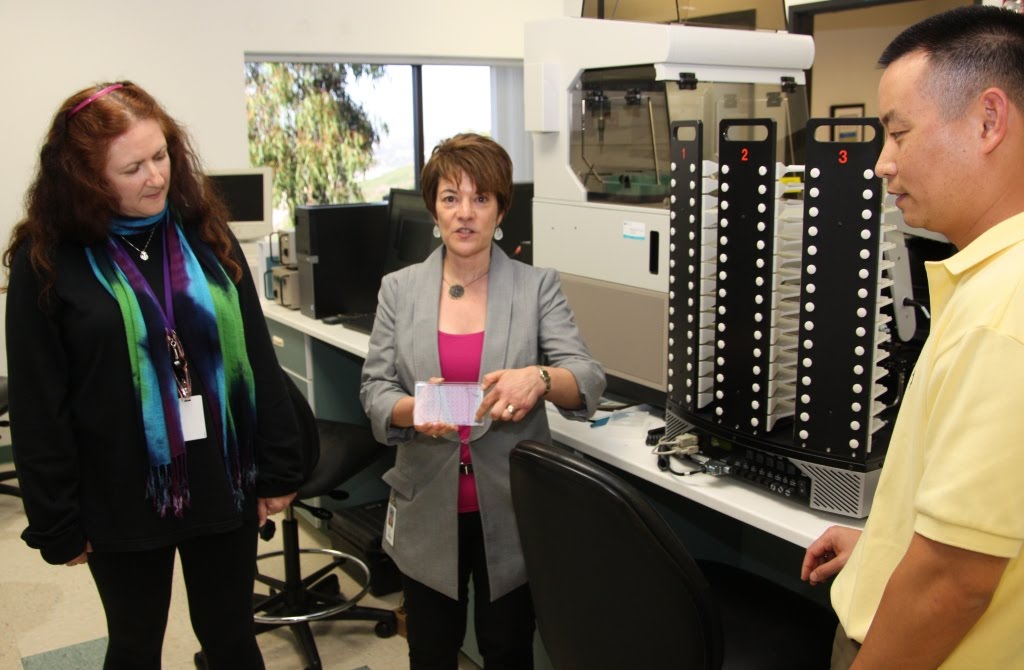 Dr. Hoffman demonstrates the preparation of a plate for use in the high-throughput machine at her left as HD team leaders Dr. Branka Mitrovic and Dr. Mike Liu look on (photo by Gene Veritas).
“We can go to 3,456 wells on a plate,” said Dr. Mike Liu, who heads one of the Vertex teams, of one of the machines. The scientists are observing multiple types of brain cells and the behavior of both normal and mutant huntingtin.
Dr. Negulescu described HTS as “sort of like panning for gold,” but at a very high speed.
Dr. Negulescu described HTS as “sort of like panning for gold,” but at a very high speed.
 A high throughput plate (photo by Gene Veritas).
Vertex uses several kinds of HTS devices, including a high-throughput microscope, where scientists can observe the effects of compounds on brain cells.
“What we’re doing is really on the cutting edge of what’s out there in the HD field,” Dr. Liu said.
The San Diego unit stood among the early pioneers of HTS when it was known as Aurora Biosciences in the 1990s. In 2000 the Hereditary Disease Foundation of Los Angeles, which also focuses on HD, contracted with Aurora to do one of the very first high-throughput screenings of compounds for potential treatments in HD (click here to read more). Vertex, which is based in Cambridge, Massachusetts, acquired Aurora in 2001. Vertex was founded in 1989.
Helping brain cells
Another facet of the HD project involves neurogenesis: the repair of damaged brain cells or the replacement of dead ones with new ones. This research is at an earlier stage than the work on proteins. One approach might involve the stimulation of neural progenitor cells to become brain cells and connect to other brain cells, said Dr. Hoffman.
Dr. Branka Mitrovic leads the second Vertex team, which is examining ways to stimulate the production of growth factors, vital substances for the creation and nourishment of the brain. HD patients suffer from a shortage of such factors.
“What we’re doing is really on the cutting edge of what’s out there in the HD field,” Dr. Liu said.
The San Diego unit stood among the early pioneers of HTS when it was known as Aurora Biosciences in the 1990s. In 2000 the Hereditary Disease Foundation of Los Angeles, which also focuses on HD, contracted with Aurora to do one of the very first high-throughput screenings of compounds for potential treatments in HD (click here to read more). Vertex, which is based in Cambridge, Massachusetts, acquired Aurora in 2001. Vertex was founded in 1989.
Helping brain cells
Another facet of the HD project involves neurogenesis: the repair of damaged brain cells or the replacement of dead ones with new ones. This research is at an earlier stage than the work on proteins. One approach might involve the stimulation of neural progenitor cells to become brain cells and connect to other brain cells, said Dr. Hoffman.
Dr. Branka Mitrovic leads the second Vertex team, which is examining ways to stimulate the production of growth factors, vital substances for the creation and nourishment of the brain. HD patients suffer from a shortage of such factors.

Dr. Branka Mitrovic (photo by Gene Veritas)
Dr. Mitrovic explained that Vertex is using some of the latest research technologies to look for compounds that may enhance the ability of the patient’s brain to self-repair.
In the effort to stop the negative impact of mutant huntingtin, Vertex hopes to find a drug or drugs that will “stop disease before it progresses too far,” Dr. Negulescu said. Such remedies might also prevent asymptomatic gene-positive individuals like me from developing the disease or at least arrest it in its early stages.
In the effort to stop the negative impact of mutant huntingtin, Vertex hopes to find a drug or drugs that will “stop disease before it progresses too far,” Dr. Negulescu said. Such remedies might also prevent asymptomatic gene-positive individuals like me from developing the disease or at least arrest it in its early stages.
Friday, December 03, 2010
Globalizing the fight against Huntington's
The participation of HD families in the search for treatments and a cure for Huntington’s disease is going global.
Starting in July 2011, registries of HD patients, at-risk individuals, and family members from different parts of the world will be combined into a single database.
Called “Enroll-HD,” this new effort aims to make it easier for scientists to understand HD, identify potential participants in crucial clinical trials, and therefore speed the process of finding therapies and a cure.
The Enroll-HD sponsor, the CHDI Foundation, Inc., released information on the new program on November 19. Backed by an anonymous donor who has contributed tens of millions of dollars, CHDI is informally known as the “cure Huntington’s disease initiative.” CHDI collaborates with hundreds of scientists from around the world.
Combining databases
Enroll-HD will combine the existing REGISTRY and COHORT databases.
REGISTRY, a Europe-wide study, is run by the Euro-HD Network. Administered by the Huntington’s Study Group, COHORT stands for “Cooperative Huntington’s Observational Research Trial.” It operates in North America and Australia.
Both databases collect information about the genetic status, lifestyle, medical history, and disease progression of patients and gene-positive individuals.
Enroll-HD also will include participants from the newly founded Latin American network of HD-affected families, physicians, and researchers, the Red Latinoamericana de Huntington. Enroll-HD also will obtain information from countries such as Singapore, South Africa, and South Korea.
“It’s a natural progression to combine the successful HD observational clinical studies into one worldwide effort that will harness the power of greater numbers of research participants,” said Dr. G. Bernhard Landwehrmeyer, a professor at the University of Ulm, Germany, the chair of Euro-HD, and the principal researcher for Enroll-HD.
People already participating in REGISTRY and COHORT will continue to consult with the same physicians at regular appointment times.
To learn more about Enroll-HD, please click here.
Latin America’s contribution
One of the most striking aspects of Enroll-HD is the inclusion of Latin America, our neighbors to the south.
Venezuela in particular has played an important part in Huntington’s research. Dr. Nancy Wexler of the Hereditary Disease Foundation spent two decades researching the world’s largest extended HD family, located in the Lake Maracaibo region. Dr. Wexler developed the pedigree (traced the genetic history) of more than 18,000 individuals and collected more than 4,000 blood samples. This pioneering work helped lead to the discovery of the HD gene in 1993. (To learn more, see her sister Alice Wexler’s book Mapping Fate.)
About 580 million people live in Latin America – nearly twice the population of the United States. In rough terms, this means that some 60,000 people in the region could have Huntington’s. Studying these individuals and their families will provide a greater understanding of HD’s devastating effects and its terrible social impact.
It could also benefit HD families victimized by ignorance and poverty. Although conditions have improved for many in recent decades, most Latin Americans are still poor by our standards, and many have little or no access to quality education. In his visits to Colombia, HD activist Phil Hardt observed HD patients living in deplorable conditions – some even in old jail cells.
The Red Latinoamericana de Huntington can help raise awareness about HD throughout the region and perhaps stimulate government support for care programs and research. It also will tie the HD families and researchers from Latin America’s countries more tightly together – and also into the global network of researchers and care and advocacy programs.
More and faster research
Above all, by including Latin America’s HD families on the rolls of potential participants in clinical trials, Enroll-HD will vastly expand the possibilities of testing more drug candidates and carrying out faster research.
The Huntington’s research community faces an extremely difficult problem. As an orphan disease, there may not be enough subjects for trials as potential drugs become ready for testing. This problem is compounded by the fact that researchers have now identified more than 700 potential drug targets. Most trials minimally require dozens of participants, and others utilize hundreds and sometimes thousands of subjects.
In Europe, HD-affected and gene-positive individuals volunteer in sufficient numbers. Ironically, Americans do not. Despite this country’s power and overall wealth, denial, fear, and ignorance still dominate many families affected by HD. This lack of American participation makes Enroll-HD even more important.
Guinea pigs?
Some might be concerned that Enroll-HD could become an attempt by scientists from rich countries to use people from poor nations as guinea pigs – that is, subjects tested unethically.
Fear of this kind of unequal relationship definitely exists in Latin America. I have frequently heard such concerns during my own historical research and travel in the region over the past quarter century.
But it’s unlikely that Enroll-HD will proceed with any kind of negative or arrogant attitude. All Enroll-HD participants will be protected by the strict protocols that govern research on human subjects.
The official Enroll-HD press release reassured current and future participants that “your samples will continue to be safely stored in the same biorepositories where they are now kept and all information about you will be securely stored in accordance with applicable local laws and regulations regarding the protection of your privacy.”
In addition, CHDI, European researchers, and Latin American representatives held on-the-ground preparatory meetings in Rio de Janeiro, Brazil, in February and Buenos Aires, Argentina, in June. The Rio meeting included representatives from Brazil, Argentina, Chile, Cuba, and Venezuela. Colombian and Peruvian representatives likely will participate in the future.
Reactions to the project
“I went to Rio because I wanted to extend a message of Hope to those in Latin America,” Dr. Ignacio Muñoz-Sanjuan, an HD researcher and the CHDI representative at the Rio meeting, wrote in his HD science blog. “This is not an American or European enterprise. It's a global fight to find a cure, which should be made available to all, rich or poor, in N[ew] Y[ork] or Maracaibo. But I also went there because we need more people to work with us. I need every affected person to participate: by donating blood, by speaking out, by enrolling in observational studies, in clinical studies. We simply cannot do it without the patients and the people at risk.”
Taíse Cadore, the vice-president of the Associação Brasileira de Huntington (Brazilian Huntington’s Association), wrote in a report that her organization “left the meeting with a great sense of optimism. We recognize the importance of our role in the development of this project and hope to be counting on the participation of our families.”
“The Red Latinoamericana de Huntington is very excited to become a part of the global Enroll-HD initiative and collaborate in this way with the international HD research community to better understand and treat Huntington’s disease,” Rodrigo Osorio, a native of Chile and the president of the Latin American organization, said of the official launching of Enroll-HD.
 Bernhard Landwehrmeyer (right) converses with Rodrigo Osorio at the CHDI research symposium in Palm Springs, CA, in February (photo by Gene Veritas).
Inspiring global involvement
As a Latin America scholar and an HD-positive person who lost a mother to Huntington’s disease in 2006, I felt especially heartened with Enroll-HD’s recognition of the global character of disease and the need to include people of all continents in the search for treatments and in the resultant benefits.
I was especially happy to see my friends at the Brazilian Huntington’s Association receive the attention they deserve as potential contributors to the fight against HD. Without wealthy benefactors or government support, they have fought long and hard to build their organization solely on the grit and donations of HD-affected families.
Their efforts should inspire HD families in America to come out of the woodwork and redouble our efforts to strengthen our own community, educate the public about HD, and prepare for participation in clinical trials. (I will write more on the Brazilian association in my next entry.)
Ultimately, Enroll-HD can help build global awareness about the need to cure Huntington’s and other neurological disorders. We all share a common condition and, as we now understand, only together will we defeat HD and these other maladies.
Starting in July 2011, registries of HD patients, at-risk individuals, and family members from different parts of the world will be combined into a single database.
Called “Enroll-HD,” this new effort aims to make it easier for scientists to understand HD, identify potential participants in crucial clinical trials, and therefore speed the process of finding therapies and a cure.
The Enroll-HD sponsor, the CHDI Foundation, Inc., released information on the new program on November 19. Backed by an anonymous donor who has contributed tens of millions of dollars, CHDI is informally known as the “cure Huntington’s disease initiative.” CHDI collaborates with hundreds of scientists from around the world.
Combining databases
Enroll-HD will combine the existing REGISTRY and COHORT databases.
REGISTRY, a Europe-wide study, is run by the Euro-HD Network. Administered by the Huntington’s Study Group, COHORT stands for “Cooperative Huntington’s Observational Research Trial.” It operates in North America and Australia.
Both databases collect information about the genetic status, lifestyle, medical history, and disease progression of patients and gene-positive individuals.
Enroll-HD also will include participants from the newly founded Latin American network of HD-affected families, physicians, and researchers, the Red Latinoamericana de Huntington. Enroll-HD also will obtain information from countries such as Singapore, South Africa, and South Korea.
“It’s a natural progression to combine the successful HD observational clinical studies into one worldwide effort that will harness the power of greater numbers of research participants,” said Dr. G. Bernhard Landwehrmeyer, a professor at the University of Ulm, Germany, the chair of Euro-HD, and the principal researcher for Enroll-HD.
People already participating in REGISTRY and COHORT will continue to consult with the same physicians at regular appointment times.
To learn more about Enroll-HD, please click here.
Latin America’s contribution
One of the most striking aspects of Enroll-HD is the inclusion of Latin America, our neighbors to the south.
Venezuela in particular has played an important part in Huntington’s research. Dr. Nancy Wexler of the Hereditary Disease Foundation spent two decades researching the world’s largest extended HD family, located in the Lake Maracaibo region. Dr. Wexler developed the pedigree (traced the genetic history) of more than 18,000 individuals and collected more than 4,000 blood samples. This pioneering work helped lead to the discovery of the HD gene in 1993. (To learn more, see her sister Alice Wexler’s book Mapping Fate.)
About 580 million people live in Latin America – nearly twice the population of the United States. In rough terms, this means that some 60,000 people in the region could have Huntington’s. Studying these individuals and their families will provide a greater understanding of HD’s devastating effects and its terrible social impact.
It could also benefit HD families victimized by ignorance and poverty. Although conditions have improved for many in recent decades, most Latin Americans are still poor by our standards, and many have little or no access to quality education. In his visits to Colombia, HD activist Phil Hardt observed HD patients living in deplorable conditions – some even in old jail cells.
The Red Latinoamericana de Huntington can help raise awareness about HD throughout the region and perhaps stimulate government support for care programs and research. It also will tie the HD families and researchers from Latin America’s countries more tightly together – and also into the global network of researchers and care and advocacy programs.
More and faster research
Above all, by including Latin America’s HD families on the rolls of potential participants in clinical trials, Enroll-HD will vastly expand the possibilities of testing more drug candidates and carrying out faster research.
The Huntington’s research community faces an extremely difficult problem. As an orphan disease, there may not be enough subjects for trials as potential drugs become ready for testing. This problem is compounded by the fact that researchers have now identified more than 700 potential drug targets. Most trials minimally require dozens of participants, and others utilize hundreds and sometimes thousands of subjects.
In Europe, HD-affected and gene-positive individuals volunteer in sufficient numbers. Ironically, Americans do not. Despite this country’s power and overall wealth, denial, fear, and ignorance still dominate many families affected by HD. This lack of American participation makes Enroll-HD even more important.
Guinea pigs?
Some might be concerned that Enroll-HD could become an attempt by scientists from rich countries to use people from poor nations as guinea pigs – that is, subjects tested unethically.
Fear of this kind of unequal relationship definitely exists in Latin America. I have frequently heard such concerns during my own historical research and travel in the region over the past quarter century.
But it’s unlikely that Enroll-HD will proceed with any kind of negative or arrogant attitude. All Enroll-HD participants will be protected by the strict protocols that govern research on human subjects.
The official Enroll-HD press release reassured current and future participants that “your samples will continue to be safely stored in the same biorepositories where they are now kept and all information about you will be securely stored in accordance with applicable local laws and regulations regarding the protection of your privacy.”
In addition, CHDI, European researchers, and Latin American representatives held on-the-ground preparatory meetings in Rio de Janeiro, Brazil, in February and Buenos Aires, Argentina, in June. The Rio meeting included representatives from Brazil, Argentina, Chile, Cuba, and Venezuela. Colombian and Peruvian representatives likely will participate in the future.
Reactions to the project
“I went to Rio because I wanted to extend a message of Hope to those in Latin America,” Dr. Ignacio Muñoz-Sanjuan, an HD researcher and the CHDI representative at the Rio meeting, wrote in his HD science blog. “This is not an American or European enterprise. It's a global fight to find a cure, which should be made available to all, rich or poor, in N[ew] Y[ork] or Maracaibo. But I also went there because we need more people to work with us. I need every affected person to participate: by donating blood, by speaking out, by enrolling in observational studies, in clinical studies. We simply cannot do it without the patients and the people at risk.”
Taíse Cadore, the vice-president of the Associação Brasileira de Huntington (Brazilian Huntington’s Association), wrote in a report that her organization “left the meeting with a great sense of optimism. We recognize the importance of our role in the development of this project and hope to be counting on the participation of our families.”
“The Red Latinoamericana de Huntington is very excited to become a part of the global Enroll-HD initiative and collaborate in this way with the international HD research community to better understand and treat Huntington’s disease,” Rodrigo Osorio, a native of Chile and the president of the Latin American organization, said of the official launching of Enroll-HD.
 Bernhard Landwehrmeyer (right) converses with Rodrigo Osorio at the CHDI research symposium in Palm Springs, CA, in February (photo by Gene Veritas).
Inspiring global involvement
As a Latin America scholar and an HD-positive person who lost a mother to Huntington’s disease in 2006, I felt especially heartened with Enroll-HD’s recognition of the global character of disease and the need to include people of all continents in the search for treatments and in the resultant benefits.
I was especially happy to see my friends at the Brazilian Huntington’s Association receive the attention they deserve as potential contributors to the fight against HD. Without wealthy benefactors or government support, they have fought long and hard to build their organization solely on the grit and donations of HD-affected families.
Their efforts should inspire HD families in America to come out of the woodwork and redouble our efforts to strengthen our own community, educate the public about HD, and prepare for participation in clinical trials. (I will write more on the Brazilian association in my next entry.)
Ultimately, Enroll-HD can help build global awareness about the need to cure Huntington’s and other neurological disorders. We all share a common condition and, as we now understand, only together will we defeat HD and these other maladies.
Friday, November 05, 2010
Enjoying the life we have left
Confronting Huntington’s disease is a full-time job. Families and caregivers must constantly watch over their stricken loved ones. At-risk individuals often struggle for years over the decision to get tested. And asymptomatic gene-positive people like me wonder daily when and how the symptoms will strike.
One big lesson that at-risk and asymptomatic HD-positive people need to learn is that we all need and deserve to take a break from time to time. If not, worrying about the disease can completely consume our energies and leave us frustrated with the fact that we have given our lives over to HD.
Lately I’ve had this feeling myself. I have become overwhelmed with worry about HD and the movement to stop it.
So I decided it was time for my own break.
Preserving the candle
On October 15, I met up with Dr. Martha Nance at a reception for the Huntington Study Group (HSG) scientists participating in a research conference in San Diego. Dr. Nance is a specialist in HD and other brain disorders and regularly reads my blog. We attended Yale together in the late 1970s.
Dr. Nance pulled me aside and offered some friendly advice. “I’m not your physician,” she said with a shy and caring smile. “But your recent blogs have concerned me. Don’t feel that you have to do the blog every week. It’s okay to do less, especially because you’ve done so much. Don’t burn the candle at both ends.”
She had caught me in the midst of yet another streak of HD-related activities: working dinners, meetings, and visits to local drug-discovery companies focusing on treatments for HD. The next morning, a Saturday, I awoke early to return to the conference site to listen to HSG scientists present some of the latest research news. I didn’t get home until late afternoon.
I indeed had done a lot with the HD movement, but the fear of getting symptoms and my commitment to the movement left me feeling as if I had the world on my shoulders. Dr. Nance’s words helped remove a huge part of that burden.
Wisdom about HD and life
They also led me to ponder my next steps in the HD movement and my strategy to stave off symptoms.
I remembered how one at-risk board member of the San Diego chapter of the Huntington’s Disease Society of America (HDSA-San Diego) resigned about the time I became involved with the chapter in the late 1990s. She had given many years to the fight, she said. Now it was time to enjoy her remaining time without symptoms.
We had that conversation before I tested positive in 1999. I remember feeling sad about her departure. We needed people like her in the fight! I couldn’t understand how she could apparently abandon a movement that might save her life.
Whenever one little voice tells me to quit, another quickly pipes up and urges me to keep going.
But now I am beginning to understand the wisdom of that former board member. She needed and deserved a break!
Nights at the computer
These feelings reached a crescendo in the days before HDSA-San Diego’s tenth annual Celebration of Hope Gala, a fundraiser supporting the local HDSA Center of Excellence for Family Services and Research and other HD programs.
I’ve helped with every one of these events, from placing copies of the chapter newsletter I edited onto each chair in the dining room to photographing and writing about the event for the newsletter and our website. One year I even had the winning bid on a great auction item: six tickets to the Macy’s Thanksgiving Day Parade in New York City.
I shared my many cross-cutting feelings about my years in the chapter with my wife, the most intimate witness to my attempts to cope with living positive for HD.
She agreed with the sentiments of Dr. Nance and that former board member.
“How many nights and weekends have you sat at the computer working on HD stuff?” she asked rhetorically. “Those were hours that you could have spent with me and our daughter. You could be exercising instead of sitting in front of the computer. That’s more important for your health.”
I didn’t regret my work, but it suddenly hit me how long I’ve been in this fight. Our daughter – the “miracle baby” who tested negative in the womb for HD – is ten. As she approaches her teens, she will need a strong and healthy father.
If I take good care of myself, I’ll have a better chance of being that father.
My wife was sitting in the bathroom, where she was drying off our dog after a bath with anti-flea shampoo. I sat down next to her to help.
“How rarely I sit down with my family in the evening to relax because of this ‘third job’ with HD!” I wrote later in my blog notes.
The blessed nap
For this year’s gala I came up with the idea to include the international spokesman for the HD cause, Charles Sabine, the Emmy Award-winning former correspondent for NBC television. Charles is HD-positive. I helped organize his part in the October 22 program and also his stimulating visit to our local support group on October 25.
While eating dinner a few nights before the gala, Charles and I exchanged strategies for avoiding symptoms. We’re both 50, so I felt an especially tight bond with him. We talked about supplements, exercise, diet, alcohol consumption, the effects of jet lag on the brain (Charles is English and passed through seven times zones to reach California), and other factors.
Charles tested positive for HD in 2005, and so far he doesn’t show any of the classic symptoms of HD. Over the past several years he has traveled widely to help raise the profile of HD, giving interviews, meeting with HD patients and their families, and speaking at research conferences and other events.
We heartily agreed that ample sleep is probably one of the best strategies for reducing stress and resting the brain. We both try to get a full night’s rest. And we try to nap daily. (By coincidence, I heard a radio report this morning stating that people who get nine hours of sleep per day have better brain performance than those who sleep fewer hours.)
“The blessed nap,” I wrote in my blog notes. “Two 50-year-old at-risk men discussing their naps. Would sound hilarious if it weren’t so dead serious.”
A big night
Speaking to the audience about the distressing experience of living HD-positive, Charles helped set the tone for the evening. One of Charles’ biggest worries is that he won’t be able to share life with his two-year-old daughter Breezy, another “miracle baby” who is negative for HD.
We also received news of great hope: the day before the gala, the California state stem-cell research agency awarded a grant of $3.8 million to Dr. Leslie Thompson of the University of California, Irvine, to investigate potential stem-cell treatments for HD. Along with HD advocates from around the state, HDSA-San Diego spearheaded the effort to make curing HD a priority of the stem-cell agency.
Later in the program I visited the table purchased by Vertex Pharmaceuticals, whose San Diego office has begun seeking possible treatments for HD. Vertex’s commitment to the gala coincided with a presentation about my family’s struggle with HD that I made at the company on September 24.
I thanked Paul Negulescu, the Vertex vice president for research and the head of the San Diego facility, and Beth Hoffman, the vice president of biology, for their commitment to HD, and I greeted all of the eight scientists seated with them. They were the largest delegation of HD scientists in the history of the event.
In addition to Vertex, dozens of other sponsors supported the event, including title sponsor Qualcomm and the presenting sponsor, the Viejas Band of Kumeyaay Indians.
 Dr. Leslie M. Thompson of UC Irvine received a $3.8 million grant for HD stem-cell research.
 Paul Negulescu and Beth Hoffman at the Vertex San Diego site in La Jolla (photo by Gene Veritas)
 Former NFL star quarterback Phil Simms (right) coaches Englishman Charles Sabine (photo by Gene Veritas)
 HD is priority: Charles (left) and CBS announcer Jim Nantz helped set the tone for the evening (photo by Gene Veritas)
One big lesson that at-risk and asymptomatic HD-positive people need to learn is that we all need and deserve to take a break from time to time. If not, worrying about the disease can completely consume our energies and leave us frustrated with the fact that we have given our lives over to HD.
Lately I’ve had this feeling myself. I have become overwhelmed with worry about HD and the movement to stop it.
So I decided it was time for my own break.
Preserving the candle
On October 15, I met up with Dr. Martha Nance at a reception for the Huntington Study Group (HSG) scientists participating in a research conference in San Diego. Dr. Nance is a specialist in HD and other brain disorders and regularly reads my blog. We attended Yale together in the late 1970s.
Dr. Nance pulled me aside and offered some friendly advice. “I’m not your physician,” she said with a shy and caring smile. “But your recent blogs have concerned me. Don’t feel that you have to do the blog every week. It’s okay to do less, especially because you’ve done so much. Don’t burn the candle at both ends.”
She had caught me in the midst of yet another streak of HD-related activities: working dinners, meetings, and visits to local drug-discovery companies focusing on treatments for HD. The next morning, a Saturday, I awoke early to return to the conference site to listen to HSG scientists present some of the latest research news. I didn’t get home until late afternoon.
I indeed had done a lot with the HD movement, but the fear of getting symptoms and my commitment to the movement left me feeling as if I had the world on my shoulders. Dr. Nance’s words helped remove a huge part of that burden.
Wisdom about HD and life
They also led me to ponder my next steps in the HD movement and my strategy to stave off symptoms.
I remembered how one at-risk board member of the San Diego chapter of the Huntington’s Disease Society of America (HDSA-San Diego) resigned about the time I became involved with the chapter in the late 1990s. She had given many years to the fight, she said. Now it was time to enjoy her remaining time without symptoms.
We had that conversation before I tested positive in 1999. I remember feeling sad about her departure. We needed people like her in the fight! I couldn’t understand how she could apparently abandon a movement that might save her life.
Whenever one little voice tells me to quit, another quickly pipes up and urges me to keep going.
But now I am beginning to understand the wisdom of that former board member. She needed and deserved a break!
Nights at the computer
These feelings reached a crescendo in the days before HDSA-San Diego’s tenth annual Celebration of Hope Gala, a fundraiser supporting the local HDSA Center of Excellence for Family Services and Research and other HD programs.
I’ve helped with every one of these events, from placing copies of the chapter newsletter I edited onto each chair in the dining room to photographing and writing about the event for the newsletter and our website. One year I even had the winning bid on a great auction item: six tickets to the Macy’s Thanksgiving Day Parade in New York City.
I shared my many cross-cutting feelings about my years in the chapter with my wife, the most intimate witness to my attempts to cope with living positive for HD.
She agreed with the sentiments of Dr. Nance and that former board member.
“How many nights and weekends have you sat at the computer working on HD stuff?” she asked rhetorically. “Those were hours that you could have spent with me and our daughter. You could be exercising instead of sitting in front of the computer. That’s more important for your health.”
I didn’t regret my work, but it suddenly hit me how long I’ve been in this fight. Our daughter – the “miracle baby” who tested negative in the womb for HD – is ten. As she approaches her teens, she will need a strong and healthy father.
If I take good care of myself, I’ll have a better chance of being that father.
My wife was sitting in the bathroom, where she was drying off our dog after a bath with anti-flea shampoo. I sat down next to her to help.
“How rarely I sit down with my family in the evening to relax because of this ‘third job’ with HD!” I wrote later in my blog notes.
The blessed nap
For this year’s gala I came up with the idea to include the international spokesman for the HD cause, Charles Sabine, the Emmy Award-winning former correspondent for NBC television. Charles is HD-positive. I helped organize his part in the October 22 program and also his stimulating visit to our local support group on October 25.
While eating dinner a few nights before the gala, Charles and I exchanged strategies for avoiding symptoms. We’re both 50, so I felt an especially tight bond with him. We talked about supplements, exercise, diet, alcohol consumption, the effects of jet lag on the brain (Charles is English and passed through seven times zones to reach California), and other factors.
Charles tested positive for HD in 2005, and so far he doesn’t show any of the classic symptoms of HD. Over the past several years he has traveled widely to help raise the profile of HD, giving interviews, meeting with HD patients and their families, and speaking at research conferences and other events.
We heartily agreed that ample sleep is probably one of the best strategies for reducing stress and resting the brain. We both try to get a full night’s rest. And we try to nap daily. (By coincidence, I heard a radio report this morning stating that people who get nine hours of sleep per day have better brain performance than those who sleep fewer hours.)
“The blessed nap,” I wrote in my blog notes. “Two 50-year-old at-risk men discussing their naps. Would sound hilarious if it weren’t so dead serious.”
A big night
Speaking to the audience about the distressing experience of living HD-positive, Charles helped set the tone for the evening. One of Charles’ biggest worries is that he won’t be able to share life with his two-year-old daughter Breezy, another “miracle baby” who is negative for HD.
We also received news of great hope: the day before the gala, the California state stem-cell research agency awarded a grant of $3.8 million to Dr. Leslie Thompson of the University of California, Irvine, to investigate potential stem-cell treatments for HD. Along with HD advocates from around the state, HDSA-San Diego spearheaded the effort to make curing HD a priority of the stem-cell agency.
Later in the program I visited the table purchased by Vertex Pharmaceuticals, whose San Diego office has begun seeking possible treatments for HD. Vertex’s commitment to the gala coincided with a presentation about my family’s struggle with HD that I made at the company on September 24.
I thanked Paul Negulescu, the Vertex vice president for research and the head of the San Diego facility, and Beth Hoffman, the vice president of biology, for their commitment to HD, and I greeted all of the eight scientists seated with them. They were the largest delegation of HD scientists in the history of the event.
In addition to Vertex, dozens of other sponsors supported the event, including title sponsor Qualcomm and the presenting sponsor, the Viejas Band of Kumeyaay Indians.
 Dr. Leslie M. Thompson of UC Irvine received a $3.8 million grant for HD stem-cell research.
 Paul Negulescu and Beth Hoffman at the Vertex San Diego site in La Jolla (photo by Gene Veritas)
 Former NFL star quarterback Phil Simms (right) coaches Englishman Charles Sabine (photo by Gene Veritas)
 HD is priority: Charles (left) and CBS announcer Jim Nantz helped set the tone for the evening (photo by Gene Veritas)
The evening’s entertainment featured a fun panel discussion with CBS television’s National Football League announcers and producers, including icons Phil Simms and Jim Nantz.
Jim closed the evening with a moving recollection of his own family’s coping with his father’s struggle with Alzheimer’s disease. He reminded the audience that their support of the HD movement was their most important reason for being in the room.
Resigning from the board
As I left the dining room at the end of the evening, I knew I had done my small part to help make it a success. The final tally isn’t in yet, but once again the chapter brought in tens of thousands of dollars for the HD cause and, just as important, increased awareness about the disease.
With a deep sense of accomplishment – but also with the wisdom afforded me by Dr. Nance and that former chapter board member – I decided to resign from the board.
“I’ve put in 12 and a half years working on practically every aspect of our chapter,” I wrote the board. “Lately I have been overwhelmed with HD commitments and need to scale back. As a person who is gene-positive for HD and luckily escaped symptoms so far, I must now concentrate on maintaining my health and spending more time with my family.”
I pledged to continue as a volunteer, concentrating on this blog, articles on HD-affected individuals and families, and reports “about research developments in order to help create hope.”
Feeling more 'normal'
Instead of board meetings, I will once again attend the support group, “my roots in HDSA.” As I’ve written before, HDSA needs to rediscover its initial mission of care. Also, I personally need to care for my own health and family while I can.
I also committed to promoting the chapter “through contacts with local pharmaceutical companies, public talks, assistance to scientists, and my collaboration with CHDI,” the multi-million-dollar “cure Huntington’s disease initiative.”
I’m not abandoning the movement. Far from it.
But I’m going to focus my energies more efficiently, and more towards my family.
And, like that other former board member, on living the life that I have left without symptoms. To live, if at least for just brief moments, as if HD doesn’t exist!
“It’s nice to feel ‘normal’ once in a while!” I wrote in my blog notes a couple days after resigning. “I haven’t felt ‘normal’ for a long time – fears and militancy constantly put me on edge. Need to get off this edge from time to time.”
Progress and optimism
It’s also important for me to take stock of the progress our movement has made – evident in Dr. Thompson’s grant and the many potential treatments being identified by researchers. When my mother was first diagnosed with HD in 1995 (she died in 2006 at age 68), there were no targets!
Today there are more than 700 potential targets! Vertex and other companies and research projects may soon have drugs that reach those targets. (I’ll be blogging soon on Vertex and other research developments.)
That sense of progress gives me hope and confidence that a treatment, and perhaps even a cure, will be found in my lifetime.
“We’re not alone,” I wrote in my blog notes. “The scientific community is out there fighting.”
Of course, nobody can guarantee a treatment or cure. But at least now I can feel optimistic.
Yes, we in the HD community deserve a break, even if only occasionally. And we also need and deserve to fully experience attitudes like optimism. As short as our time may be, we all need to live – and enjoy – the life we have left.
Jim closed the evening with a moving recollection of his own family’s coping with his father’s struggle with Alzheimer’s disease. He reminded the audience that their support of the HD movement was their most important reason for being in the room.
Resigning from the board
As I left the dining room at the end of the evening, I knew I had done my small part to help make it a success. The final tally isn’t in yet, but once again the chapter brought in tens of thousands of dollars for the HD cause and, just as important, increased awareness about the disease.
With a deep sense of accomplishment – but also with the wisdom afforded me by Dr. Nance and that former chapter board member – I decided to resign from the board.
“I’ve put in 12 and a half years working on practically every aspect of our chapter,” I wrote the board. “Lately I have been overwhelmed with HD commitments and need to scale back. As a person who is gene-positive for HD and luckily escaped symptoms so far, I must now concentrate on maintaining my health and spending more time with my family.”
I pledged to continue as a volunteer, concentrating on this blog, articles on HD-affected individuals and families, and reports “about research developments in order to help create hope.”
Feeling more 'normal'
Instead of board meetings, I will once again attend the support group, “my roots in HDSA.” As I’ve written before, HDSA needs to rediscover its initial mission of care. Also, I personally need to care for my own health and family while I can.
I also committed to promoting the chapter “through contacts with local pharmaceutical companies, public talks, assistance to scientists, and my collaboration with CHDI,” the multi-million-dollar “cure Huntington’s disease initiative.”
I’m not abandoning the movement. Far from it.
But I’m going to focus my energies more efficiently, and more towards my family.
And, like that other former board member, on living the life that I have left without symptoms. To live, if at least for just brief moments, as if HD doesn’t exist!
“It’s nice to feel ‘normal’ once in a while!” I wrote in my blog notes a couple days after resigning. “I haven’t felt ‘normal’ for a long time – fears and militancy constantly put me on edge. Need to get off this edge from time to time.”
Progress and optimism
It’s also important for me to take stock of the progress our movement has made – evident in Dr. Thompson’s grant and the many potential treatments being identified by researchers. When my mother was first diagnosed with HD in 1995 (she died in 2006 at age 68), there were no targets!
Today there are more than 700 potential targets! Vertex and other companies and research projects may soon have drugs that reach those targets. (I’ll be blogging soon on Vertex and other research developments.)
That sense of progress gives me hope and confidence that a treatment, and perhaps even a cure, will be found in my lifetime.
“We’re not alone,” I wrote in my blog notes. “The scientific community is out there fighting.”
Of course, nobody can guarantee a treatment or cure. But at least now I can feel optimistic.
Yes, we in the HD community deserve a break, even if only occasionally. And we also need and deserve to fully experience attitudes like optimism. As short as our time may be, we all need to live – and enjoy – the life we have left.
Subscribe to:
Posts (Atom)