Showing posts with label science. Show all posts

Sunday, May 17, 2026

For Huntington’s Disease Awareness Month, reflections on teaching about this devastating disorder at the University of San Diego


First proclaimed by President George H. W. Bush in 1991, Huntington’s Disease Awareness Month (May) encourages affected families to share their stories about this rare neurological disorder with the wider world.


For that reason, among others, I served on the board of the San Diego Chapter of the Huntington’s Disease Society of America (HDSA) from 1998-2010. In this blog, begun in 2005, I have written articles commemorating HD Awareness Month.


A 2019 posting about HD Awareness Month featured a photo of me pointing to HDSA #LetsTalkAboutHD flyers posted on my office door at the University of San Diego (USD), where I teach history and research science and technology studies.


As a fulfillment of a long-term goal to advance both awareness-building and deepen my knowledge of HD science, in the spring semester of 2025 I inaugurated a new course, A History of the Brain: Examining Huntington’s Disease. Professors often say that the best way to learn a subject is to teach it. Student feedback is crucial in this process.


This month, in the third offering of the course, I distributed a flyer containing HD Awareness Month promotional material from HDSA and the Huntington’s Disease Foundation.


Each holding a flyer, three students – Ana-Lucia Moreno, Ava Puorro, and Mia Wilde – had a picture of me taken with them in the classroom and posted it on Wilde’s Instagram with the title “National Huntington’s Disease Awareness Month.”


“Best class ever with Dr. Serbin, who has Huntington’s disease and taught us so much about it in class!” they wrote on the posting.


They included the link to this blog. “Watch his blog to learn more about HD and how we can make all people feel included.”


From left to right, Mia Wilde, Gene Veritas (aka Kenneth P. Serbin), Ana-Lucia Moreno, and Ava Puorro in Wilde’s Instagram post about HD Awareness Month. The jacket I am wearing is much-appreciated swag from the Annual HD Therapeutics Conference, sponsored by CHDI Foundation, Inc., the biggest private funder of HD research (personal photo).


Keys to understanding the history of HD


A History of the Brain has great relevance to the present. At the outset, I acknowledge that I am not a neuroscientist but a historian, HD gene carrier, and advocate.


An introductory course that fulfills the history requirement in USD’s core curriculum, A History of the Brain teaches basic skills in how to interpret history. The students have a wide variety of majors and career interests, including premed, neuroscience, biotech, business, natural sciences, engineering, and the humanities. The course also counts towards a major or minor in history.


I lecture on the basic scientific understanding of the brain from antiquity to the present, based on the masterful book by Andrew P. Wickens, A History of the Brain: From Stone Age surgery to modern neuroscience. It helps provide an overview of humanity’s understanding of the brain in understandable terms.


To launch discussion about the disease, students do short writing assignments based on the course readings. They include neurologist Thomas Bird’s Can You Help Me? Inside the Turbulent World of Huntington Disease. As I stated in my review of the book, “With non-technical, limpid prose, Dr. Bird tells the full story of HD’s wide-ranging medical, socioeconomic, and legal implications through a series of poignant vignettes, based on hundreds of HD cases."


The students also read two classic works by prominent HD family member and historian Alice Wexler, Ph.D. In The Woman Who Walked into the Sea: Huntington’s and the Making of a Genetic Disease, Dr. Wexler explains the deep stigma and misunderstanding about HD that developed in the nineteenth and twentieth centuries. In Mapping Fate: A Memoir of Family Risk and Genetic Research she chronicles the crucial work by her family and a myriad of scientists to discover the huntingtin gene in 1993.


Emotional debates and discussions


Many days in the course produce deeply emotional debates and discussions.


My students’ recognition of the need for social inclusion for all echoes the course’s deep exploration of the stigma and discrimination associated with HD, other neurological disorders, mental illness, and disabilities.


Those themes emerge in the books about HD and in the selection of articles from my blog included in the course readings. For its contributions in giving a voice to the HD community, last year my blog received the 11th Victor Gonzalez Santos Community Award, which supports local families in San Diego with HD. My articles, which include stories of my family’s struggles with HD, and my discussions with the students add a deeply personal element to HD and the cause to defeat it.


The course studies in details HD’s triad of devastating symptoms: involuntary movements, cognitive loss, and behavioral and psychiatric difficulties. We also delve into many other difficult challenges faced by the HD community, such as genetic testing, family planning, and bioethical issues like abortion and suicide. We also discuss the quest for treatments of this still incurable disorder.


Students see how I bared my heart in blog articles like the one about my mother’s final moments before dying from HD and the revelation that I carried the HD gene. As a result, I need to be prepared to talk in class about the most devastating aspects of the disease and the fears of experiencing them myself.


College classes provide an exercise in intellectual freedom and debate, with a professor being open to all views. In one class last year we intensely debated police misunderstanding and mishandling of HD-affected individuals, who are often seen as being under the influence of drugs or alcohol.


I introduced the students to something new for most of them: the Psychiatric Emergency Response Team, which has specialists trained to interact with and identify resources for those with behavioral health issues and who may pose a threat to themselves or others. The students concluded that this team was the appropriate alternative to calling the police in the case of HD or other disorder.


Invaluable insights


The course closes with an important religious perspective on the HD cause. We ponder the question, “how could God allow people to suffer from disease?” We examine Pope Francis’s historic audience with the HD community in 2017 and his declaration that HD should be “hidden no more!”


One of my projects at USD is to publish an annotated collection of about a dozen or some of my blog articles.


My interaction with the students and their thoughts on my blog and the HD cause will provide invaluable insights for that project.


A ‘very meaningful’ experience


The course has also underscored for me the fact that Huntington’s disease is still not a household word in the U.S. as compared to Alzheimer’s, Parkinson’s, ALS (amyotrophic lateral sclerosis), and other disorders. For most of the students, it is their first exposure to HD.


HD families still lack an effective therapy.


In a very poignant way, the course introduces young people to something we all share: mortality. Tragically, last year a vibrant and accomplished 42-year-old USD sociology professor, Greg Prieto, Ph.D., died of cancer – after offering his own reflections on facing death.


With A History of the Brain, I hope to have move us a bit further towards the greater awareness that the HD community still needs.


My students’ HD Awareness Month Instagram post is an example of the impact the course has had.


In an e-mail to me, Mia Wilde reported that the post had some 600 views and 100 likes, “a really great amount of engagement.”


“Another person reached out asking what Huntington’s disease was, so I gave them a brief overview about it being a hereditary disease and shared some of what we learned in class,” Wilde wrote.


Another person told Wilde that “it was such a thoughtful thing that we were doing because they had a friend who had Huntington’s disease before, which I thought was very meaningful to hear.”

Wednesday, November 05, 2025

Understanding the FDA’s surprising step back on uniQure drug that slows Huntington’s disease


Less than six weeks after uniQure announced that its gene therapy drug slowed the progression of Huntington’s disease by 75 percent over three years, the U.S. Food and Drug Administration (FDA) has backtracked on its conversations with the company regarding the timeline and data needed for potential approval of the remedy.


The company’s plan to apply for approval of the drug, AMT-130, in early 2026 and launch it into the market later that year may no longer be possible.


In a November 3 press release uniQure announced that, after a recent meeting with the FDA, the company believes that the “FDA currently no longer agrees” that data from its clinical trial of AMT-130 using an "external control" as a comparison "may be adequate to provide the primary evidence in support of” an application for approval.


The external control refers to data taken from Enroll-HD, the global HD patient registry of more than 22,200 people, as a baseline, rather than those taking a placebo, to compare with those on AMT-130. After extensive consultations with the FDA in 2024, uniQure had gotten permission from the agency to use the Enroll-HD data.


“This is a key shift from prior communications with the FDA in multiple … meetings over the past year,” the uniQure release stated. “Consequently, the timing of the BLA [Biologics License Application] submission for AMT-130 is now unclear.”


uniQure expects to receive the final minutes of its meeting with the FDA within 30 days and plans to urgently interact with the agency “to find a path forward for the timely accelerated approval of AMT-130,” the press release continued.


“We are surprised by the FDA’s feedback at the recent pre-BLA meeting, which is a drastic change from the guidance the FDA provided in November 2024,” said Matt Kapusta, the uniQure CEO. “This news is unexpected, and we are truly disappointed for people living with HD, who have no disease-modifying treatment options for this devastating disease.”


Kapusta added that “we strongly believe that AMT-130 has the potential to bring substantial benefit to patients, and we remain fully committed to working with the FDA to determine the best path forward to rapidly bring AMT-130 to patients and their families in the U.S.”


David Margolin, M.D., Ph.D., uniQure's vice president for clinical development, presents data illustrating AMT-130's slowing of the progression in Huntington's disease at the 20th Annual HD Therapeutics Conference, Palm Springs, CA, February 25, 2025 (photo by Gene Veritas, aka Kenneth P. Serbin).


FDA claims to ‘unleash gene therapies’


The October 30 Huntington’s Disease Society of America (HDSA) webinar on AMT-130, featuring uniQure’s chief medical officer, Walid Abi-Saab, M.D., offered no inkling of the FDA’s new position.


Some 1,000 people attended the webinar – a sign of the excitement about AMT-130 in the HD community. Reuniting after 17 years of estrangement, my own family has found great hope in the possibility of this treatment, though we understand that the drug is not a cure and might not even reach the public.


The FDA so far has provided no comment to the media on the matter. At the top of its website’s homepage it has the phrase “first six months of FDA reforms,” including “unleashing cell and gene therapies.”


As this blog reported in July, under the Trump administration the uncertainty of public funding for science has created serious challenges to HD research.


Politics and society play a role


Science and medicine do not act in a vacuum and are impacted by politics and society, as HD family member and historian Alice Wexler brilliantly illustrated in her book The Woman Who Walked into the Sea: Huntington’s and the Making of a Genetic Disease (click here to read my review).


In July, a New York Times report titled “Inside the Collapse of the FDA” detailed how Health and Human Services Secretary Robert F. Kennedy Jr., is “dismantling the agency.”


The key biotech and life sciences website STAT reported that since uniQure and the FDA had set drug submission “benchmarks” last year, “the agency has undergone considerable changes. Vinay Prasad, a physician with a reputation for taking a more conservative view of gene therapies, now oversees the division with authority over AMT-130.”


Dr. Prasad heads the Center for Biologics Evaluation and Research.


Only last week STAT reported that a “slow-boiling feud” between Dr. Prasad and his staff “is threatening the future of the center that regulates the nation’s vaccines, biological products, and blood supply.”


According to the report, officials in the center described it as “rife with mistrust and paranoia” and with fears of “retaliation” for pushing back on Dr. Prasad. The center has lost hundreds of employees this year to retirements, layoffs, and resignations. Dr. Prasad has also pushed out senior leaders, including “top cell and gene therapy regulators,” STAT reported.


Prasad has also played a role in limiting access to Covid-19 vaccines, according to STAT and the New York Times.


The HD community is ‘highly mobilized’


The scientist-written website HDBuzz noted that, although “the reason for the change of heart” of the FDA is “not currently clear,” “it makes the timeline for advancing AMT-130 less clear, with additional uncertainty as the U.S. government shutdown continues.”


“The decision by the FDA to not agree that an external control group can be used to apply for a [drug application] doesn’t change the data” of AMT-130’s actual effect in the clinical trial run by uniQure, HDBuzz stated. It simply means that the FDA would want to see more data, possibly from a trial designed with a placebo control group, before moving forward with a BLA for AMT-130.


HDBuzz also noted that uniQure is working with the equivalent of the FDA in the United Kingdom and Europe, with an approval there possibly leading to acceptance elsewhere.


HDBuzz stated that “we push forward – together.”


On November 5 HDSA and four other HD entities issued a joint statement: following the regulatory update about uniQure, “it’s clear that stronger alignment and collaboration among Huntington’s disease (HD) patient and family organizations are more critical now than ever.” The four are Huntington’s Disease Foundation (formerly Hereditary Disease Foundation), HD Reach, Help4HD International, and Huntington’s Disease Youth Organization.  


“The next steps here are uncertain,” the brokerage and investment banking firm Stifel wrote, “but given the highly mobilized patient community in Huntington’s, and other external political forces that may have influence on the agency, the story here may not be over.”

Monday, February 24, 2025

As a ‘biological being,’ I embrace science’s fight against disease


I am a biological being.


This phrase came to me about a decade ago, and I have been hoping to write about its meaning for a long time.


Now, with scientific research at key American institutions such as the National Institutes of Health and university labs under attack from the Trump administration, the phrase resonates with me stronger than ever.


From the time I was hospitalized in 1977 with two herniated discs after shoveling heavy snow through decades of participation in Huntington’s disease research studies, I have been acutely aware of my body as the object of biomedical observation.


Seeing scans of deteriorating HD brains at scientific conferences leaves me deeply worried about the shrinking of my own brain – the inevitable result of the fact that I carry the HD gene.


In March 2022 I observed preliminary data presented by Triplet Therapeutics from SHIELD-HD, a two-year research study of 70 presymptomatic and early-disease-stage carriers of the HD mutation. Triplet aimed to use SHIELD-HD to support plans for a groundbreaking clinical trial to attack a key driver of HD, somatic expansion, the mutant huntingtin gene’s tendency for continued expansion with age. The program was scuttled because the firm folded in October 2022 as it lacked investment funds.


The 2022 SHIELD-HD data showed deterioration in the brains of the gene carriers.


For the first time, I saw information about the impact of the HD gene on my own brain. I had volunteered for SHIELD-HD, undergoing MRI brain scans and cognitive tests and giving samples of blood and my cerebrospinal fluid (CSF) at the HD clinic at the University of California, San Diego.


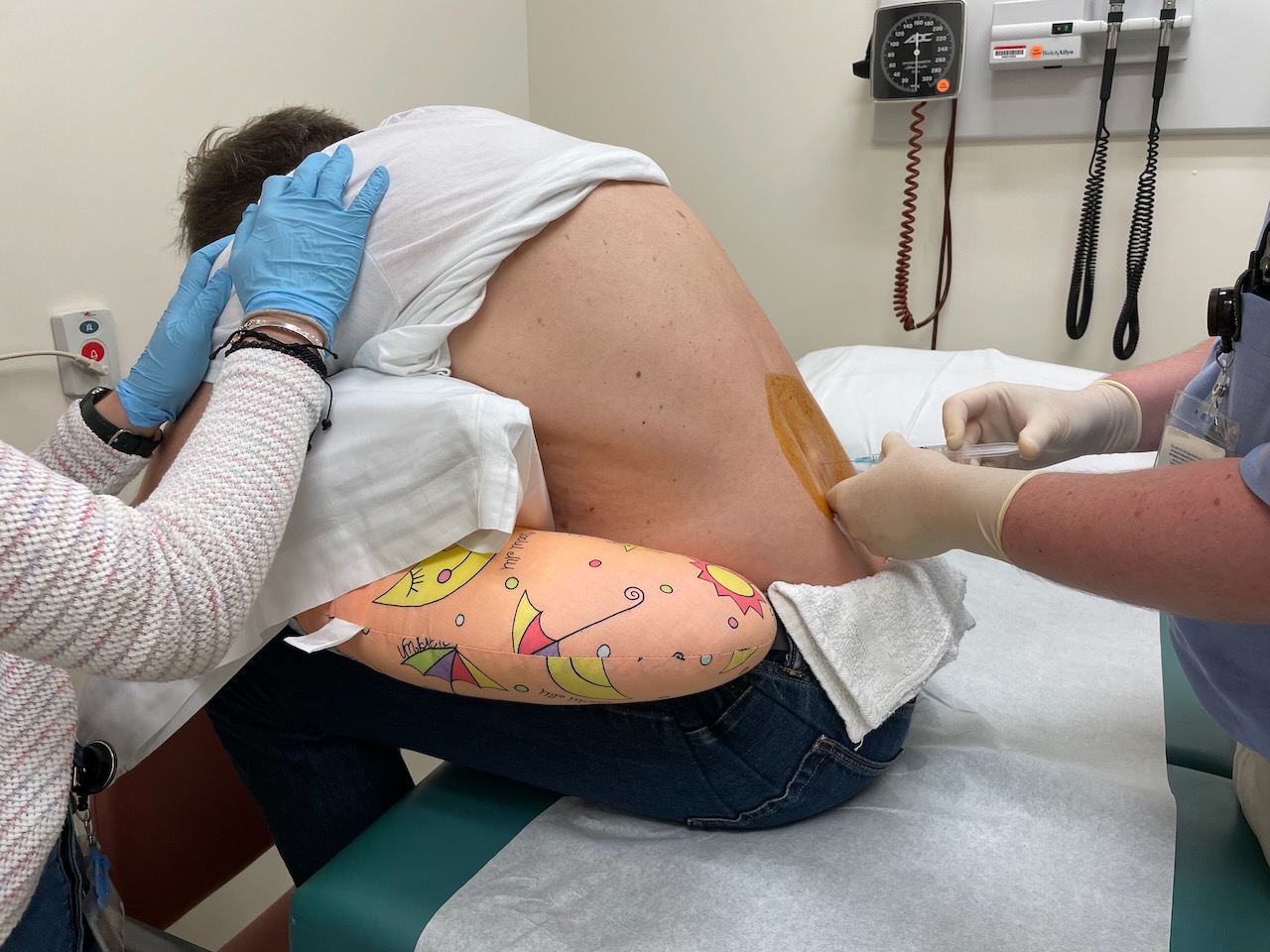
Below are photos of me in the clinic in August 2022, just two months before the Triplet shutdown. The first shows a neurologist injecting an anesthetic to prepare for the drawing of my CSF. In the second photo the doctor draws a small amount of my CSF. It was the last of my several CSF drawings over the course of SHIELD-HD. Scientists see analysis of CSF, which bathes the brain, as a major tool in the search for therapies for HD


Having CSF drawn is a safe procedure but can be painful. Each time I drove home by myself within a couple hours of the drawing. I am very glad I did it.


Analysis of SHIELD-HD


With the end of Triplet, final analysis of the key SHIELD-HD data was completed by CHDI Foundation, Inc., the largest private funder of HD research. The analysis was presented at the 19th Annual HD Therapeutics Conference, sponsored by CHDI, in February 2024.


A future article will further explore my participation in SHIELD-HD and the importance of that program for HD research.


The 20th Therapeutics Conference: a sign of collaboration


As a biological being, I embrace science, not useless conspiracy theories. At the University of San Diego, where I teach and research, I began a new course this month called “A History of the Brain: Examining Huntington’s Disease.” One key lesson from the history of brain science: reliance on superstition was replaced with scientific observation – the key to solving neurodegenerative disorders like HD.


On a large scale, so has the HD community participated in and supported science – from the start of the hunt for the gene in the 1970s to programs today such as Enroll-HD. Tens of thousands of individuals from around the world have taken part, despite the fact that HD is a rare disease, with about 40,000 affected individuals in the U.S.


CHDI, the Huntington’s Disease Society of America, the Hereditary Disease Foundation, Help4HD International, and other HD organizations also rely on science and cooperate with scientific institutions.


A magnificent example of scientific collaboration will take place starting this evening in Palm Springs, CA, as the 20th HD Therapeutics Conference gets under way at the Parker hotel.


Stay tuned for reports about the meeting.

Saturday, January 04, 2025

Savoring 20 years of my Huntington’s disease blog


This month I am celebrating the 20 years of this blog.


I began At Risk for Huntington’s Disease on January 10, 2005, wanting to “squeeze as much life into my days as possible” before experiencing the debilitating HD symptoms that led to my mother’s death a year later. Because I lived in what I called the “terrible and lonely HD closet” – fearful of genetic discrimination – I used the pseudonym “Gene Veritas,” “the truth in my genes.” That name reflected the fact that I had tested positive for the HD gene in 1999.


My mother died at 68, after two decades of debilitating symptoms, which was very painful to watch.


I turned 65 last month. By this age, I had expected to have full-blown HD, which would have left me unable to work, drive, or write.


But, according to my latest neurological checkup, I don’t yet have apparent HD symptoms!


In general, the more abnormal the gene, the earlier the age of disease onset. My mother and I have the same gene mutation, suggesting a similar disease path. However, although my mother’s symptoms started in her late 40s, one or more modifier genes, the functions of which were discovered a decade ago, have perhaps delayed my disease onset.


This article is number 336. Each day of good health is a blessing.


Gene Veritas (aka Kenneth P. Serbin) with his blog (photo by Regina Serbin)


The impact


In 2012, I exited the HD closet by publishing an essay – and using my real name, Kenneth P. Serbin – in The Chronicle of Higher Education. It was titled “Racing Against the Genetic Clock.” Going public opened new vistas of advocacy and enabled me to blog with greater transparency.


In December 2022. I published a detailed analysis of the blog in “Striving for a Realistic and Unapologetic View of Huntington’s Disease” in the Journal of Huntington’s Disease. It described how the blog has helped give voice to the HD community by exploring the major challenges faced by HD families, becoming a key reference for those families, and chronicling the quest to defeat the disorder.


As I observed, the blog has also “helped document the new and harrowing experience of living in the gray zone between a genetic test result and disease onset.”


At Risk for HD has addressed multiple topics including advocacy, caregiving, family trauma, coping strategies, genetic testing, discrimination, leaving the HD closet, participation in research and clinical trials, as well as religion, faith, and spirituality.


When my mother was diagnosed with HD in 1995 – two years after the discovery of the gene – little hope existed for treatments that could slow the progression of HD. However, in the past decade, advances in academic labs and biopharma firms have led to key clinical trials that show potential for affecting the course of HD and perhaps even a cure (click here to read more).


Telling the story of those complex developments has become a major focus of At Risk for HD. With the growing number of research projects, I have necessarily highlighted those that appear closest to producing actual drugs such as the Roche gene silencing program, which I have covered extensively.


In 2021, the first Roche trial showed lack of efficacy. In 2023 Roche started enrolling volunteers in a more focused trial to see if the drug might work at least in some patients. Other key trials are in progress or being planned.


Hoping for an HD-free world, savoring life


Writing the entries of At Risk for HD has given me great meaning and purpose, which researchers have identified as increasing well-being and positively impacting the course of the disease.


For now, I plan to continue blogging as long health permits – and until the quest for a cure is complete.


In February, I hope to attend the crucial 20th Annual HD Therapeutics Conference at the Parker Hotel in Palm Springs, CA. The conference is sponsored by CHDI Foundation, Inc., the largest private funder of HD research.


In 2011, I delivered the conference keynote speech before 250 scientists, physicians, and biopharma reps – a decisive step towards my complete exit from the closet in 2012 and chronicled in this blog.


I have described the conference as the “Super Bowl of HD research,” covered in many blog articles and videos of scientists (see, for example, this one).


With the rest of the HD community, I hope for the announcement of effective treatments. I very much look forward to reporting on progress.


Just as important is the need to savor life – another key lesson of my journey with the HD community, this blog, and my friends and family.

Wednesday, May 20, 2015

The search for Huntington's disease treatments is indeed ‘rocket science’ – and we can all help build the rocket

For people facing Huntington’s disease and other devastating, untreatable conditions, the powerful wish for a cure can conjure up the image of an elated scientist bursting from a laboratory and declaring “Eureka!”

However, it is unlikely a treatment for HD will emerge in this way.

We often misunderstand scientific progress, as explained in an essay in the May 16, 2015, edition of The New York Times by prominent physicist Leonard Mlodinow, Ph.D.

“Why do we reduce great discoveries to epiphany myths?” asked the sub-headline for Dr. Mlodinow’s online article, which was titled “It Is, in Fact, Rocket Science.”

“The mythical stories we tell about our heroes are always more romantic and often more palatable than the truth,” Dr. Mlodinow writes. “But in science, at least, they are destructive, in that they promote false conceptions of the evolution of scientific thought.”

From Isaac Newton to Charles Darwin to Stephen Hawking, we have oversimplified the process of discovery, Dr. Mlodinow explains. Rather than the eureka moments popularized in books and the media – like the apple falling on Newton’s head – these scientists’ discoveries involved years of hard work and questioning of assumptions, including their own.

Thus, Dr. Mlodinow reminds us that breakthroughs result from the cumulative build-up of many moments of discovery by scientists past and present.

He thus underscores a crucial point for the Huntington’s disease community: finding treatments will necessarily involve a collective effort by scientists and volunteers in research studies and clinical trials.

“Even if we are not scientists, every day we are challenged to make judgments and decisions about technical matters like vaccinations, financial investments, diet supplements and, of course, global warming,” Dr. Mlodinow points out. “The myths can seduce one into believing there is an easier path, one that doesn’t require such hard work.”

We in the HD community must all play our part in the quest for treatments.

A eureka moment deflated

As a carrier of the deadly HD mutation who watched his mother succumb to the disease, I have sometimes fallen prey to the seductive scenario described by Dr. Mlodinow, and even done so in this blog.

Four years ago this month, I was so excited about Alnylam Pharmaceuticals’ progress towards a remedy that I posted a picture of myself holding an Alnylam compound designed to attack HD at its genetic roots. I wrote that the compound, “the potential cure in my hand,” seemed magical.

I later made the image my Facebook profile photo.

(See the photo below and click here to read more.)


Gene Veritas holding the Alnylam compound in 2011 (photo by Dr. Matthias Kretschmer, Alnylam)

I had perhaps become overconfident about the Alnylam project.

In collaboration with its partners Medtronic and CHDI Foundation, Inc., the nonprofit virtual biotech focused on HD treatments, Alnylam was planning to apply in 2012 for permission to start a clinical trial.

In early 2012, however, Alnylam cut a third of its work force in order to reduce costs. In May of that year, less than a year after my 2011 visit, the company shifted its business strategy. It downgraded the HD project and fired the scientific director in charge

Alnylam chose instead to concentrate on less complex – and perhaps more profitable – projects to find drugs for other conditions. Alnylam passed on the responsibility for testing the compound in a human clinical trial to Medtronic.

To date, Medtronic has announced no plans for a human clinical trial of the Alnylam compound.

“Medtronic believes the siRNA [gene-silencing] drug-device program continues to represent an exciting opportunity to combine an innovative therapeutic strategy with state-of-the-art drug device delivery technology for Huntington’s disease,” Jack Lemmon, Ph.D., a Medtronic program manager, responded in an e-mail to my request for an update on the project. “Pre-clinical work has generated promising results; however the therapy research program has been paused since 2013 until partnerships can be established allowing us to sustain the research. At this time, it is premature to discuss timeframes, but we hope to continue work to find a treatment for this devastating neurodegenerative disease.”

Shots on goal

I am concerned that the project runs the risk of entering a not uncommon limbo, which one former director of the National Institutes of Health calls the “valley of death,” the increasingly difficult transition between laboratories and clinical trials.

Devising the Alnylam compound involved a significant investment of time, money, and expertise. In my extensive interviews with Alnylam scientists in 2011, and even in a conference call with some of those same researchers after the announcement of the 2012 cutback, they expressed enthusiasm about the promise of the compound.

The Alnylam compound may – or may not – ultimately play a role in the search for treatments.

Without the Alnylam compound, the HD community would have one less shot on goal in the critical gene-silencing field.

I am disappointed at the lack of action – much less progress – regarding the Alnylam compound.

Fortunately for the HD community, one of those shots is scheduled to take place this year: Isis Pharmaceuticals, Inc., and Roche will start a historic gene-silencing clinical trial using a different type of drug technology. Other companies and labs are also focusing on the development of gene-silencing approaches for HD.

The Alnylam project didn’t meet the expectations of many in the community. However, it has still provided valuable data from which other researchers can benefit. I am grateful for Alnylam’s contributions to the quest for treatments, and I’m crossing my fingers that Medtronic can resume the project.

I indeed recognize that the path to treatments is not easy. Nor is it straight.

One example of a potentially fortuitous outcome of the Alnylam decision: the dismissed HD project director, Dinah Sah, Ph.D., now works as the senior vice president of neuroscience for Voyager Therapeutics, one of the new companies exploring gene-silencing for HD.


Dinah Sah, Ph.D., of Voyager Therapeutics (photo by Gene Veritas)

A road paved with cooperation

Enthusiasm is essential, but it must be tempered with the recognition that scientists need time – and money – to test hypotheses.

It took some two decades to discover the huntingtin gene. At the time of this breakthrough in 1993, people in the HD community celebrated.

Rightfully so, hope for treatments increased significantly.

Since then, hundreds of researchers from around the globe have published thousands of scientific papers on HD. Along the way they have identified hundreds of potential HD drug targets (biological pathways).

From the 1970s until today, thousands of individuals from HD-affected families have participated in research studies and, more recently, a growing number of clinical trials.

While many of us are disappointed that successful treatments have not emerged, we must recognize that the enormous amount of scientific work regarding HD should contribute – perhaps in ways no one yet knows – to future progress.

The road to treatments is paved with cooperation, and with the recognition that multiple drugs may be needed to manage this complex genetic disorder. (Thus, scientists don’t say “cure” when referring to HD.)


Cooperation: the HD community out in force at an HDSA Team Hope Walk (photo by Gene Veritas)

Something larger than ourselves

Our society worships individual “heroes.

However, in the fight to defeat HD, each participant contributes with his or her talents and resources: financial donations, scientific expertise, caregiving, and daily dedication to the cause.

In this long-term commitment, we strive for the well-being of those beyond ourselves: the children who have yet to develop symptoms, the future generations of HD families, and other disease communities such as Alzheimer’s, Parkinson’s, and many conditions even rarer than HD like dentatorubral-pallidoluysian atrophy, known as DRPLA.

For now, I’ll keep my Facebook profile photo as a symbol of hope governed by caution.

Yes, defeating HD is rocket science. When, collectively, we have completed that rocket, we can all ride it together.

(Please remember during HD Awareness Month to donate generously to the Huntington’s Disease Society of America or the HD cause of your choice!)