Showing posts with label University of San Diego. Show all posts

Sunday, May 17, 2026

For Huntington’s Disease Awareness Month, reflections on teaching about this devastating disorder at the University of San Diego


First proclaimed by President George H. W. Bush in 1991, Huntington’s Disease Awareness Month (May) encourages affected families to share their stories about this rare neurological disorder with the wider world.


For that reason, among others, I served on the board of the San Diego Chapter of the Huntington’s Disease Society of America (HDSA) from 1998-2010. In this blog, begun in 2005, I have written articles commemorating HD Awareness Month.


A 2019 posting about HD Awareness Month featured a photo of me pointing to HDSA #LetsTalkAboutHD flyers posted on my office door at the University of San Diego (USD), where I teach history and research science and technology studies.


As a fulfillment of a long-term goal to advance both awareness-building and deepen my knowledge of HD science, in the spring semester of 2025 I inaugurated a new course, A History of the Brain: Examining Huntington’s Disease. Professors often say that the best way to learn a subject is to teach it. Student feedback is crucial in this process.


This month, in the third offering of the course, I distributed a flyer containing HD Awareness Month promotional material from HDSA and the Huntington’s Disease Foundation.


Each holding a flyer, three students – Ana-Lucia Moreno, Ava Puorro, and Mia Wilde – had a picture of me taken with them in the classroom and posted it on Wilde’s Instagram with the title “National Huntington’s Disease Awareness Month.”


“Best class ever with Dr. Serbin, who has Huntington’s disease and taught us so much about it in class!” they wrote on the posting.


They included the link to this blog. “Watch his blog to learn more about HD and how we can make all people feel included.”


From left to right, Mia Wilde, Gene Veritas (aka Kenneth P. Serbin), Ana-Lucia Moreno, and Ava Puorro in Wilde’s Instagram post about HD Awareness Month. The jacket I am wearing is much-appreciated swag from the Annual HD Therapeutics Conference, sponsored by CHDI Foundation, Inc., the biggest private funder of HD research (personal photo).


Keys to understanding the history of HD


A History of the Brain has great relevance to the present. At the outset, I acknowledge that I am not a neuroscientist but a historian, HD gene carrier, and advocate.


An introductory course that fulfills the history requirement in USD’s core curriculum, A History of the Brain teaches basic skills in how to interpret history. The students have a wide variety of majors and career interests, including premed, neuroscience, biotech, business, natural sciences, engineering, and the humanities. The course also counts towards a major or minor in history.


I lecture on the basic scientific understanding of the brain from antiquity to the present, based on the masterful book by Andrew P. Wickens, A History of the Brain: From Stone Age surgery to modern neuroscience. It helps provide an overview of humanity’s understanding of the brain in understandable terms.


To launch discussion about the disease, students do short writing assignments based on the course readings. They include neurologist Thomas Bird’s Can You Help Me? Inside the Turbulent World of Huntington Disease. As I stated in my review of the book, “With non-technical, limpid prose, Dr. Bird tells the full story of HD’s wide-ranging medical, socioeconomic, and legal implications through a series of poignant vignettes, based on hundreds of HD cases."


The students also read two classic works by prominent HD family member and historian Alice Wexler, Ph.D. In The Woman Who Walked into the Sea: Huntington’s and the Making of a Genetic Disease, Dr. Wexler explains the deep stigma and misunderstanding about HD that developed in the nineteenth and twentieth centuries. In Mapping Fate: A Memoir of Family Risk and Genetic Research she chronicles the crucial work by her family and a myriad of scientists to discover the huntingtin gene in 1993.


Emotional debates and discussions


Many days in the course produce deeply emotional debates and discussions.


My students’ recognition of the need for social inclusion for all echoes the course’s deep exploration of the stigma and discrimination associated with HD, other neurological disorders, mental illness, and disabilities.


Those themes emerge in the books about HD and in the selection of articles from my blog included in the course readings. For its contributions in giving a voice to the HD community, last year my blog received the 11th Victor Gonzalez Santos Community Award, which supports local families in San Diego with HD. My articles, which include stories of my family’s struggles with HD, and my discussions with the students add a deeply personal element to HD and the cause to defeat it.


The course studies in details HD’s triad of devastating symptoms: involuntary movements, cognitive loss, and behavioral and psychiatric difficulties. We also delve into many other difficult challenges faced by the HD community, such as genetic testing, family planning, and bioethical issues like abortion and suicide. We also discuss the quest for treatments of this still incurable disorder.


Students see how I bared my heart in blog articles like the one about my mother’s final moments before dying from HD and the revelation that I carried the HD gene. As a result, I need to be prepared to talk in class about the most devastating aspects of the disease and the fears of experiencing them myself.


College classes provide an exercise in intellectual freedom and debate, with a professor being open to all views. In one class last year we intensely debated police misunderstanding and mishandling of HD-affected individuals, who are often seen as being under the influence of drugs or alcohol.


I introduced the students to something new for most of them: the Psychiatric Emergency Response Team, which has specialists trained to interact with and identify resources for those with behavioral health issues and who may pose a threat to themselves or others. The students concluded that this team was the appropriate alternative to calling the police in the case of HD or other disorder.


Invaluable insights


The course closes with an important religious perspective on the HD cause. We ponder the question, “how could God allow people to suffer from disease?” We examine Pope Francis’s historic audience with the HD community in 2017 and his declaration that HD should be “hidden no more!”


One of my projects at USD is to publish an annotated collection of about a dozen or some of my blog articles.


My interaction with the students and their thoughts on my blog and the HD cause will provide invaluable insights for that project.


A ‘very meaningful’ experience


The course has also underscored for me the fact that Huntington’s disease is still not a household word in the U.S. as compared to Alzheimer’s, Parkinson’s, ALS (amyotrophic lateral sclerosis), and other disorders. For most of the students, it is their first exposure to HD.


HD families still lack an effective therapy.


In a very poignant way, the course introduces young people to something we all share: mortality. Tragically, last year a vibrant and accomplished 42-year-old USD sociology professor, Greg Prieto, Ph.D., died of cancer – after offering his own reflections on facing death.


With A History of the Brain, I hope to have move us a bit further towards the greater awareness that the HD community still needs.


My students’ HD Awareness Month Instagram post is an example of the impact the course has had.


In an e-mail to me, Mia Wilde reported that the post had some 600 views and 100 likes, “a really great amount of engagement.”


“Another person reached out asking what Huntington’s disease was, so I gave them a brief overview about it being a hereditary disease and shared some of what we learned in class,” Wilde wrote.


Another person told Wilde that “it was such a thoughtful thing that we were doing because they had a friend who had Huntington’s disease before, which I thought was very meaningful to hear.”

Thursday, November 10, 2022

Ten years out of the terrible and lonely Huntington’s disease closet, as new research and investments offer hope for treatments


Ten years ago this month, I exited the “terrible and lonely Huntington’s disease closet” by publishing an essay on my plight and advocacy as an HD gene carrier in The Chronicle of Higher Education.


Fortunately, asymptomatic as I near 63, I continue to teach, research the history of the HD cause, and enjoy family milestones such as my gene-negative daughter Bianca’s graduation from college and my wife Regina’s and my 30th anniversary celebration – events that I feared HD would prevent me from appreciating.


As we approach Thanksgiving, my favorite holiday, I feel a profound gratitude to my family, friends, and colleagues at work and in the HD cause.


So I want to reflect on my journey since exiting the closet. I also want to report on new paths of research that could offer hope for what we in the HD community (and beyond) desperately await: effective therapies (treatments).


Becoming a more effective – and convincing – advocate


I started this blog in January 2005 under the pseudonym Gene Veritas. Having told my family’s story using my real name (Kenneth P. Serbin) in a widely read publication has enabled me to become a more effective – and convincing – advocate. I could now speak with full transparency about HD, provide an example for others still hiding in the closet, and build new partners in the fight to raise awareness and funds.


Before exiting the closet, I was sheepish about fundraising and other aspects of my advocacy, restricting my efforts to relatives and close friends who knew about my family’s struggles. After my exit, I became more self-assured.


In 2013, the Serbin Family Team in the annual Hope Walk of the Huntington’s Disease Society of America (HDSA) became the top fundraiser nationwide, taking in more than $16,000 in donations from dozens of generous supporters.


Collaborating with work colleagues


I most feared the consequences of revealing my story at my workplace, the University of San Diego (USD), because of concerns about discrimination. I knew HD gene carriers had been fired by their employers. My USD colleagues were shocked by my revelation.


However, those colleagues ultimately showed great solidarity. By advocating about HD at work, I attracted new allies, boosted awareness, and served as a bridge to resources for those facing HD (click here to read more).


My advocacy reached a milestone in May 2017, when I traveled with my family to Rome to help represent the U.S. HD community at HDdennomore: Pope Francis’ Special Audience with the Huntington’s Disease Community in Solidarity with South America. My trip was sponsored by several USD units, including the Frances G. Harpst Center for Catholic Thought and Culture, directed by Jeffrey Burns, Ph.D. Later that year, the center hosted a talk by me exploring the social, scientific, and religious meaning of this extraordinary the papal event.


Francis became the first world leader to recognize HD, declaring that it should be “hidden no more.”


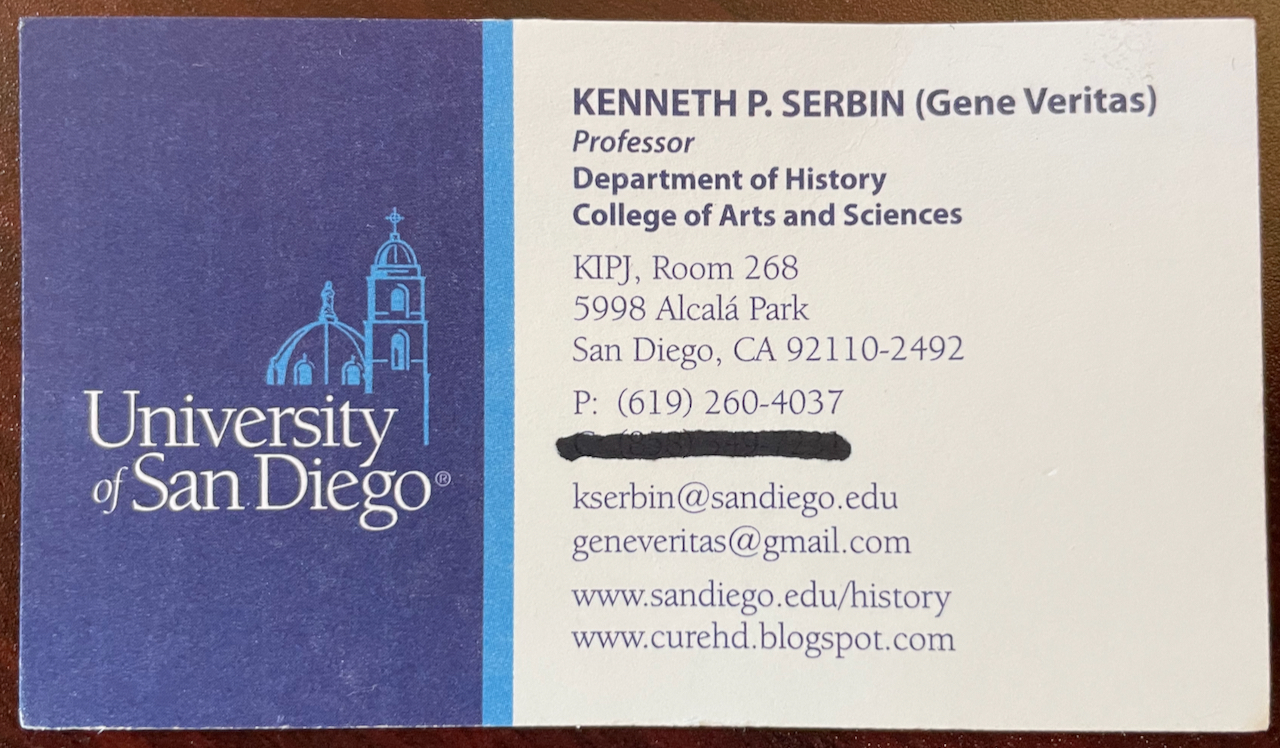
Business card of Kenneth P. Serbin (aka Gene Veritas) shared at scientific conferences and with anyone interested in learning about the HD cause (photo by Gene Veritas)


In early 2020, before the coronavirus pandemic exploded in the U.S., Dr. Burns and I collaborated in a screening at USD of the short documentary Dancing at the Vatican, which features HDdennomore. In late 2020 I helped promote the launch of the film online.


This year, I fulfilled one of the long-term goals outlined in my 2012 coming-out essay: shifting my academic focus from my beloved Brazil to the history of the quest for HD therapies.


With support from USD and The Griffin Foundation, I submitted the project for funding to the National Science Foundation. Although I was not granted funding initially, the foundation’s program officers encouraged me to reapply.


PTC’s helpful infusion of new capital


We all anxiously await effective therapies. Over the past ten years, I have increased my attention to the intensification of the efforts by labs and biopharma companies to achieve success.


The last several years of such efforts have felt like an emotional roller coaster for the HD community, though that’s not unusual for a difficult endeavor like drug development, which involves both positive and negative clinical trial results and cumulative learning.


Last month, I reported on the abrupt shutdown of the firm Triplet Therapeutics, Inc., which had explored a much-awaited proposed therapy. I also noted that the U.S. Food and Drug Administration (FDA) had requested that PTC Therapeutics, Inc., provide further information before allowing a clinical trial of its HD drug, PTC518.


But there was also potential good news.


Despite the FDA-imposed delay in a U.S. trial, PTC has reached a financing deal with the investment firm Blackstone, based on PTC’s plans to expand its drug pipelines to other diseases. The deal, which in the best-case scenario could infuse $1 billion of investment, puts “PTC in a strong position to continue to execute our mission,” Emily Hill, PTC’s chief financial officer, stated in an October 27 press release.


PTC518, a so-called splicing molecule, is also classified as a small molecule drug. It is thus taken as a pill – in contrast with riskier, less convenient delivery methods used by other HD programs, which include brain surgery and spinal injections. Early next year, PTC will furnish an update on the PTC518 trial. The trial continues in several European countries and Australia.


Roche diversifies its approach


In March 2021, Roche reported disappointing news: its gene silencing drug tominersen (an antisense oligonucleotide, or ASO) failed to improve symptoms in volunteers in the firm’s GENERATION HD1 Phase 3 (large-scale testing of effectiveness and safety) trial. This September, Roche announced GENERATION HD2, a less ambitious, Phase 2 (effectiveness, dosage, and safety) retesting of tominersen to start in early 2023.


In its presentation of GENERATION HD2 at the annual Huntington Study Group annual meeting in Tampa, FL, on November 3, Roche revealed that it has expanded its pursuit of HD therapies by embarking on two preclinical (nonhuman) projects.


Whereas tominersen targeted both the normal and abnormal (expanded) huntingtin gene, Roche will now seek to develop a drug that aims at just the abnormal gene. (Wave Life Sciences already reported in September that it had successfully targeted the abnormal gene in an early stage clinical trial, although yet without evidence of impacting symptoms.)


Like PTC’s program, Roche’s second preclinical program will aim at developing a splice modifier that would be taken orally.


“The medical need in the HD community is clear and we recognize that a range of different therapeutic approaches are likely to be required,” Mai-Lise Nguyen, of Roche’s Global Patient Partnership, Rare Diseases, wrote me in a November 3 e-mail.


A slide from the Roche presentation at the 2022 Huntington Study Group meeting illustrating the firm's three approaches to attacking Huntington's disease (slide courtesy of Roche)


Another ten years?


After the major disappointment in the shutdown of Triplet, I was heartened to learn of Blackstone’s massive investment in PTC, which indicates that both firms see PTC’s potential treatments as viable and profitable.


I was also encouraged to see how Roche, in the words of its Huntington Study Group presentation (see photo below), has augmented its HD research portfolio, reflecting a “commitment to advance scientific understanding and drug development in HD through continued collaborations” with HD organizations.


With the ingenuity of HD scientists and the dedication of HD family members to participation in research, the march towards potential therapies continues. I hope to chronicle continuing progress over the coming years not only free of the “HD closet,” but, thanks to new therapies, free of significant HD impacts, as well.


A slide from the Roche presentation demonstrating the commitment and collaborations involved in the quest for HD therapies (slide courtesy of Roche)

Thursday, May 21, 2020

In the pandemic, we need to rediscover patience and grasp our responsibility


In this time of pandemic, the virtue of patience is paramount. So is the need to grasp our impact on the history of the planet and its effect on our lives. We who are afflicted with rare diseases have already had to learn many hard life lessons, which apply to the vital efforts to confront the coronavirus. 

As we mark Huntington’s Disease Awareness Month, we recall how many in the HD and other neurological and rare disease communities have demonstrated great fortitude and also patience as we await effective treatments. Since learning of my mother’s diagnosis with HD in 1995 and my positive test for the mutation in 1999, I have worried about the inevitable onset of symptoms and yearned for a successful clinical trial to produce a drug to stave off the disease or ameliorate it.

“HD warriors” like my mother and caregiver father (both deceased) have had to confront the disease on a daily basis for a decade or longer. 

Drugs like tominersen, the gene-silencing compound now in a historical Phase 3 clinical trial run by Roche, require painstaking development and often well over a decade to reach the market.

The tominersen project began in 2007, and Roche expects to analyze Phase 3 data in 2022. (Tominersen was previously known as RG6042 and, before that, as IONIS-HTTRx.)

The best-case scenarios for an effective and safe COVID-19 vaccine for the general public point to some time in 2021. 

“What people don’t realize is that normally vaccine development takes many years, sometimes decades,” Dan Barouch, M.D., a virologist at Beth Israel Deaconess Medical Center in Boston, stated in a news report. “And so trying to compress the whole vaccine process into 12 to 18 months is really unheard-of.”

A vaccine might never be found; after decades of intense research, science still has not developed one for AIDS.

Drug development requires precision and patience.

Possible hope from new drug development approaches

That said, by dint of biomedical progress (but lacking overall preparedness for a pandemic), the current worldwide effort could take place more rapidly than previous drug-development work.

With positive results in the very early stage of its vaccine program, drug maker Moderna, Inc., is using an RNA-based approach to attempt to block the actions of the coronavirus.

Ionis Pharmaceuticals, Inc., the developer of tominersen, is also looking into ways its drug technology “could benefit COVID-19 patients, first by looking at our existing pipeline to see if any clinical or preclinical drugs would have a use in treatment in either the disease, or more likely the complications of the disease arising from the acute respiratory syndrome,” Eric Swayze, Ph.D., the firm’s senior vice president of research, wrote in an e-mail to me on May 8. Ionis designs drugs using antisense oligonucleotides (artificial strands of DNA), a form of gene silencing technology.

“In the 2002/2003 SARS epidemic we did done some work with ASOs targeting both the coronavirus itself as well as host factors, and had preliminary hints of activity [effect],” Swayze added. “Because of this, we are making newer generation ASOs targeted to the SARS-CoV-2 [COVID-19] virus as well as host factors that contribute to the infection and disease. 

“We plan to work with collaborators who have the capability to test our lead ASOs in virus cultures. We believe that our recent pulmonary program advances position us to quickly move forward, provided that our drugs look promising. However, we feel this remains a high-risk discovery project, with many challenges ahead.”

Behind the reaction against lockdowns

However, despite the need for a long-term fight against COVID-19, only a few weeks after lockdowns began, tiny groups of purported “protestors” appeared demanding to “open up” states. They were egged on by President Donald Trump, who has declined to marshal national resources against the virus, and organized by conservative groups.

I have wondered: What if Americans had wanted to give up only three weeks after the 1941 attack on Pearl Harbor?

The initial impatience about COVID-19 was clearly politically motivated. Since then, some criticism of lockdowns results from growing economic hardship: with a 14.7 percent unemployment rate, the U.S. has lost the greatest number of jobs since the Great Depression of the 1930s. In addition, many small business owners have had to curtail their work or even shut down completely.

The pain hits professors and students

The economic pain has hit American universities such as my employer, the University of San Diego (USD), which switched to remote, online instruction in mid-March. Confronting an unexpected deficit, the president has announced a 50 percent cut in retirement benefits and a salary and hiring freeze.

There is no consensus nationally on how to resume classes in the fall, with leaders of different campuses struggling with uncertainty. The nation’s largest public university, California State University, for example, has announced, that its campuses will move nearly all instruction online.

With USD’s dependence on tuition for institutional survival and its reputation for high-quality instruction in relatively small classes in small classrooms, the administration has launched a still inchoate plan to reopen for the fall semester early, in mid-August. According to administrators, because of the loss in student fees, going remote again would extend losses by tens of millions of dollars, forcing possible layoffs and furloughs of some instructors and employees, an increased teaching load for the main faculty, and other types of cutbacks.

Many professors, including myself, fear returning to campus so soon; in normal times, packed dorms, classrooms, and other facilities (and student parties administrators can’t control) provide ideal conditions for a virus to spread. Though young people are less likely to suffer from coronavirus symptoms, some do get serious cases, and asymptomatic people can of course spread the virus to others more vulnerable.

Universities and their employees will seek to implement social distancing, testing for COVID-19, and other measures. Ultimately, depending on the course of the pandemic, many might have to resort again to remote learning.

We cannot return to ‘normal’

In fact, three in four Americans have supported social distancing and wearing masks.

Without good health, we are restricted economically, as the HD community knows so well.

I believe that the impatience comes in part from our culture of instant gratification, epitomized by online shopping and overnight delivery. Another part relates to political orientation, with Republicans favoring a more rapid opening than Democrats (for one analysis, click here).

I think many people – myself included – wrongly thought that, after a month or two of lockdown, we would return to “normal.”

However, as New York Governor  Andrew Cuomo put it on April 1, “I don’t think we get back to normal. We get to a new normal.” As a result of the crisis, society will undergo a “transformation,” and we must assure that it be “positive and not negative,” Cuomo urged.

“I fear that the resumption of normality would signal a failure to learn,” commented Pulitzer-Prize-winning medical writer Siddhartha Mukherjee, M.D. “We need to think not about resumption but about revision.”

He added, with reference to how the drive for instant success has exacerbated the pain of the pandemic: “To what extent did the market-driven, efficiency-obsessed culture of hospital administration contribute to the crisis?”

The perspective of Big History

Cuomo echoed the point that professional historians like me make to students and readers of our books: history is ever-changing, often with great progress, but also devastating setbacks, including world wars, plagues, and inhumane practices like slavery.

I teach a course called “Big History: From Cosmos to Cannibals,” which begins with the start of the universe and ends with the dawn of the modern era: Europeans' conquest of the Americas, beginning in the late 1400s and quickly causing epidemics of Old World diseases in which tens of millions of native Americans died in the hemisphere – a very poignant point of comparison with the pandemic this past semester. A field that has emerged recently, Big History embraces the idea that human development must be understood in the context of physics, biology, evolution, and the transition from small bands of hunter-gatherers to cities with millions of people.

Over the past several years, my classes have focused on how we now live in the Anthropocene, an era in which humans have taken control of the earth’s systems (atmosphere, oceans, land, life, and others).

Human agency has led to global warming, probably a more daunting challenge to humankind than coronaviruses, and many other threatening phenomena.

Human control has contributed to the crisis

In fact, some commentators have asserted that the pandemic has resulted from the humans’ super-control of the earth and our encroachment on the last vestiges of nature in areas such as the Amazon rainforest (for some examples, click here, here, and here).

Deforestation (for cash crops and cattle), mining, a growing population, and the expansion of urban areas have put the environment and the species therein under greater stress, making them more susceptible to viruses and zoonosis (jumping of a virus from one species to another, including humans).

Human domination of the planet has intensified over the past several decades. I witnessed the devastation firsthand of the Amazon in 1988 and 1990, during my time in Brazil as a graduate student. I saw gold prospectors who penetrated the deepest recesses of the forest, using clandestine airstrips. I also viewed up close how many square miles of trees had been cut down.


Above, using modern equipment, men prospect for gold by excavating the floor of the Amazon rainforest in Brazil, 1988 (photo by Gene Veritas, aka Kenneth P. Serbin). Below, Gene Veritas (wearing sunglasses) with workers at the mining site (personal photo).


Reconnecting with ourselves, and the planet

In my Big History course just concluded this semester, we were all deeply saddened by the onset of the pandemic. However, in the context of history, a devastating viral outbreak was highly likely. Leading scientists have also warned the world for decades.

The pandemic serves as a global alarm. The Earth is a system, and it is crying out against our dangerous intrusions into rainforests and other attacks on the environment. Ironically, with the decrease in vehicle traffic, the vast reduction in pollution gives us a glimpse of the air quality we once had and must achieve again to stem the tide.

A key lesson of my Big History course is that the modern world led humans to think they were separate from nature, but, in reality, we are ever more interconnected. The pandemic will perhaps force humanity to rediscover our identity (for some, a spirituality) of being one with nature. We are part of the Earth, not over and above it.

As Dr. Mukherjee pointed out, the virus has laid bare many things, such as the inequality of our health system. It has also laid bare our impatience. To overcome the virus, we need to regain patience and, along with it, humility and respect for the planet.

As Dr. Mukherjee and others have urged, we also need to learn from this crisis and make better policy choices for future threats of all types.

(Disclosure: I hold a symbolic amount of Ionis shares.)

Sunday, March 15, 2020

In times of crisis, Huntington’s and other chronic disease communities provide examples of fortitude


For individuals and families facing Huntington’s and other chronic diseases, daily living often seems like nonstop crisis. These communities, including selfless caregivers, have demonstrated great fortitude.

The current coronavirus pandemic adds another giant, unknown layer to the kind of challenges and suffering many in these communities are already accustomed to.

The country’s reaction to the pandemic and the shutdown of daily routines starkly reminded me of the national climate in the months following the September 11, 2001, terrorist attacks on New York City and Washington, D.C. Resulting in 3,000 deaths, 9/11 led to a temporary grounding of all domestic flights, the fear of subsequent attacks (including nuclear), and panic regarding other, unrelated terrorist threats such as the deliberate spread of highly dangerous anthrax bacteria. The economy also suffered serious long-term effects.

Members of the San Diego Chapter of the Huntington’s Disease Society of America (HDSA), in the bewildering days after 9/11, held a previously planned fundraiser and got ready to hold its first Celebration of Hope Gala.

With so many other, urgent demands on potential donors, we feared people might not remember our needs.

Later that fall, in an editorial in Conquest, our chapter newsletter, I wrote the following:

On September 20, less than two weeks after the crisis, members of the public and local organizations participated in the Third Annual Indy Go-Kart Challenge to raise funds for the cure of HD. Then, on October 11, the one-month anniversary of the attack, several hundred San Diegans took part in the Celebration of Hope Dinner to assist the Center of Excellence for Family Services and Research at the University of California, San Diego. We raised tens of thousands of dollars at these events. Elsewhere in the country other HDSA events went on as planned.

In this manner HDSA and its supporters have sent a resounding message that generosity and compassion are far stronger than the hateful politics of terror. We will move ahead, no matter what the odds are against us. This is the American spirit.

Unprecedented impact on daily life

So far, the coronavirus pandemic has had an unprecedented impact on the United States, with schools, universities, and many other institutions closing or switching to remote, online operations. As of March 15, at least 65 people had died in the U.S., with worst-case scenarios projecting 200,000 to 1.7 million deaths.

The pandemic has changed my workplace unlike any earlier tragedy. After 9/11, no classes were cancelled by my employer, the University of San Diego (USD). In 2003, the devastating Cedar Fire in San Diego County left 15 dead, destroyed 2,820 buildings, and charred more than 280,000 acres. In response, USD shut down for just two weeks and finished the semester normally, with everybody back on campus.

Now, because of the virus, USD has cancelled classes this week and will finish the semester (eight more weeks, plus final exams) online. The University of Pennsylvania, where my HD-free daughter Bianca studies, will do the same. My wife and I are worried that Bianca will not be able to make it home in time before potential travel restrictions.

Each hour, we learn of more victims of the virus and further curtailment of life as we know it.

Impact on the HD community

The global crisis has also impacted the mission of HDSA and individual HD families.

On March 13, HDSA CEO Louise Vetter sent an e-mail to “friends of HDSA” announcing that the organization “holds the well-being of our families, volunteers and staff as our top priority” and will therefore postpone “ALL local HDSA events (educational & fundraising) nationwide” until April 30. That complies with public health recommendations to curtail public gatherings to slow the spread of the coronavirus.

According to Vetter, HDSA still plans to hold its 35th Annual Convention in New Orleans, June 4-6, but will continue to follow the guidance from the Centers for Disease Control, World Health Organization, and state and local health agencies.

HDSA’s national headquarters in New York City is closed. However, the entire staff is working remotely and has the resources “to continue the uninterrupted support of our mission during this time,” Vetter assured.

The Huntington’s Disease Youth Organization postponed its May 2020 international congress in Glasgow, Scotland, to March 2021.

I have accepted an invitation to deliver the keynote address at the 37th National Conference of the Huntington Society of Canada in November, but have been told to hold off on reserving flights until the pandemic’s long-term effects become clear.

Visiting the afflicted

For one HD community member and blogger, Mandi, 33, the pandemic meant that on March 12 she could not visit her 58-year-old HD-stricken father, Danny, at the Missouri nursing home where he resides.

“They are locking all doors for the safety of people there,” wrote Mandi, a dedicated caregiver and herself at risk, but untested, for HD. “Was my first reaction sad I couldn’t see my dad? Sure, but I immediately checked myself. I realized my own selfish want to see my dad was tiny in comparison to keeping the people in the nursing home safe because who knew if I was a carrier since you can have it for over a week and not show symptoms.”

Mandi pointed out how the nursing home’s restriction is “terrifying for those of us with possibilities of losing family.” She wants “to do everything in my power to protect him as I always have.”

However, she concluded: “Until we really know what we are dealing with let’s just take the precautions seriously.”


Danny (left) and Mandi (family photo)

Especially resilient

With the coronavirus pandemic, the world can learn from the example of the HD community and our generous supporters.

We in the HD community, and other neurological disease groups, face relentless adversity. HD grinds down the brain, leaving the affected like my late mother unable to walk, talk, or care for themselves. Caregivers like Mandi and my late father are true “HD warriors.” 

However, because of this, we have developed a very realistic view of life.

“We are all in a race to death, but people at risk for life-shortening diseases know that their time to the finish line is painfully fast and troubled,” I wrote in 2009 in an article titled “HD: hurtling towards death.”

At the same time, we also have a special appreciation for the “preciousness of life.”

Confronting HD makes us especially resilient. I am hopeful that the HD community will successfully meet the challenges of the coronavirus pandemic and, as in facing past challenges, become even stronger.