This article is Part 1 of a two-part series.
CHDI Foundation, Inc., the largest nonprofit effort aimed at developing therapies for Huntington’s disease, has expanded its efforts and partnerships to accelerate the defeat of the deadly disorder.
That’s the message transmitted in a July 29 interview by Robert Pacifici, Ph.D., CHDI’s chief scientific officer, who has a very personal commitment to disease eradication, and in a July 13 public presentation by Douglas Macdonald, Ph.D., CHDI’s director for research operations and scientific alliances.
CHDI emerged in 2003 out of the Hereditary Disease Foundation, where it was known as “The Cure Huntington’s Disease Initiative.” Funded by donors who wish to remain anonymous, “CHDI” is no longer an acronym but simply part of the foundation’s name.
According to Dr. Pacifici, and as reported previously in this blog, CHDI continues to spend $100 million annually on HD research and programs. The number of staffers at its offices in Los Angeles, CA, New York, NY, and Princeton, NJ, has grown to 100, doubling in ten years.
A virtual biotech firm, CHDI has no labs. Instead, it partners with, funds, and outsources projects to contract research organizations (CROs), academic labs, and pharmaceutical and drug discovery companies like Ionis Pharmaceuticals, Inc., the developer of RG-6042, a gene-silencing drug now in a historic Phase 3 clinical trial run by Roche. Roche took over the license after an Ionis Phase 1/2a trial successfully and safely lowered the amount of huntingtin protein, normal and mutant, in trial volunteers’ cerebrospinal fluid (CSF). Roche is now evaluating whether this reduction of huntingtin protein leads to clinical benefit (efficacy) in the Phase 3 trial.
“On any given day, there are about 700 other people who are supported by CHDI that are working on various aspects of the drug discovery and development pipeline that we try and orchestrate and integrate and enable,” Dr. Pacifici told me at the Los Angeles office, which is strategically located three miles from the city’s international airport.
CHDI seeks to “push the field forward” towards effective treatments and other “therapies,” which could include approaches other than drugs, he explained.
However, unlike private for-profit firms, CHDI does not seek to grow or perpetuate itself: “We actually don’t want to build a big company. We’d like to dissolve CHDI, because our job is done.”
CHDI is motivated by “time, not money,” because it wants to “accelerate” the discovery of therapeutics, Dr. Macdonald said in his talk at the Fourth Annual Convention of the San Diego Chapter of the Huntington’s Disease Society of America (HDSA-San Diego).
“We don’t have any competitors,” he added. “We only have collaborators.”
Robert Pacifici, Ph.D. (photo by Gene Veritas, aka Kenneth P. Serbin)
An in-depth look
You can watch my interview with Dr. Pacifici, my recording of Dr. Macdonald’s presentation, and the 2019 CHDI research highlights report, Postcard from Palm Springs, in the videos at the end of this article.
I first met Dr. Pacifici in December 2007, when he spoke at a “Spotlight on Huntington’s Disease” that I organized at the University of California, Los Angeles, for the oversight board of the California Institute for Regenerative Medicine, the state’s $3 billion voter-approved stem cell initiative.
In 2009, I visited a CHDI office for the first time, in Los Angeles, to interview Dr. Pacifici and other scientists to learn more about the organization. Since then, I have done seven video interviews with Dr. Pacifici – during the foundation’s annual HD Therapeutics Conference in Palm Springs, CA – to obtain snapshots of the progress towards treatments. In 2011, I keynoted the sixth conference in a major step out of the terrible and lonely HD closet.
Our July 29 interview was our ninth overall and, at 82 minutes, our longest and most in-depth. I sought to gain perspective on CHDI and the overall efforts towards therapies. I also wanted Dr. Pacifici’s assessment of so-called natural and alternative remedies used by some in the HD community, such as CBD oil, and also of the potential role of repurposed drugs – the topic of Part 2 of this series.
I first came in touch with Dr. Macdonald because he was CHDI’s point person for collaborations with Ionis and other gene-silencing projects. His July talk in San Diego was the most comprehensive public presentation of CHDI’s activities in lay terms that I have seen. (Also see Dr. Pacifici’s June 28 overview of CHDI at the 34th Annual HDSA Convention in Boston.)
Recording these two scientists in July and exploring their ideas once again helped me cope with my status as an HD gene-carrier and, I hope, contributed mental stimulation to help delay the inevitable disease onset. (Click here to read more.)
July 2019 marked a personal milestone for me: not only tracking CHDI for a decade, but also living symptom-free.
Douglas Macdonald, Ph.D., at the 2019 HDSA-San Diego chapter convention (photo by Randy Oto)
Battling genetic diseases
In interviewing HD scientists, I often ask what led them to focus on HD, a rare disease, rather than more common afflictions. In Dr. Pacifici’s case, his own family’s struggle against familial Mediterranean fever (FMF) motivated him to become a drug hunter and ultimately focus on HD.
“Like, unfortunately, too many of you, my family also had a rare genetic disorder,” he said, referring to the HD community and FMF.
Dr. Pacifici explained that FMF caused his father to have “recurrent bouts of horrible stomach pain and elevated fever and eventually ended up passing away from complications related to the disease at the very early age of 47, when I was just four years old.”
As a result, Dr. Pacifici had firsthand knowledge of a genetic disease’s “devastating” impact on a family.
“The thing that’s really crazy is that it turns out that the disease is now treatable, and it’s treatable with a drug that’s been around a very long time,” he said. “It’s a natural thing from the crocus flower called colchicine.”
Colchine was introduced as a treatment in 1972. However, as with HD, there is no cure.
Dr. Pacifici pointed out that, tragically, each day his father passed by a pharmacy that carried colchicine, but before a doctor in Turkey using the drug to treat gout had noticed that gout patients with FMF also got relief from that condition.
As a child, Dr. Pacifici, who grew up in New York City, took part in FMF clinical studies at the National Institutes of Health (NIH) in Bethesda, MD. At 8, with the discovery of colchicine as an FMF treatment, he started taking the drug, as did his 24-year-old brother. Dr. Pacifici’s son also inherited the disease and takes colchicine.
The HD gene is dominant, with each child of an affected parent having a 50-50 chance of inheriting the mutation, which inevitably brings on the disease. The FMF gene is recessive, which means that an individual must inherit a copy from both parents.
“As it relates to HD, I’ve experienced the tragedy of a drug that comes too late, in the case of my dad,” Dr. Pacifici said.
He added that his story is also relevant because “we scientists very often ask for HD families to participate in clinical trials.”
“There’s nothing that’s more precious to a drug hunter than an observation in the population you seek to treat,” he said, echoing a frequent theme of his interviews and talks. “I think I can speak to the challenges and difficulties of participating from the patient perspective – and certainly in the advantages and the upside of that – because I participated in clinical trials before colchicine was discovered.”
Dr. Pacifici recalled giving “what seemed like gallons of blood every time I visited [the NIH] in the hopes that somehow the material that I was providing would enable research and help further a treatment. When I ask folks to participate in clinical trials, I know what a big ask I’m making, but I also know what the upside and the advantages are.”
In Part 2 of this series, Dr. Pacifici addresses colchicine’s attributes – its “natural” source and its repurposing as a drug for FMF – as potential drug development models for HD.
First, find out what’s broken
According to Dr. Pacifici, with CHDI’s help the field of HD drug development has matured to a point where major pharmaceutical companies like Roche conduct critical clinical trials, expecting a potential business payoff.
A decade ago, attempts to develop treatments were based on a “shallow understanding” of HD, he said.
CHDI has encouraged labs to deepen our understanding of the disease. Scientists have needed to discover what’s “broken” in HD before they can attempt to fix it, he explained.
As a result, the 1993 discovery of the gene “has finally, finally been leveraged,” Dr. Pacifici observed. Currently, just in the category of gene silencing approaches like RG-6042, at least eight different types of treatments are in clinical development. (Companies with advanced programs include Wave Life Sciences, Takeda, uniQure, and Voyager Therapeutics.)
“They all share the common theme that they’re trying to turn off the huntingtin gene or reduce the amount of toxic huntingtin protein that’s present in cells,” he noted.
“There’s never been a more promising time in HD drug discovery and development,” Dr. Pacifici concluded, cautioning that in drug development there are no “guarantees.”
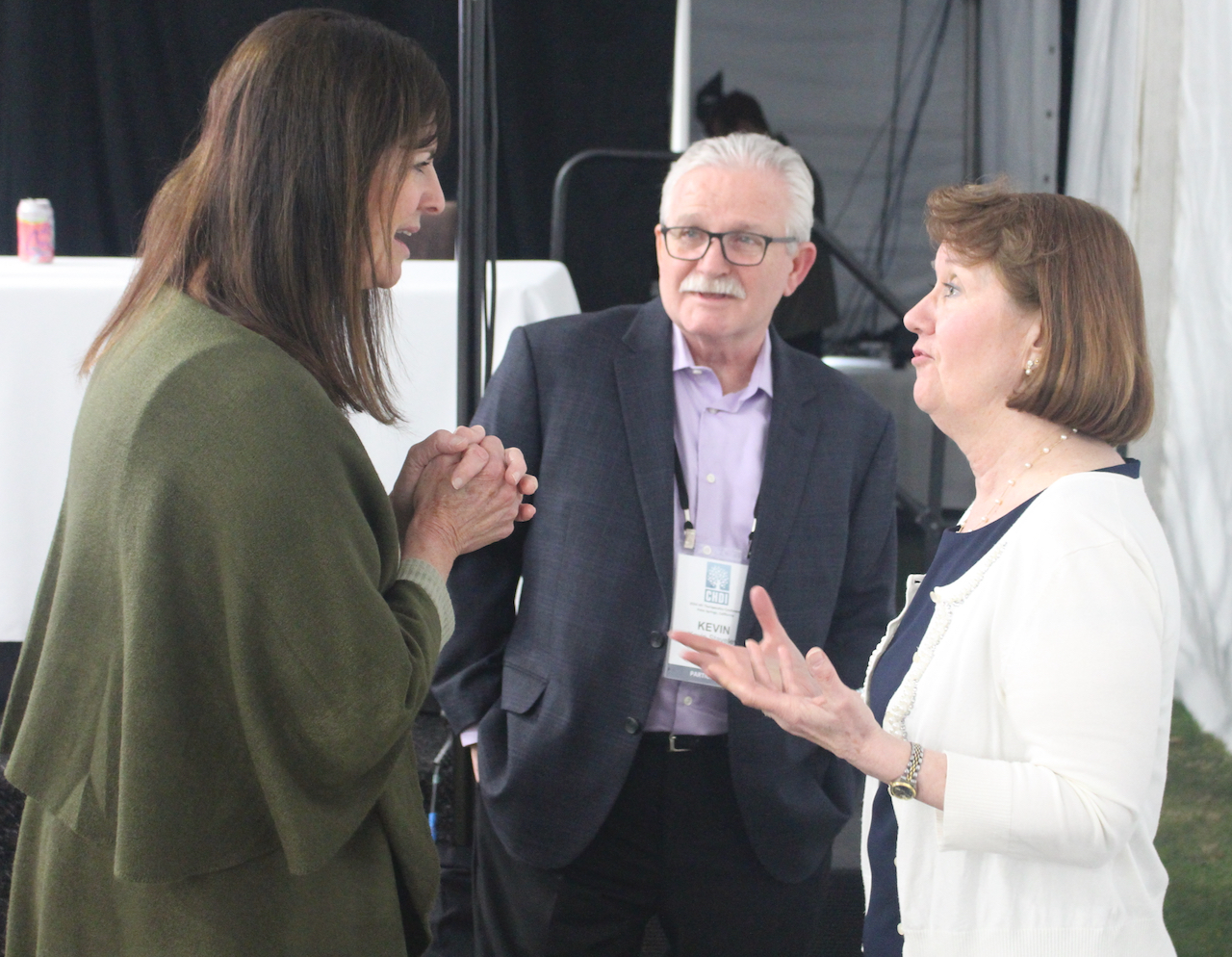
Scientists at the 2019 HD Therapeutics Conference (photo by Gene Veritas)
De-risking clinical trials
The progress in research has made for improvement in the design of clinical trials and ultimately the chances of their success, Dr. Pacific explained.
CHDI’s job as a nonprofit “is to do what’s called de-risking, to make a project look more and more attractive,” he said. “Because when it comes to later-stage clinical development, we want and need those big companies to come in.”
A major example: with Dr. Macdonald working as coordinator, CHDI and collaborating labs, CROs, and physicians developed a key technique (assay) to measure the amount of mutant huntingtin protein in clinical trial volunteers’ CSF, which runs along the spine and bathes the brain. Ionis then used this assay in its Phase 1/2a trial. In the trial, investigators draw CSF samples from volunteers via lumbar puncture. This is sometimes called a spinal tap, and is similar to an epidural procedure that many women undergo when giving birth.
To accelerate the quest for treatments, CHDI openly shares of all its HD-related data and resources. Thus, the CSF huntingtin test is available to all companies and researchers. “This exact assay is now being used in all of these [huntingtin lowering] trials,” Dr. Macdonald said in his talk.
Dr. Macdonald added that, instead of grants, CHDI uses contracts in its partnerships, with mandatory reporting of lab results. As explained by Dr. Pacifici at the HDSA convention, this business model gives CHDI “laser-like focus” on HD, preventing partners from getting sidetracked with discoveries potentially helpful in other diseases.
In addition, CHDI sponsors Enroll-HD, a global database, clinical research platform and observational study of HD-affected individuals and their relatives, now numbering more than 20,000. Enroll-HD seeks to improve clinical trials, facilitate access to them, and improve clinical care.
CHDI has established centralized biomaterial/reagent repositories of mice, cells, DNA, antibodies, and patient samples (such as blood) that researchers can access.
CHDI has also worked with the nonprofit Critical Path Institute to form the Huntington’s Disease Regulatory Science Consortium (HD-RSC) to create new tools and methods to advance efficient clinical development and address the regulatory needs for approval of HD therapeutics. Participants include Roche and other pharmaceutical and biotech firms, technology companies, academic institutions, nonprofit biomedical research institutions, and advocacy organizations.
According to Dr. Pacifici, these entities are “collaborating with each other to interface with the EMA (the European Medicines Agency) and the Food and Drug Administration (FDA) to figure out how we can design better, faster, more sensitive trials, even trials that involve people who are much earlier in the disease and not symptomatic. We’d like to have people treated as early as possible, before a lot of the damage occurs in the brain, and when the drug has the best possibility to exert its effects.”
In these types of collaborations, CHDI leverages its connections, nonprofit status, and independence to help position clinical trial programs for success, he added.
Roche’s ‘breathtaking’ investment
As a result of such de-risking, “there’s been a ton of interest” in HD among drug companies, Dr. Pacifici observed. The industry has also taken careful note of the Roche project.
“These are numbers of people and numbers of dollars and numbers of sites and a sophistication that are breathtaking, when you look at the investment that needs to be made,” he said, referring to the RG-6042 trial, which will include a total of 660 volunteers at more than 90 sites in at least 18 countries. “How wonderful that you’ve got this professional organization that’s done that part of the pipeline time and again.”
Because the field has advanced to human clinical trials (as opposed to experiments in animals), researchers will learn more than ever before about the disease and potential drugs, and they’ll be doing it faster, he said.
Roche is injecting RG-6042 into the trial volunteers through a lumbar puncture. If the drug lowers the level of huntingtin protein successfully in the right place and at the right time and produces an improvement either in the course of disease progression or certain symptoms, incentive will grow for companies to develop an oral pill. (In 2018, CHDI teamed up with PTC Therapeutics to investigate that possibility.)
The news in March that Roche would reduce the lumbar punctures from monthly to bi-monthly in the 25-month trial “is an indicator of very positive things,” and that the trial administrators are already learning from the experiment, Dr. Pacifici observed.
With the billions of dollars spent on many unsuccessful trials for Alzheimer’s disease and other neurological disorders, companies are also turning to HD as a potential template for developing treatments for those conditions, Dr. Pacifici added.
Alternatives to huntingtin lowering
Dr. Pacifici said that he is “very happy to see the number of different, complementary programs” aiming to lower the mutant huntingtin protein.
However, he added that it “would be foolhardy to have a monolithic portfolio and say that’s the only mechanism. Because if for some reason – it’s still formally possible – that none of these therapies will actually have the beneficial effect we’re all hoping and praying for, we don’t want to start from scratch in five years and say, ‘Gosh, I wish we had some other irons in the fire.’”
Indeed, although knowledge about both the normal and mutant huntingtin proteins has increased substantially, it’s still not clear whether the mutant protein causes the disease, although experiments in mice showed that the Ionis drug relieved and even reversed symptoms.
“We still don’t [know] with unabashed certainty,” Dr. Pacifici admitted. “That may sound frustrating for people. But in science, to know – to rule something out definitively – is pretty difficult.”
However, he pointed out, different explanations are not necessarily mutually exclusive. For example, both the proteins and the RNA (which carries the message from the DNA to make the protein) could both be toxic, he said. The critical question, he noted, is how does such knowledge impact the drug-making process? Other newly discovered aspects of huntingtin biology are adding further nuance to the drug-making process, he said.
Thus, CHDI is looking at alternatives to lowering the huntingtin protein. In particular, over the past five years it has included a new focus on the genetic aspects of the disease made possible by dramatic scientific discoveries.
Modifier genes: nature delays or speeds onset
A major example involves so-called modifier genes, that is, genes other than the huntingtin gene that delay or speed HD onset. Using data from over 9,000 HD gene carriers and their family members, an international group of researchers (known as the GeM-HD Consortium) has identified 23 potential modifier genes. This type of broad-ranging study is known as GWAS, genome-wide association study. (Click here for the 2019 CHDI presentation “Genetic Modifiers” by Marcy MacDonald, Ph.D., no relation to Douglas.)
Some of the modifiers delay onset, whereas others hasten it, Dr. Pacifici explained. Next to huntingtin lowering approaches, modifier genes and related issues make up CHDI’s second major strategy for defeating HD.
Normal gene carriers normally carry ten to 25 so-called CAG repeats on their huntingtin gene – letters and words in the genetic alphabet. The disease usually occurs in people with 40 or more repeats.
Dr. Pacifici pointed to the example of people with 40 so-called CAG repeats on the huntingtin gene. The average age of onset for those with 40 repeats is about 50. However, data reveal outliers experiencing onset as early as 25 and late as 65, a 40-year difference.
“Imagine if we had a drug that could delay onset of motor symptoms by 40 years!” Dr. Pacifici exclaimed. “My gosh, that would be fantastic. Nature’s kind of done that experiment for us. It’s told us that it is possible to modulate the disease.”
The key now is for drug developers to create a drug based on what nature did, he pointed out, adding that CHDI has formed an internal group to further research modifier genes.
At the HDSA convention, Dr. Pacifici outlined some of the other crucial findings from the GWAS research. Some people’s CAG repeats are interrupted with a CAA, in effect shortening the chain of CAGs. “You actually get the disease later,” Dr. Pacifici stated.
According to Dr. Pacifici, another finding has demonstrated that somatic expansion – a further expansion of the mutation – can occur in people with the genetic defect, thus hastening symptoms. In other words, over a lifetime, the CAG repeats can actually increase, say, to 100 or more, thus causing brain cells to die. (Early in life, much higher numbers of repeats cause juvenile HD.)
(This research could possibly explain why my mother and I, both with 40 repeats, have had different experiences with HD. She probably had onset in her late 40s and died at age 68. I am 59 and, at my HD checkups earlier this year, did not shown apparent symptoms. At 59, my mother had full-blown HD. I will explore this topic in a future article.)
In his convention talk, Dr. Pacifici also reported on CHDI’s collaboration with IBM, which has produced a model of the disease with nine stages instead of the traditional four. This ongoing project will help design better clinical trials, he said.
We still need to ‘roll up our sleeves’
The complexities of HD and the fact that people will probably need different kinds of therapies depending on their age and individual characteristics underscore the likely need for a Huntington’s cocktail, that is, a combination of therapies, Dr. Pacifici observed.
I first heard the idea of a cocktail mentioned at an HDSA leadership conference in 2000, and it’s recurred frequently.
The elements of that cocktail, of course, remain to be assembled. I asked Dr. Pacifici to expand on a comment he had made in 2009: that the answer for successfully treating HD will come out of “left field.”
“Amazing events” can still occur in scientific research, he explained. However, more specifically, Dr. Pacifici referred to the fact that “99.9 percent of biomedical research” happens outside of the sphere of HD and CHDI, with reams of publications in academic journals and in patent applications.
“It’s not so much that we’re going to find the cure in there, but some critical observation may be made that says, ‘Ah, here’s something that’s a piece to the puzzle or the beginning of a new, fruitful line of investigation,’” he explained.
As the situation stands now, CHDI won’t shut down any time soon. Researchers, drug companies, academics, medical personnel, and HD families and their supporters will need to keep alive their excellent record of collaboration. If successful, the new drug RG-6042 could be just the first of many needed for HD.
Defeating HD will still “require rolling up our sleeves” and being smart, Dr. Pacifici concluded.
(You can watch my interview with Dr. Pacifici, my recording of Dr. Macdonald’s presentation, and the 2019 CHDI research highlights report, Postcard from Palm Springs, in the videos below.)
(Next time, Dr. Pacifici explores the question: are we failing to solve HD by ignoring potential “natural” remedies, other alternative therapies, and repurposed drugs?)
(Disclosure: I hold a symbolic amount of Ionis shares.)