Showing posts with label repeat expansion disorder. Show all posts

Wednesday, October 23, 2024

At Harvard-MGH’s Mouro Pinto Lab, deploying CRISPR in the quest to cure Huntington’s disease


With a $1 million grant from the Hereditary Disease Foundation (HDF), a team of top researchers led by Ricardo Mouro Pinto, Ph.D., of Harvard Medical School, is deploying CRISPR to target genetic modifiers of Huntington’s disease.


In brain cells, these modifiers accelerate or slow so-called somatic expansions in HD.


The Mouro Pinto Lab at Harvard-affiliated Massachusetts General Hospital (MGH) specializes in research on these expansions. Scientists describe this process as the tendency of the mutant, expanded, disease-causing huntingtin gene to keep expanding abnormally. This causes the dysfunction – and possibly also death – of brain cells, leading to HD symptoms  (click here to read more). As scientists now see somatic expansion as a key driver of HD, research on this process has burgeoned.


Investigators have identified the modifier genes affecting expansion through deep research in human data. In speeding or slowing somatic expansion, those genes can hasten or delay disease onset. Many academic and biopharma groups, including the Mouro Pinto Lab, are investigating modifiers as potential drug targets.


The Mouro Pinto Lab is focusing on how one modifier gene, MLH3, acts harmfully as a “scissors” in HD. (By convention, human MLH3 gene is always capitalized and italicized; in contrast, the non-human gene is rendered as Mlh3.)


In an August 7 interview at his lab, Dr. Mouro Pinto described an experimental drug his team is testing in mice to deactivate the MLH3 scissors, a potential first step in seeking a treatment in people.


“I'm extremely optimistic about our approach,” Dr. Mouro Pinto said. “We can see what our drug does to somatic expansions. Can it slow it down? And our preliminary data is very encouraging in the sense that we can do that.”


On August 10, Dr. Mouro Pinto provided an update on the project at HDF’s HD2024: Milton Wexler Biennial Symposium. Announced in October 2023, the foundation’s two-year Transformative Research Award supports his team’s research of “therapeutic targeting of somatic CAG expansions with CRISPR base editing.” A group of anonymous donors funds the award.
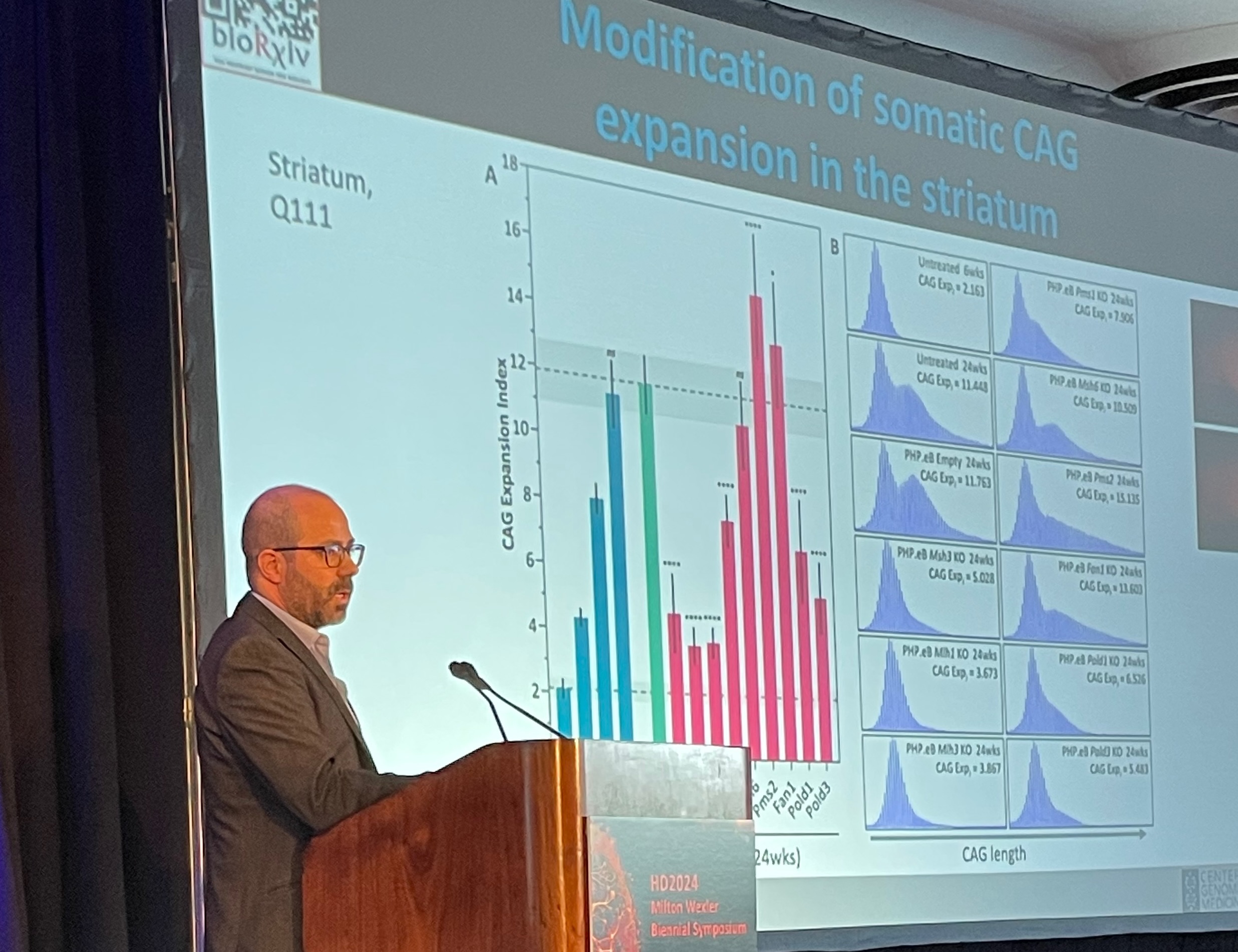


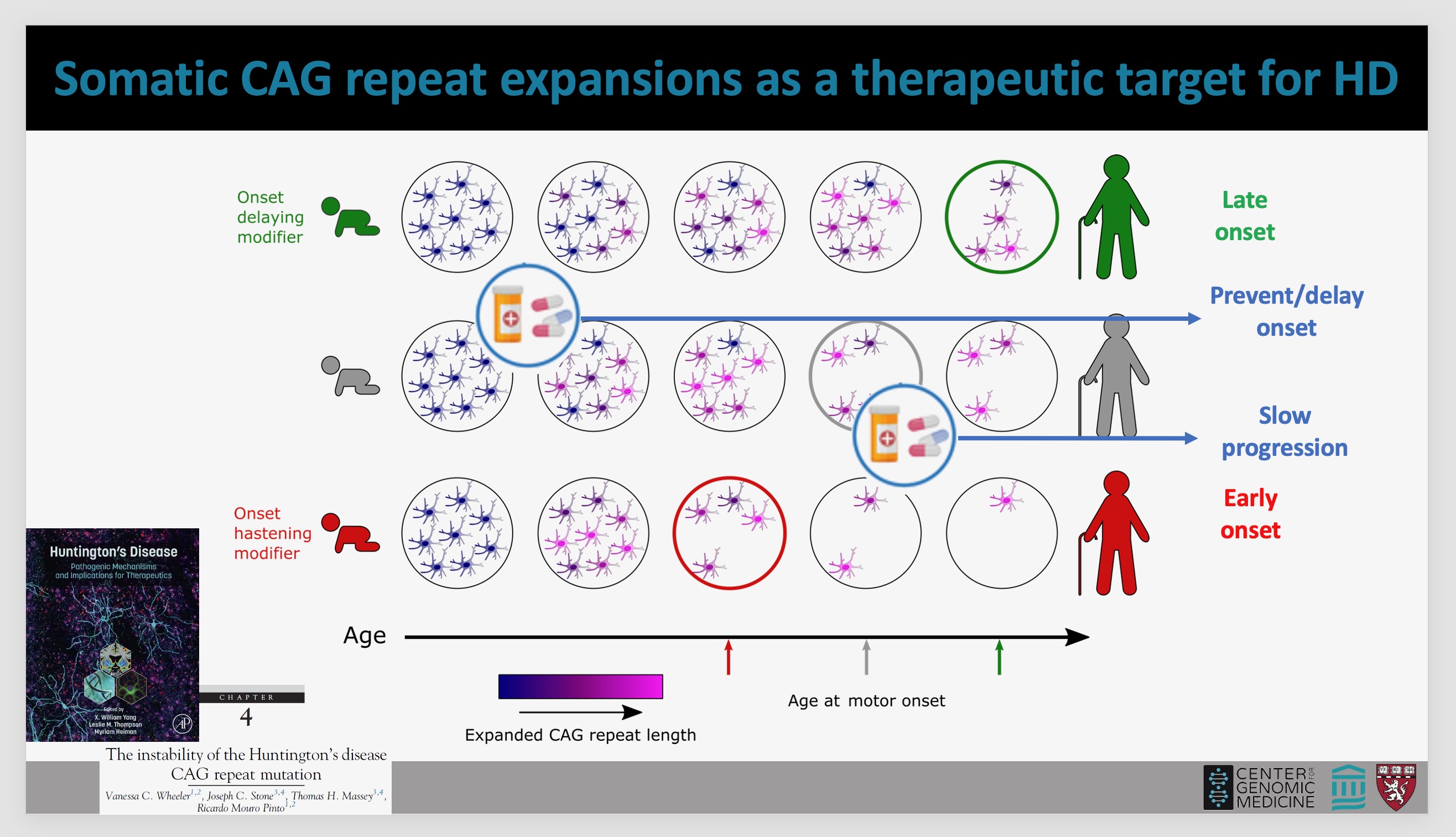
Above, at the HDF symposium, Dr. Mouro Pinto displays a slide demonstrating how his lab’s experimental drug slowed somatic expansion in the striatum of mouse brains. In humans, the striatum is one of the areas most affected by HD. Below, a Mouro Pinto slide illustrates how a drug could impact somatic expansion and therefore prevent or delay HD onset, or slow progression of the disease in humans (photo of Dr. Mouro Pinto by Gene Veritas, aka Kenneth P. Serbin, image of slide courtesy of Dr. Mouro Pinto). (To make it larger, click on an image.)


Innovative collaborators


Seven innovative labs are collaborating with the Mouro Pinto team.


James Gusella, Ph.D., whose Harvard lab discovered the huntingtin gene in 1993, is one of three co-investigators on the project.


Gusella’s team has developed the human cell line that “allows us to model somatic instability so we can test the drugs,” Dr. Mouro Pinto explained.  That cell line has the expansions of the segment of the DNA code CAG (cytosine, adenine, and guanine), identified in 1993 as the underlying cause of HD.


At the symposium the HDF awarded Gusella the Leslie Gehry Prize for Innovation in Science, including $100,000 for research and a plaque with a small sculpture by the renowned architect Frank Gehry.


Specialists in somatic expansion


A native of Porto, Portugal, Dr. Mouro Pinto received his Ph.D. in molecular genetics at Brunel University in England in 2010, focusing on Friedreich’s ataxia, a debilitating genetic neuromuscular disorder. Along with HD, Friedreich’s is one of more than 50 repeat expansion disorders. In Friedreich’s and others, somatic expansion also plays a role. Scientists also refer to this process as somatic instability.


From 2010-2015, Dr. Mouro Pinto worked as a postdoctoral fellow in the lab of Vanessa Wheeler, Ph.D., an associate professor of neurology at Harvard, MGH researcher, and pioneer in the study of somatic instability. The Wheeler lab is collaborating with the Mouro Pinto group on the HDF project.


For Portuguese-speaking advocates, in 2022 I interviewed Dr. Mouro Pinto in his native tongue, discussing his work and outlook for HD therapies. We spoke at the 17th HD Therapeutics Conference, sponsored by CHDI Foundation, Inc., the largest private funder of HD research and a backer of the Mouro Pinto Lab.


On August 6, the HDF and MGH co-hosted a tour of the Mouro Pinto Lab for about 20 HDF officials, donors, and HD family members. Dr. Wheeler participated, too. I took part at the invitation of the HDF. At the start, Dr. Mouro Pinto presented an overview of the HDF project.


Above, before the tour of his lab, Dr. Mouro Pinto presents a slide demonstrating the path of his scientific studies. Below, Dr. Mouro Pinto explains the purpose of a PCR (polymerase chain reaction) workstation, where they isolate and make billions of copies of the CAG repeat so they can study it in more detail (photos by Gene Veritas). 


 A key task: measuring the expansion


In 2016 Dr. Mouro Pinto won the first Berman-Topper Family HD Career Development Fellowship from the Huntington’s Disease Society of America. That funding allowed him to conduct research demonstrating that modifier genes can speed or slow somatic expansion in mice, he said.


According to Dr. Mouro Pinto, his lab’s more recent examination of postmortem tissue from HD patients revealed that somatic expansion had occurred in about 30 different brain regions. In all, 50 different tissues were examined, showing different rates of somatic expansion in the liver, muscle, kidney, and others. Some of the fastest expansion was in the brain, he added.


To measure a drug’s effect in a clinical trial, brain biopsies are currently not an option, Dr. Mouro Pinto pointed out. However, measuring somatic expansion in blood, liver, and cerebrospinal fluid, which bathes the brain, could serve as biomarkers. A biomarker is a sign of a disease or effect of a drug. He noted that other researchers are already investigating somatic expansion in the blood.


“What is the right tissue, bio fluid to obtain from the patient?” Dr. Mouro Pinto asked. “And then what is the right test to be sensitive and accurate? So those two things are actually other aspects of research in our lab that we're trying to develop.”


Having those biomarkers will be crucial if the potential CRISPR drug reaches a human clinical trial, he observed.


CRISPR: a one-time, permanent edit of the gene


CRISPR stands for “clustered regularly interspaced short palindromic repeats,” a strand of RNA that, when activated by an enzyme, can edit DNA. Bacteria evolved this technique to defend against viruses.


Jennifer Doudna, Ph.D., and Emmanuelle Charpentier, Ph.D., won the 2020 Nobel Prize in Chemistry for their work in identifying and understanding CRISPR. Click here to read more about CRISPR, its potential for treating HD, and its powerful implications for the future of humanity.


Scientists have now used CRISPR to edit human genes in labs and in clinical trials that have resulted in drugs approved by the U.S. Food and Drug Administration (FDA). In December 2023 the FDA approved two CRISPR drugs for sickle cell disease, an inherited disorder that primarily affects people of African descent.


This first wave of CRISPR clinical trials has started with the “lowest-hanging fruit,” diseases that “affect the liver or the eye or the ear,” Dr. Mouro Pinto pointed out. The brain is far more difficult to research, so it has been challenging to address brain diseases with CRISPR drugs, he said.


“You're doing it at the level of the DNA and that causes a permanent change,” he emphasized. “Once you treat and you introduce the change you made, that will stay in that cell forever.”


A CRISPR clinical trial “will look, essentially, the same as any other HD trial,” he explained. “You'll need to collect samples. And you'll need to conduct a battery of physical tests, cognitive tests and behavioral tests. It will still be evaluated exactly by the same standards as any other clinical trial.”


In contrast with most other HD drug approaches, CRISPR has a key, beneficial difference. “It’s a one-time treatment,” Dr. Mouro Pinto said.


An ‘amazing toolbox’


Dr. Mouro Pinto underscored that in addition to serving as a drug, CRISPR has provided an “amazing toolbox” for less costly and more efficient and precise lab research.


In contrast with the old, very expensive process of breeding large numbers of mice over years, CRISPR “has accelerated the rate of research tremendously” and dramatically reduced the numbers needed, he said. With CRISPR, they can much more quickly pursue tasks such as making mutations in mice or screening a large number of genes to see which might modify somatic expansion, he said. The lab’s paper on this topic will be published in Nature Genetics.


The lab also can deliver a CRISPR reagent to a young mouse, transforming it into a model for study and producing results in a few weeks.


A unique ‘humanized Mlh3 mouse’


Use of CRISPR enabled a “really critical” step in the HDF project: creation of what Dr. Mouro Pinto described as a “humanized Mlh3 mouse,” a unique research step. To prepare the potential CRISPR drug for testing in mice for efficacy against HD and safety, the lab introduced into the animals a small sequence of human DNA from the MLH3 gene.


The scientists have crossed these mice with engineered HD mice. After a few generations downstream, this will result in mice with the expanded and the humanized modifier gene, which will be tested with the CRISPR reagent to see if it stops somatic expansion, Dr. Mouro Pinto continued.


The crossing was also necessary to assure that the humanized segment of DNA itself does indeed experience somatic instability, because the goal of the research is to stop instability, he added.


Another key step will involve measuring the CRISPR reagent’s impact on somatic expansion, irregular movements, and behavioral symptoms in the mice, Dr. Mouro Pinto said. For this stage, the lab will have the key assistance of the “extremely experienced” Cathleen Lutz, Ph.D., M.B.A., vice president of  The Jackson Laboratory Rare Disease Translational Center, he noted.


‘Promoting the flavor without the scissors’


As it develops greater precision, the Mouro Pinto Lab has found that one of two MLH3 variants has the scissors that cause harmful genetic cutting. That gets closer to solving the HD puzzle.


In a February HDF webinar about the project, Dr. Mouro Pinto explained that in people without HD, the MLH3 variant without scissors – the good variant – is present.


He said that he is confident that promoting expression (activation) of the good variant over the bad would be better tolerated as a treatment than simply turning off the bad. He described this approach as “promoting the flavor without the scissors, as opposed to completely getting rid of the protein” that results from the gene.


“In a mouse that doesn’t have the scissors, you completely stabilize the repeat,” Dr. Mouro Pinto stated in the webinar. “We know that the scissors component of this protein is essential for promoting CAG expansions.”


Furthermore, in human HD cells the team not only reduced but eliminated the bad version of MLH3.


They achieved this using a technique known as base editing.


Dr. Mouro Pinto noted that with standard CRISPR editing, a sequence of DNA can be broken up, potentially causing unwanted effects. In contrast, in base editing, no breakage occurs, because scientists edit the DNA by simply changing a letter of the genetic code, for example, from A (adenine) to G (guanine), or C (cytosine) to T (thymine).


Significantly, his team edited both copies of the MLH3 gene and completely shifted expression from the “bad” version towards only making the “good” “scissor-less” version of MLH3 protein. As a result, the experiment completely stabilized the CAG repeat (i.e. the CAG stopped expanding in edited cells), Dr. Mouro Pinto stressed.


There are two bases because, as Dr. Mouro Pinto reminded, every cell has two copies of each gene – a copy from each parent.


Partnering on more precise gene editing


Only a few projects have started exploring base editing for HD, and most are happening in research labs such as his, Dr. Mouro Pinto said.


To maximize the benefits for HD patients, the HDF project will seek to improve on this editing.


Recognizing the many other labs are examining directly targeting the CAG expansion, Dr. Mouro Pinto believes that, instead, deactivating a modifier gene such as the MLH3 scissors is a safer and easier strategy.


On this aspect, the Mouro Pinto Lab will partner with co-investigator David Liu, Ph.D., of both Harvard and the Massachusetts Institute of Technology (MIT). Dr. Liu invented both base editing and prime editing.


As Dr. Mouro Pinto pointed out in our interview, base editing allows for more “precise base changes.” In the HDF webinar, he noted that this method prevents breaking up of the DNA.


Harvard’s Benjamin Kleinstiver, Ph.D., another innovative co-investigator, has engineered CRISPR enzymes that “literally can go anywhere in the genome,” Dr. Mouro Pinto added. This enables the team to target any sequence of DNA it needs to, he said.


The lab continues to seek improvements in its enzyme to “achieve highest specificity and maximum efficacy,” he said.


The potential path to a clinical trial


“It's too early” to gauge whether the experimental CRISPR reagent can undergo testing in humans and have a “therapeutic impact,” Dr. Mouro Pinto told me, noting that four key questions must be answered in mice first. The lab aims to answer them in the coming months.


He described the outcome needed in the series of mouse experiments: “Did we change the DNA? Yes. Okay. Did we change which version of MLH3 is made? Yes. Okay. Next. Did we reduce the CAG instability? Yes. And then do we have any impact on HD symptoms?”


Currently the lab is working on the first step, with “promising” indications so far, Dr. Mouro Pinto said.


If the project proves successful, other, distinct projects testing the reagent in other animals, such as nonhuman primates, would follow, Dr. Mouro Pinto explained. The HDF grant does not include funds for those steps.


Emphasizing safety, avoiding unwanted edits


Dr. Mouro Pinto underscored that the team strives to find the safest CRISPR drug possible.


In line with more stringent FDA standards and bioethical concerns regarding gene editing, the project must carry out “due diligence” to avoid “very serious adversity.” That includes so-called off-target effects of gene editing, in which a gene such as one for cancer is accidentally activated or turned off, Dr. Mouro Pinto cautioned.


“It is not uncommon for these drugs to have some activity in unwanted regions of the genome,” he explained.  “We need to spend a lot of time looking for unwanted modifications.”


The CRISPR agent is “not yet ready for the clinic,” Dr. Mouro Pinto added.


He noted that the project is not doing edits in the sex cells; offspring therefore cannot inherit any genetic changes.


Finding the best way to deliver the cargo


The lab has no name yet for the experimental reagent, that is, its CRISPR enzyme.


“This is still an experimental reagent,” Dr. Mouro Pinto stressed. “I don't want to create false expectations. We are primarily putting effort into making sure that our cargo is good, that it's really doing what we want.”


The “cargo,” the potential drug, needs to be delivered safely and effectively into the brain and to the right cells, Dr. Mouro Pinto said. A common strategy in gene therapy is using a virus, specifically, an adeno-associated virus (AAV).


The Mouro Pinto Lab is using an AAV that works well in mice but not possible for humans, he said. As part of the HDF project, the team is searching for the ideal delivery system, which could be an AAV, a lipid nanoparticle, or extracellular vesicle, he continued. All three are tiny.


“There are many people now working on AAVs that you inject systemically,” Dr. Mouro Pinto said. “You give it into a vein, they go everywhere in your body including crossing the blood-brain barrier and entering the brain.” They can reach “almost every single neuron in the brain,” he added.


The blood-brain barrier is a membrane that protects the brain from harmful substances and germs.


Another project collaborator, Benjamin Deverman, Ph.D., of Vector Engineering and Harvard and MIT, has greatly improved the ability of AAVs to cross the blood-brain barrier in humans. In May, these critical findings for solving brain disorders were published in Science magazine.


“It's going to unlock this sort of roadblock that we have with delivery,” Dr. Mouro Pinto said of this breakthrough.


Lipid nanoparticles also can be injected into the blood. Some researchers are exploring oral administration of extracellular vesicles.


These vehicles pose less burden on clinical trial participants and patients in comparison with other methods, such as spinal taps or direct injection into the brain, a “complex surgical procedure,” Dr. Mouro Pinto observed.


“We're a little bit agnostic to the delivery strategy,” Dr. Mouro Pinto said, noting that the science of these delivery methods is evolving rapidly. By the time the project concludes in October 2025, “there might be a variety of different delivery options that we may want to consider.”


“Synergizing” with other HDF awardees


Dr. Mouro Pinto sees “opportunities to synergize” with the team that also received a 2023 Transformative Research Award, under the leadership of Beverly Davidson, Ph.D., of the University of Pennsylvania and Jang-Ho Cha, M.D., Ph.D., the chief scientific officer of Latus Biosciences. Latus focuses on precision delivery of gene therapy. An expert in AAVs, Dr. Davidson presented the team’s work at the HDF symposium.


Titled “Advancing gene therapies for HD” and focusing on AAVs, that project could potentially provide a delivery system for the CRISPR reagent, Dr. Mouro Pinto said.


Dr. Beverly Davidson presenting her team’s work on AAVs at the 2024 HDF symposium (photo by Gene Veritas).


Getting to market, looking beyond HD


In the event of the CRISPR reagent’s success in the lab, MGH will assist in commercializing it, Dr. Mouro Pinto said.


The hospital could license the technology to a biopharma company or, as in the case of the Davidson-Cha project, to start a company like Latus to bring the drug through a clinical trial and to market.


“We're open to those conversations and we've been fortunate to have a very collaborative interaction with industry partners so far,” Dr. Mouro Pinto told me.


The problem of somatic expansion “is shared across a large number of repeat expansion diseases,” he observed. “Individually, they're rare diseases. Collectively, they're not a rare disease. They actually affect a large number of patients around the world.”


“If our hypothesis is correct, the therapeutic benefit will not be limited to HD patients,” he concluded.


Disclosure: the Hereditary Disease Foundation covered my travel expenses to tour the Mouro Pinto Lab and attend the 2024 symposium.


Sadly, Michael McCabe, a 62-year-old Boston HD man who told his story at this year’s HDF symposium, died suddenly on September 12. Donations in Michael’s memory are suggested to the Huntington’s Disease Society of America.


Gene Veritas (left) and Dr. Mouro Pinto in the MGH lab (personal photo)

Friday, October 21, 2022

After abrupt shutdown of Triplet Therapeutics, Huntington’s disease community regroups in the fight for therapies


Triplet Therapeutics, Inc., a Cambridge, MA-based start-up that aimed to transform the treatment of Huntington’s disease and related disorders, has shut down, citing a lack of new investment partners and the discovery that its proposed HD drug caused adverse effects in animal tests.


On October 11, Triplet CEO Nessan Bermingham announced the company’s closure on his LinkedIn page. The abrupt closure was another piece of tough news regarding potential therapies for HD.


In March 2021, Roche and Wave reported negative trial results for drugs aimed at reducing the toxic mutant huntingtin protein in patients’ brains. These drugs are antisense oligonucleotides (ASO), a synthetic modified single strand of DNA that can alter production of certain proteins.


Triplet’s strategy


Triplet had designed its own ASO, but with a different strategy: to stop the deleterious expansion of the mutant huntingtin gene (click here to read more). Known as somatic expansion, this process drives the disease and can hasten the onset of symptoms. By slowing this expansion, Triplet had hoped that its drug would head off the disease early.


Triplet scientists and others have viewed this approach as a more effective alternative to the “huntingtin lowering” strategy devised by Wave, Roche, and others.


Capitalizing on recent groundbreaking HD genetics research, Triplet, founded in late 2018, developed the only clinical trial program to slow or stop somatic expansion in HD. Triplet also had hoped to develop treatments for others among the 50 rare conditions with somatic expansion, which, like HD, are called repeat expansion disorders.


Brian Bettencourt, Ph.D., Triplet's former senior vice president for research, explains a slide illustrating the firm's pathway to a potential HD drug at the 15th Annual HD Therapeutics Conference, 2020 (photo by Gene Veritas, aka Kenneth P. Serbin).


“It is with great sadness we announce the closure of Triplet Therapeutics,” Bermingham wrote on LinkedIn.


The “underlying science of targeting repeat expansion disorders” remains “a viable approach from our vantage point,” Bermingham wrote. However, crucially, in animal studies, the data from Triplet’s HD drug “reflected prior experiences” with ASO toxicity in the central nervous system – a reference to the Roche and Wave results.


Specifically, the ASO showed signs of harming neurons (brain cells). “As a therapeutic modality, given Roche’s data, our data, lack of efficacy from Wave products, our belief is that neurons may be particularly sensitive to antisense oligonucleotides,” Bermingham told STAT.


Triplet secured $59 million in initial financing and investment. After the bad news in 2021 from Roche and Wave, Triplet struggled to raise the money needed for its planned next step: an early phase clinical trial of its ASO. “The clinical data really put a chill on the overall interest or risk perceived within Huntington’s disease,” Bermingham noted.


SHIELD HD continues to provide key data


To provide data about the disease for the clinical trial it was planning, Triplet has run a separate, two-year study, without a drug, of approximately 70 presymptomatic and early-disease-stage carriers of the HD mutation. Called SHIELD HD, the study involves cognitive testing, brain MRI scans, blood tests, and examination of cerebrospinal fluid drawn from spinal taps (click here to read more). The sites are Canada, France, Germany, the United Kingdom, and the U.S.


In March, Triplet scientists presented a preliminary analysis of this data at the 17th Annual HD Therapeutics Conference, sponsored by CHDI Foundation, Inc., the virtual nonprofit biotech focused exclusively on developing HD therapies. CHDI is the largest private funder of HD research.


SHIELD HD may end in the next few months. In Bermingham’s announcement about the closure of Triplet, he said that CHDI, “a great partner and patient advocate,” stepped in to help SHIELD HD sites complete their work.


Triplet’s representatives are now seeking potential partners to continue the company’s research, including a new plan for a clinical trial.


Assessing risk


In an online interview with me on October 21, Irina Antonijevic, M.D., Ph.D., the former chief medical officer of Triplet, explained that discovering toxicity of the ASO in the animal studies surprised the firm’s researchers. However, she emphasized that the toxicity was “minimal” at therapeutic dose levels, with the animals not suffering any functional loss.


As noted publicly, Triplet had also developed several, more potent backup ASOs, Dr. Antonijevic said. The more potent the drug, the smaller the dose needed, therefore reducing the chance of toxicity or an adverse effect, she added.


Nevertheless, in a more risk-averse investment climate, Triplet could not find the necessary partners to carry on its clinical trial program with the added concern about the toxicity, Dr. Antonijevic observed.


“I think that they are just sort of very different risks,” she said. “Somebody takes maybe a risk to say, ‘Maybe this drug has a risk, but I have a disease, and I know what this disease will do to me.’”


For a drug company, the risk involves “investing millions” and waiting years to see if there is a return on investment, she said.


Tweaking drug safety, efficacy, and delivery


Triplet’s experience revealed how the field of HD drug development needs to tweak the safety, efficacy, and delivery of ASOs into the brain. Despite the challenges, a number of other firms and many researchers believe ASOs merit more study and clinical trials.


Roche has developed a revised clinical trial plan, including lower and thus potentially less toxic doses of its ASO. It will start a second trial of that ASO in early 2023.


Wave, building on its failed 2021 early stage trials of two ASOs, put a third drug into another small, early phase trial. Unlike the previous drugs, this Wave ASO successfully reduced the mutant huntingtin protein. Also, for the first time, it did this without lowering the level of the healthy protein – something that occurs with the Roche drug.


“This is, as far as we know, the first time anyone has ever selectively lowered only one copy [of a total of two] of a protein inside of a human body,” the HD science site HDBuzz commented on Sept. 30.


The method of delivery is important for all drugs, especially for ones introduced into the brain. The Roche and Wave trials use spinal taps (intrathecal injections). Triplet had projected using an

injection via a small reservoir implanted on the top of the brain. The firm uniQure is injecting its drug using brain operations.


Developing a pill


Drug developers point out that the most convenient HD drug would be a pill – taken orally, at home, and without medical assistance. These drugs are known as small molecules.


Several firms have embarked on small molecule clinical trial programs for HD.


An important trial of one of these small molecule drugs, a huntingtin-lowering pill developed by Novartis, was halted in August for safety reasons. Some of the trial volunteers on the drug developed problems with their nerves, known as peripheral neuropathy.


FDA requests more data from PTC


On October 18, another firm enrolling people in a clinical trial for a small molecule, PTC Therapeutics, Inc., was asked by the U.S. Food and Drug Administration (FDA), to provide further information before allowing a clinical trial of its HD drug, PTC518. PTC announced that enrollment is ongoing for the planned 12-month Phase 2 trial in several European countries and Australia.


Both branaplam and PTC518 are so-called splicing molecules.


“PTC pioneered the development of splicing molecules and we have learned about the essential elements to successfully develop these molecules,” Jeanine Clemente, the senior director of corporate communications at PTC, wrote me in an October 20 e-mail in response to my questions about the FDA decision. “We cannot comment on the FDA’s thoughts regarding branaplam or splicing molecules, in general.”


However, Clemente pointed out that PTC518 is highly specific and selective for the huntington gene.” She added that, in many important ways, “PTC518 is different than branaplam.”


HDBuzz also noted that PTC518 “may have more ideal drug properties, compared to branaplam.”


The FDA has asked PTC for additional data to support the dose levels and duration proposed in the trial, Clemente wrote.


Clemente added that PTC enrolled its trial entirely with patients outside of the U.S., including approvals to conduct the study at all proposed dose levels. “There have been no treatment-associated adverse events reported to date,” she stated. “We will continue to work with the FDA to potentially enable enrollment of U.S. patients in the trial.”


Keeping perspective in a difficult fight


Triplet will host a podcast later this year to discuss the “birth, life and death” of the firm, CEO Bermingham stated in his announcement of the closure.


The HD community must keep the Triplet shutdown – and all news regarding the ups and downs of the search for HD therapies – in perspective, noted Martha Nance, M.D., the director of the Huntington’s Disease Society of America Center of Excellence at Hennepin County Medical Center in Minneapolis.


“We would not do research if we already knew all the answers,” Dr. Nance wrote me in an October 18 e-mail. “HD patients and families have bravely faced their difficult disease for generations, and the doctors and scientists are doing their best, along with patients and families, to find a brighter path.”


As an asymptomatic HD gene expansion carrier who has not yet participated in a clinical trial, I had high hopes for the Triplet program, with its focus on attacking the disease in the early stages. I was deeply saddened to hear that the firm closed. I also felt in the gut once again the hard reality of marshalling resources – including financial support – for combating rare diseases.


Companies like Triplet are venture capital-funded businesses pursuing high-risk, high-reward endeavors, and many such endeavors fail. So we are fortunate to have a nonprofit like CHDI as a backstop.


Dr. Nance’s wisdom reminded me of the need to join with my fellow HD and rare disease advocates to regroup in the fight for therapies.


“Finding a solution to brain cell death in HD is not easy,” she observed. “And as we edge closer to an answer, each failure seems more dramatic. It would be nice if the answer would just reveal itself, if the answer to HD was simple and easy, but we will not let the setbacks of the last two years prevent us from moving forward.”

Thursday, October 15, 2020

Triplet Therapeutics aims to transform the approach to treating Huntington’s disease, similar disorders


Huntington’s disease causes complex symptoms and attacks the brain ­– the most difficult organ to access with drugs. Thus, current remedies only help manage symptoms. They do not stop the disorder from progressing and, ultimately, causing death.


Now, building on groundbreaking research into the genetic roots of HD, Triplet Therapeutics, Inc., is taking a bolder stance: restoring the idea of transformative treatment onto the agenda by directly attacking the disease's underlying causes.


Founded in late 2018, Cambridge, MA-based Triplet aims to start a clinical trial in the second half of 2021 for a potential drug, for now called TTX-3360, targeted at stopping the mutant huntingtin gene’s tendency for continued expansion with age. That expansion compromises brain cells and triggers disease. Using the same mechanism, Triplet hopes to develop transformative treatments for many of the more than 50 other so-called repeat expansion disorders (REDs). For REDs of the central nervous system, it would use the same drug as for Huntington’s.


The DNA that comprises the mutations of many REDs – as with Huntington’s – occurs in triplets of the letters of the genetic alphabet. This helped inspire Triplet’s name. But other repeats, from 3-12 letters long, have also been described. Also as in HD, the DNA in other repeat expansion disorders grows longer and thus may cause disease.


“There's a lot of the genome that we actually don't know about, and a lot of putative genes there that, frankly, we don't know functionally what they do,” Triplet founder and CEO Nessan Bermingham, Ph.D., said in a January interview on the podcast BioBoss. “So, I think of the opportunities in our industry as we think about treating disease is very much going in and trying to actually understand and segment these regions of the genome to understand how targeting them may actually prevent or treat or cure disease.”


The efforts for treatments have taken “significant steps forward,” Dr. Bermingham observed.


Triplet secured $59 million in initial financing and investment. The company’s scientific advisory board includes key researchers in the fight against Huntington’s such as Harvard University geneticist James Gusella, Ph.D., the leader of the team that discovered the huntingtin gene in 1993, and Sarah Tabrizi, FRCP, Ph.D., a professor at University College London and one of the chief medical collaborators in the development of the historic Phase 1/2a HD gene-silencing clinical trial run by Ionis Pharmaceuticals, Inc., followed by an in-progress Phase 3 trial run by Roche (discussed below).


Triplet has also consulted with CHDI Foundation, Inc., the nonprofit virtual biotech dedicated solely to developing HD therapies (drugs and/or other treatments) and sponsor of the 15th Annual HD Therapeutics Conference in February. Produced by former NBC-TV foreign correspondent and global Huntington’s advocate Charles Sabine, this year’s conference highlights video featured Triplet and its senior vice president for research, Brian Bettencourt, Ph.D. Dr. Bettencourt was the lead scientist in the design of TTX-3360.


As I wrote nine years ago, preventing onset in premanifest (presymptomatic) gene HD gene expansion carriers like me has been the “Holy Grail” not only for Huntington’s, but other neurological disorders, given that brain damage starts many years before visible symptoms occur. 


“To hear what has been up and coming in the past five years and to hear what Triplet Therapeutics has been doing is so exciting for somebody like me who is premanifest and who has kids, one who is at risk,” said leading advocate Lauren Holder, 34, during her July 22 interview of Irina Antonijevic, M.D., Ph.D., Triplet’s chief medical officer, on the Help4HD Live podcast.


Above, Brian Bettencourt, Ph.D., Triplet’s senior vice president for research, explains a slide illustrating the firm’s pathway to a potential HD drug at the 15th Annual HD Therapeutics Conference (photo by Gene Veritas, aka Kenneth P. Serbin). Below, Nessan Bermingham, Ph.D., Triplet founder and CEO (Triplet photo).


Leveraging trailblazing insights of HD genetics


As a December 2019 news release stated, Triplet is “leveraging insights of human genetics to target the underlying cause” of REDs.


Those insights from genetic data collected over decades in more than 9,000 people affected by HD have changed standard thinking about Huntington’s genetics. This type of broad-ranging study is known as GWAS, genome-wide association study. 


“My company, Triplet Therapeutics, was quite literally founded based on the information that came out of the Huntington’s GWAS,” Dr. Bettencourt said in his interview with Sabine. “The GWAS provided us a really, really rich list of good gene targets for drugs.”  These genes modify the age of onset and progression of HD.


“The research in HD has really driven the research in this entire field,” Dr. Antonijevic told me in an interview via Zoom on October 4. From 2009-2010, she served as CHDI medical director. Later, she worked for Wave Life Sciences, which is conducting an HD clinical trial with a drug similar to the one developed by Roche for its historic clinical trial. 


Dr. Antonijevic pointed to the “trailblazing” work of Harvard University HD genetics researchers Dr. Gusella, Marcy MacDonald, Ph.D., and Jong-Min Lee, Ph.D. With others, they demonstrated why people with the same repeat length in the huntingtin gene can experience widely different ages of onset (click here to read more).


This might very well explain why HD struck my mother in her late 40s, turned her into a debilitated, mere shadow of herself by her late 50s, and took her life at 68, while I, with the same degree of mutation, have reached 60 essentially healthy, without motor onset, and able to function normally.


Somatic expansion: a driver of disease


The disease-causing expansion of the relevant portion of the huntingtin gene is the trinucleotide repeat CAG, letters in DNA alphabet. The expansion over an individual’s lifetime is known as somatic expansion or somatic instability. The breakthrough in HD genetics has revealed that so-called modifier genes linked to the speeding or slowing of somatic expansion can hasten or delay the age of HD onset by just a few years or by as many as 40.


Most of the modifiers contribute to the maintenance and repair of DNA, which, in general, helps cells remain healthy. Scientists call this process the DNA damage response (DDR) pathway.


“We tend to think of DNA as a fixed blueprint, an overarching plan for the biological bricks and bridges that constitute our cells, organs, and bodies,” a recent HDBuzz article explained of somatic instability. “But like any good plan, DNA is actually dynamic and adaptable.” 


Roche/Ionis achievement a ‘stimulus’ to other companies


Like Roche’s historic, in-progress Phase 3 gene-silencing clinical trial (GENERATION HD1), the Triplet program will use an antisense oligonucleotide (ASO), a synthetic modified single strand of DNA that can alter production of certain proteins.


In its Phase 1/2a trial, the Roche ASO successfully reduced the amount of mutant huntingtin protein in participants’ cerebrospinal fluid (CSF), obtained from lumbar punctures (spinal taps). The CSF bathes the brain. Roche researchers are looking hard for biomarkers (signs of disease and a drug’s effectiveness) in the CSF. Triplet and other research programs are also studying CSF. 


Roche and its partner Ionis, which designed the drug candidate Tominersen over nearly a decade, did the scientific heavy lifting required to develop the first HD ASO and administer it safely to clinical trial volunteers using lumbar punctures.


To date, Roche has not reported any serious adverse effects after the many lumbar punctures done on the hundreds of volunteers in its clinical trial program. The company expects to complete GENERATION HD1 and start analyzing data in 2022.


“The demonstration in a clinical study that a drug can lower mutant huntingtin levels was a critical development for the field,” Ignacio Muñoz-Sanjuán, Ph.D., the CHDI vice president for translational biology, told Sabine in the HD Therapeutics Conference highlights video. “It really provides stimulus to many other companies to use similar approaches and similar methodologies to try to establish treatments that really benefit the life of patients.”


Ionis has also been studying the control of somatic expansion as an additional Huntington’s therapy. Researcher Jeff Carroll, Ph.D., presented on this topic at the HD Therapeutics Conference. In July he co-published a paper on this subject with a team of researchers, including two Ionis scientists. The research demonstrates that lowering the huntingtin protein with an ASO in mice and human neurons in a lab (but not yet in a clinical trial) decreases somatic expansion and may also decrease the size of the expansions.


"We remain committed to finding effective treatments for Huntington's disease and are investigating multiple targets beyond lowering of huntingtin in our drug discovery group and with academic collaborators," Frank Bennett, Ph.D., Ionis executive vice president and chief scientific officer, wrote me in an October 12 e-mail.


Taking the foot off the disease accelerator


Dr. Antonijevic indicated that Triplet has leveraged publicly available knowledge gained from the Roche/Ionis program and others to plan Triplet’s development program.


“I think it is great to see that there is trial activity,” she said. “Ultimately the more trials with different approaches there are, the better the chance that there will be a treatment for the patient.”


Dr. Irina Antonijevic (Triplet photo)


However, Dr. Antonijevic pointed out a key difference between Triplet’s approach and Tominersen: lowering the amount of the mutant huntingtin protein does “nothing” to block the harmful expansion of the huntingtin gene, because it does not “touch the DNA.”


As with all ASOs, the Triplet approach blocks the action of RNA. However, Triplet’s drug will act “upstream” of the mutant, disease-causing gene itself by targeting another gene that promotes huntingtin’s somatic expansion, Dr. Antonijevic explained. 


“This is why we say it’s upstream: it affects the huntingtin gene at the DNA level,” she observed. “This is where we think it matters. The continuously increasing toxicity of the mutant gene is stopped, because the expansion at the DNA level is stopped.”


At the HD Therapeutics Conference, Dr. Bettencourt drew a contrast between the huntingtin lowering done by the Ionis/Roche ASO and Triplet’s targeting of somatic expansion. Huntingtin lowering is like “putting a brake on the process,” he said. As a result, the drug is “not dealing with the constant foot on the gas, whereby the DNA repeat is continuing to expand.” Triplet is different: “our therapies quite simply seek to remove that foot on the gas,” with the DNA no longer expanding, he said.


Dr. Brian Bettencourt (Triplet photo)


Drug candidate now ready


Triplet announced the selection of its ASO drug candidate, TTX-3360, in July. “TTX” stands for Triplet; 3360 is the number of the molecule.


Triplet very quickly developed its ASO because of “luck and expertise combined,” Dr. Antonijevic told me, explaining that TTX-3360 has been tested in animals, including non-human primates (monkeys). “We are excited to move it forward.”


To help select candidate compounds, Dr. Bettencourt stated at the Therapeutics Conference that Triplet relied on computational screening, experiments in animals, and tests in cells derived from HD patients. The company has also used siRNAs, small interfering RNA molecules, to test potential drug targets.


In its studies in non-human primates, one of Triplet’s test drugs was safe, well-tolerated, and had significant “knockdown” (reduction, a desired positive effect) on the targeted gene, Dr. Bettencourt added.


Dr. Antonijevic stated that TTX-3360 will target a modifier gene, but did not reveal which one. The modifier gene itself is “not pathologic,” she added. However, by reducing this gene’s expression as a protein that acts on the huntingtin gene, Triplet hopes the deleterious expansion of the huntingtin gene will slow or stop.


Triplet has not yet announced how it will deliver TTX-3360 in in the Phase 1/2 trial.


“Ultimately what we think is most important is that we get the drug to those areas in the brain that are important to target when treating an individual with Huntington’s disease, and we will let the science drive what the right delivery is,” she said.


SHIELD HD: preparing for a clinical trial


Before Triplet can launch a study of its drug aiming to cure HD, it wants to understand in greater detail how the disease progresses. It also wants to confirm existing biomarkers and measure new ones to help track the effectiveness of its drug. 


Under Dr. Antonijevic’s leadership, last May Triplet initiated SHIELD HD, a critical, two-year “natural history study” of approximately 60 HD gene expansion carriers to help prepare the Phase 1/2 clinical trial of TTX-3360 that the firm hopes to launch in the second half of 2021. Triplet is recruiting volunteers in Canada, France, Germany, the United Kingdom, and the U.S.


“SHIELD HD” aligns with some of the letters in the study’s longer scientific name, “but ultimately it reflects that we think of our approach as a protection from the disease,” she told me. 


A natural history study involves no “intervention or treatment,” she added. “We are studying the disease as it would normally progress, using clinical [observation] and biomarkers. So, it is really the natural course of the disease.”


As part of the study, Triplet scientists are analyzing volunteers’ CSF, MRI brain scans, blood, and data from cognitive tests, including HD-CAB, a refined “cognitive assessment battery” developed with input from the U.S. Food and Drug Administration and researchers predominantly for premanifest individuals, Dr. Antonijevic said in the Help4HD Live interview.


“It is really a performance test,” Dr. Antonijevic told advocate Holder. “This is something that does not require the physician or the investigator to assess a patient, but it is the individual who performs the test.”


The cognitive tests provide a “snapshot in time” of the individual’s decline because of HD and measures change over time, Dr. Antonijevic continued. “It’s really more objective than, for instance, a rating scale.” (Physicians use rating scales to determine a person’s level of HD.)


The study is also measuring DDR gene expression and the brain protein neurofilament light chain, the latter a marker of disease progression. SHIELD HD participants are also evaluated by a physician. Increasing somatic expansion in HD models was associated with elevations of neurofilament light chain, Dr. Bettencourt noted in his conference talk.


A slide from Dr. Bettencourt's presentation explaining SHIELD HD (screenshot by Gene Veritas)


Participants before official onset


Because of Triplet’s ultimate goal to prevent onset of symptoms, SHIELD HD is enrolling volunteers who have not yet experienced motor onset ­– the involuntary movements and problems with gait that form the classic criteria for diagnosing HD but have been called into question over the past few decades.


As Dr. Antonijevic told advocate Holder, studies of postmortem HD brains demonstrate that somatic expansion occurs many years before motor onset.


“There are a number of symptoms that are measurable, trackable, and predictable long before motor symptom onset,” Dr. Bettencourt noted at the Therapeutics Conference. He described the three groups of individuals under study in SHIELD HD as “prodromal,” “peri-manifest,” and “manifest.”


Prodromal refers to a period of years before motor onset, during which gene carriers have already shown some cognitive and emotional symptoms. Within the prodromal period, peri-manifest signifies the start of so-called “soft” motor symptoms. Manifest individuals have an official diagnosis of HD.


(For an in-depth discussion of premanifest and early-HD stages, click here.)


Aiming to improve clinical trial design, researchers continue to refine definitions of onset and disease progression. For instance, IBM has produced a model of the disease with nine stages instead of the traditional three. The traditional stages are after motor onset and do not include the first two of early-stage categories indicated above. 


SHIELD HD volunteers can do Phase 1/2 trial


Significantly, eligible SHIELD HD participants can later participate in the TTX-3360 Phase 1/2 trial, Dr. Antonijevic explained to Holder. This will enable the clinical trial investigators to compare an individual’s performance in SHIELD HD, with no drug, to a period on treatment. 


“This can be statistically a very powerful tool to measure the effect of a therapy,” Dr. Antonijevic observed.


Triplet projects the trial as a Phase 1/2 so that it can test for the crucial safety and tolerability typical of a Phase 1 but also perform measurements that could “tell us a little bit more about the mechanism of our drug,” Dr. Antonijevic told me. “We’ll be looking at the totality of data from this Phase 1/2 study to inform the subsequent study.”


Helping hundreds of thousands of patients


Triplet’s leadership has emphasized how the company’s search for an HD drug might work for other REDs, the repeat expansion disorders. These include myotonic dystrophy type 1, fragile X syndrome, familial amyotrophic lateral sclerosis (ALS), and spinocerebellar ataxias as well as dentatorubral-pallidoluysian atrophy.


Large-scale genetic studies such as the Huntington’s GWAS “have revolutionized the way we identify the underlying genetic drivers of repeat expansion disorders,” CEO Bermingham stated in the news release about SHIELD HD. “Our targeted approach is based on results from these studies with our internal research providing insight into the central role the DDR mechanism plays in these diseases. Our approach has the potential to address a broad range of repeat disorders addressing unmet medical needs for hundreds of thousands of patients.”


As Bermingham stated in the BioBoss podcast, the potential now exists to treat large numbers of diseases with the same drug.


According to Dr. Antonijevic, the number of REDs is actually increasing: scientists are discovering new disease genes, and a growing number of existing disease genes are now known to undergo somatic instability. She believes that ranking them by number of affected people is not helpful, in part because for each diseased person there can be many more asymptomatic gene carriers.


For example, there are an estimated 41,000 HD-affected individuals in the U.S., and more than 200,000 at risk for having inherited the gene. Some 140,000 people in the U.S. suffer from myotonic dystrophy type 1, and, Dr. Antonijevic noted, additional people are at risk. Myotonic dystrophy type 1 symptoms include skeletal muscle weakness and myotonia (difficulty relaxing muscles after use), cardiac dysfunction, respiratory dysfunction, excessive daytime sleepiness, cataracts, and other abnormalities.


The focus on a one-drug-for-all approach distinguishes Triplet from other companies that have developed ASOs against a specific disease gene, she added.


Previously, scientists have sought a way to address energy loss in HD-affected brain cells and other disorders such as epilepsy as a possible path to a common drug to correct the problems in bioenergetics (click here and here to read more), but without success so far.


To further its strategy, on August 18 Triplet announced that it would take part in a large international natural history study of myotonic dystrophy type 1 aimed at deepening understanding of the disorder and developing therapies.


Rescuing neurons – and people


Despite the COVID-19 pandemic, SHIELD HD – the natural history study ­– is “definitely on schedule,” Antonijevic told me. Dr. Bettencourt said that Triplet plans to provide a report on its research, including SHIELD HD, at the 2021 HD Therapeutics Conference.


Triplet’s plan for a Phase 1/2 trial of TTX-3360 in 2021 is exciting news for the HD community and beyond – not just for individuals with diseases caused by repeat expansion disorders, but for the hundreds of thousands of asymptomatic gene carriers (like me) fearful of their futures.


As Dr. Antonijevic said to Holder, “We think that, by intervening early, we could rescue more neurons and have ultimately hopefully a greater therapeutic benefit.”


The Triplet drug development program became possible because of the decades of research by scientists around the globe – and the participation of thousands of HD families in research studies.


A growing number of companies are competing to develop HD therapies. However, thanks to CHDI’s nonprofit role, academic researchers, and the overall ethos of the HD cause, researchers have collaborated in remarkable ways.


The HD community can take great comfort and pride in the hope that its efforts can potentially benefit so many other rare and neurological disease communities.


More than ever, #CureHD can become a dream fulfilled.


(Disclosure: I hold a symbolic amount of Ionis shares.)