Pope Francis
created a moment of “superlatives” for the Huntington’s disease community in
his historic May 18 meeting with HD-afflicted families, international advocate
Charles Sabine said a day later, citing record involvement in the cause, global
awareness, and a “poignant” focus on HD’s tough challenges.
A former foreign
correspondent for NBC News and presymptomatic carrier of the HD gene, Sabine
helped organize “HDdennomore, Pope Francis’s Special Audience with
the Huntington’s Disease Community in Solidarity with South America” (click here for background on the event).
Sabine, as did prominent
HD scientist and Italian senator-for-life Elena Cattaneo, read an introductory statement
preceding Francis’s own speech.
“Your Holiness,
today marks a new chapter in the history of humanity’s forgotten families,”
Sabine told the pontiff as the audience and web viewers from around the planet
listened. “Never before has a world leader recognized
the suffering of Huntington’s patients and their carers.”
He described HD
as the “harshest affliction known to mankind” and also the “most misunderstood,
and until today, the most hidden.” Despite that, Huntington’s has never
defeated the human spirit, Sabine asserted. Francis could now affirm that “it
is not a sin” to have HD.
Thanking the
pope on behalf of the HD community, Sabine praised Francis’s “wisdom” and “compassion,
which has shone the light of your church on our disease, at last, so that it be
hidden no more.”
In his own
stirring speech, Francis elaborated on some of Sabine’s points and
declared that HD disease should indeed be “hidden no more!”
Visiting the HD families
The day after,
Sabine visited the several dozen HD family members from South America, a main
focus of HDdennomore, at their lodgings, the Passionist fathers’ monastery.
Located in the historic center of Rome just south of the Colosseum and with a
large inner courtyard, the monastery provided the HD families with an idyllic setting
for repose and meals. HDdennomore provided transportation to the Vatican and
other sites during the week-long stay in Rome.

Charles Sabine (center, white shirt), flanked by HDdennomore co-organizers Ignacio Muñoz-Sanjuan, Ph.D., and Senator Elena Cattaneo, Ph.D., and surrounded by South American HD family members (photo by Gene Veritas, aka Kenneth P. Serbin)
The guests
included the juvenile-HD-afflicted 15-year-old Brenda of Buenos Aires,
Argentina, the pope’s hometown, and 13-year-old Anyervi, a member of an HD
family from Venezuela’s Lake Maracaibo region, the site for decades of critical
research in the search for the HD gene led by Nancy Wexler, Ph.D., who attended
the event. Both Anyervi and Brenda have been ostracized by other children
because of prejudice regarding HD.
Before the
pope’s arrival for the audience, Sabine called the two on stage individually.
Anyervi received a soccer ball and jersey signed by Brazilian soccer superstar
Neymar, who greeted the boy in a short video. Brenda was serenaded in person by
Argentine smash-hit singer-songwriter Axel.
Sabine’s reflections
At the
monastery, an upbeat Sabine circulated among the families and HD advocates,
conversing and joking. He took a break to speak with me about his impressions
of the event in its immediate aftermath.
GV: What is your feeling
about the meeting with the pope?
CS: It’s mostly
a feeling of immense relief that, after a year and a half of planning, on a day
when a more than a million things could have gone wrong, nothing major did.
That’s my immediate sense.
But I’m so
extraordinarily pleased at the words of Pope Francis. That was beyond my
control other than the set of notes which I gave him in preparation, which he
requested, about the disease. He could not have been more eloquent, poignant,
and to the point and focused on the real problems and issues that you and I and
everyone else faces with this disease.
And he
eloquently and, I believe, truthfully and sincerely made the point that this disease
should be – and he used these words – “hidden no more.” And that is something
that I could never really have dreamt would happen in my lifetime.
GV: That he’d actually use
those words?
CS: Yes. But he
did say – and this is important – that it is a great slogan but that it must
become more than just a slogan. That’s now what we’ve got to do.
GV: So that’s the question, Charles: what
comes next for “HDdennmore” and this whole movement?
CS: Well, I was
a little surprised when I read in The
Washington Post this morning that the “HDdennomore” event in the Vatican
yesterday was the beginning of an initiative. That sounds a little bit
daunting. It was the initiative to
me! To hear it described as a beginning is both daunting and exciting. Okay,
I’ll take that. Let’s call this just the beginning. Where next? Washington?
London? We’ll see.
GV: So you’re kind of
basking in the joy of this for the time being?
CS: Yeah, I’m
just so pleased for all of these families who are standing here in this
courtyard of this peaceful Passionisti convent here in Rome with all of these
patients. I saw many of these patients a month ago in their homes in Maracaibo.
Physically they appear better. They are absolutely flying. They are all
smiling, they’re all laughing, they’re all talking.
Okay, they have
just had a pretty amazing experience, but it just shows really what can happen.
Already we’ve had messages from all over the world of people not only just
congratulating us. I’m stunned how many people watched the event. I had no idea
that so many people would watch it. I’ve had messages from people who were
watching it in the middle of the night on the West Coast. There was one nurse
whose family were watching it in the Philippines. People were watching this all
over the world.

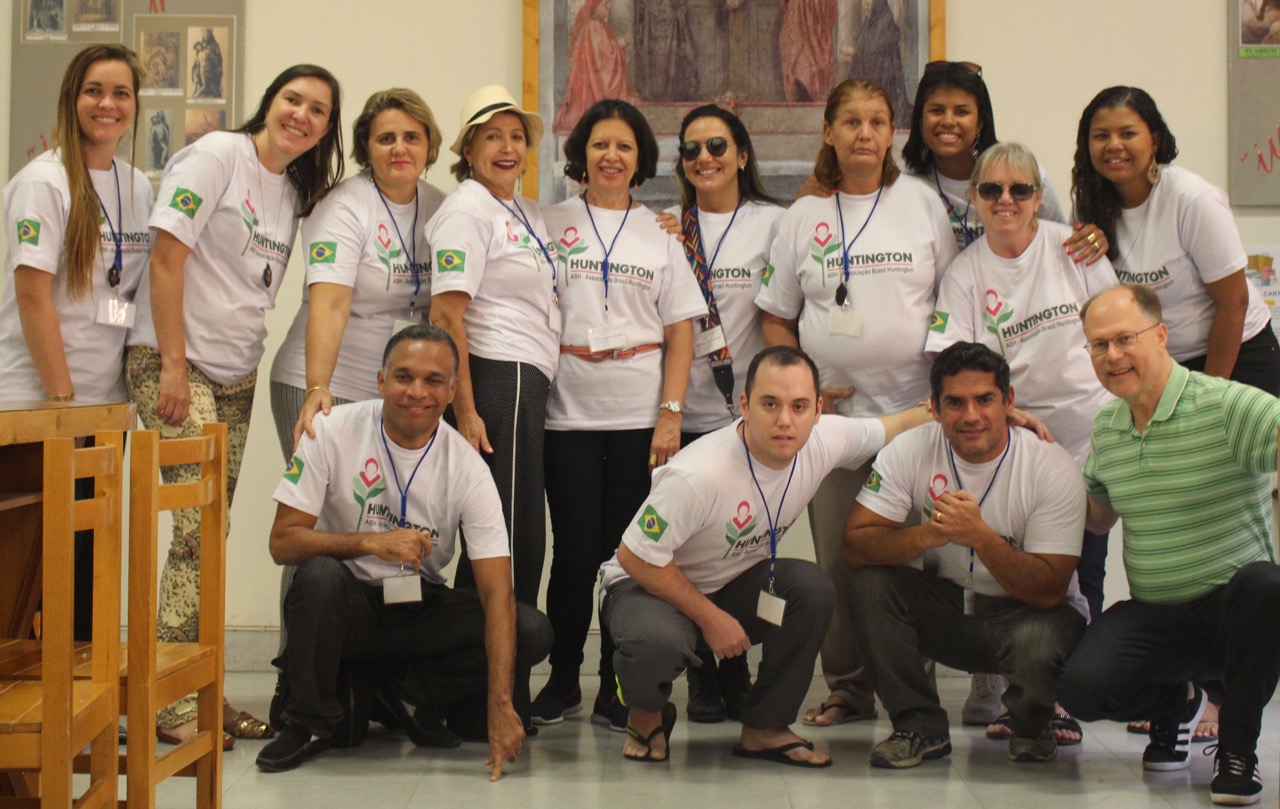
South American HD families preparing for a group photo at the Passionist fathers' monastery, May 19, 2017 (photo by Gene Veritas)
The reaction has
already been intense. We’ve had messages of just not support for the event, but
also financial bequests. Anyervi, the little 13-year-old who got the Neymar
shirt, he’s already had a wealthy benefactor in Italy who’s asked to sponsor
him now for the rest of his life. We’ve had other requests to help.
We had a meeting
just yesterday, which followed after our event, with industrialists who are
looking into ways in which they can help South American families, in particular
in Venezuela, where one of them has land he’s donating now with a view to
providing food. There was a clinicians’ meeting after that. They were coming up
with ideas for working together to get drugs and medical services into South
America. It’s already happening.

Anyervi of Venezuela (photo by Gene Veritas)
GV: Did you have a meeting
with a cardinal and/or other people in the Vatican afterwards?
CS: Yes, I
wasn’t present at them, but there have also been meetings with cardinals to get
across the points that Pope Francis made so eloquently and directly about how
this disease has been ignored.
And he admitted
it. He was very frank. The pope said and was implicitly admitting that his
church had failed. He didn’t want to say it like that, but he said these people
have been ignored. He didn’t say these people have been ignored, but not by the
Church. He said they’ve been ignored. That means they’ve been ignored by the
Church. And that’s a wonderful admission.
What we need to
do now is to insure that his words are now made into actions on the ground by
the cardinals, the archbishops, and the priests across not just South America but
all around the world to make it understood that this should be a disease that
no one should feel, as I said in my words there, that it is a sin. I spoke to
the pope yesterday. I said thank you for making clear the truth – one of the
truths that’s been omitted from this disease for centuries – which is that it’s
not a sin to have Huntington’s disease in your family.
GV: The pope mentioned the
issue of embryonic stem cells. Do you want to comment on that?
CS: It was a
little bit of a shame that he did that. It’s the one thing about that speech
that was a little bit disappointing. I don’t think he needed to get into that because
it wasn’t particularly relevant to that event.
Unfortunately,
many of the newspapers from around the world have taken that as a headline,
which is a bit of a shame. [The Pope stated that no scientific research, no
matter how “noble” its goal, “can justify the destruction of human embryos.”] Of
course, that’s an issue that’s still a stumbling block with the Catholic
Church. But I personally don’t think that for one second his mentioning that in
his talk should take one iota away from the fact that it was a resounding,
total success.

Pope Francis during the HDdennomore special audience (photo by Gene Veritas)
GV: Do we know who wrote
the pope’s speech?
CS: I don’t
know. I gave him three pages of notes that talked about what we go through,
including, in particular, the shame and the stigma. And certainly the themes
that were in that I saw in there. I don’t whether he wrote it or if he had
others. But they wrote it very, very well.
It was really, I
thought, brilliantly working in, as he would naturally, the point of mercy and
Jesus. The event yesterday personified yesterday more than any other event exactly
that new philosophy of his of putting mercy before doctrine, which is not a
popular one amongst many on the right.
But the fact is,
there were so many superlatives yesterday. There were 1,700 people there,
according to the Associated Press and Reuters. That was by far and away the
largest collection of people with regard to Huntington’s disease, by some
measure. There were 150 patients – at least – that were there, and probably a
lot more. That in itself is another record. There have never been that many
people in one room affected by Huntington’s disease. There could have been
people in there affected by disease that we didn’t meet.
There were at
least 27 countries represented. I don’t know whether that’s a record, but
certainly the other two are.