Showing posts with label genome. Show all posts

Wednesday, August 28, 2019

What if we could turn off the cause of Huntington’s disease?


What if scientists could simply switch off a mutated gene causing a debilitating neurodegenerative disorder like Huntington’s disease?

Known as gene (or genome) editing, that approach is a current hot research topic, generating hope for sufferers of genetic diseases like HD.

Gene editing will be the focus of a symposium on September 4 sponsored by life science start-up incubator Johnson & Johnson Innovation, JLABS (hereafter simplified as JLABS) and the Janssen Pharmaceutical Companies, the drug-discovery arm of Johnson & Johnson, in San Diego, CA.

At the sponsors’ invitation, I will give a presentation, based on my two decades as an HD advocate, on the health and social challenges faced by HD-affected individuals and their families. The two firms have also invited seven leading scientists and biotech executives to speak at the symposium, titled “Science Alliance: Silencing Neurodegenerative Diseases and Sensory Disorders with Gene Editing.”

HD community members can watch the live webcast of the event for free by registering at the event website and entering the discount code “HDCOMMUNITY” at check out. Attendance in person is $35 for the general public and $20 for students and academics, at the JLABS facility at 3210 Merryfield Row, San Diego.

Recent milestones in gene therapy “have ignited interest” in the field and “especially its application to neurological disorders,” the website states. Gene editing has opened the door to innovation in the treatment of diseases like HD, spinal muscular atrophy, and ALS, according to the organizers.

The website points out that, as the technology progresses, key questions are emerging, such as how to effectively deliver gene editing drugs to the brain.

Owned by Johnson & Johnson, JLABS provides labs, offices, marketing, education, and events for early-stage life-science companies unaffiliated with Johnson & Johnson. In San Diego, one of the world’s leading biotech hubs, it offers services to 60 companies; globally, JLABS serves 580 companies.

The pharmaceutical arm of Johnson & Johnson, the Belgium-based Janssen was acquired in 1961.

Advances in gene editing

Gene editing is different from gene silencing, the technique used in the Phase 3 Roche clinical trial currently in progress in the U.S. and a projected 17 other countries (click here to read more). Roche’s RG6042 is an antisense oligonucleotide, an artificial strand of DNA designed block the production of the huntingtin protein in brain cells.

With gene editing, scientists make changes in the actual DNA – a revolution in biomedical research.

The gene-editing technology currently getting the most attention – one already used in the search for HD treatments – is known as CRISPR. Scientists first observed CRISPR occurring naturally in bacteria in the 1990s. In 2002, scientists discovered additional DNA instructions called “Cas.” The combination CRISPR/Cas actually comprises the bacterial immune system. (Click here to read more.)

“There’s no equivalent of word processing software to edit genes,” then Ph.D. candidate Leora Fox (now a Ph.D.) wrote in HDBuzz in 2017. “To fix genes on a microscopic scale, one cell at a time, the faulty code has to be located and physically cut – and that’s what CRISPR/Cas does.”

To alter a gene, scientists need to insert CRISPR/Cas into the cells.


(Image credit: Ernesto del Aguila III, National Human Genome Research Institute, and Wikimedia Commons)

In a disease like HD, the goal is to use this mechanism to cut directly (that is, shorten) the defective, elongated gene. Researchers are also looking at other ways to deploy gene editing.

In recent years, HD research groups have used this technology to edit the HD gene in the brains of genetically modified “HD mice”. One group developed a technique that led to beneficial effects in mice, including the recovery of older mice that had already developed symptoms. (Click here to read more.)

Chinese researchers have used gene editing in human embryos to fix the mutation behind the blood disease beta-thalassemia, which reduces the amount of red blood cells. However, the embryos were not implanted. 

Gene editing is still far from use in human clinical trials. Among the challenges, scientists need to find ways to effectively deliver such a treatment to the brain and avoid inadvertent editing of other genes. (Click here to read more.)

(Late last year a researcher in China claimed to have used CRISPR to alter the genomes of twin baby girls through in vitro fertilization to enable them to resist potential infection from HIV. The news of this development sparked renewed controversy over the use of biotechnology to intervene in human life.)

The symposium participants

To explore gene editing in neurodegenerative and sensory disorders (difficulties with the five senses), JLABS and Janssen have invited seven researchers and executives to the September 4 symposium, including at least two with experience with CRISPR. They include:

Leah Aluisio, Associate Director, Janssen Research and Development;

Alexis C. Komor, Ph.D., Assistant Professor, Department of Chemistry and Biochemistry, UCSD; 

Young Jik Kwon, Ph.D., Professor, Department of Pharmaceutical Sciences, University of California, Irvine, and co-founder, Responsive Polymers Therapeutics, Inc., and Jupiter Therapeutics, Inc.;

Sanjay Mistry, Ph.D., Head of JLABS @ San Diego, Johnson & Johnson Innovation, JLABS;

Gerry Rodrigues, Associate Vice President, Allergan;

Arthur Suckow, Ph.D., CEO, DTx Pharma; and

Gene Yeo, Ph.D., MBA, Professor, University of California, San Diego, and co-founder, Locana and Eclipse Bioinnovations.

Their bios are available on the event website.

Imagining a cure?

As a speaker, I hope to portray HD’s devastating impact and the urgent need for effective treatment.

In the HD world, scientists avoid the word “cure.” HD is so complex that many have said a cocktail of drugs will be needed to target the multiple problems in the brain and elsewhere in the body.

For the first time, actually switching off or completely removing a mutation might enable us to imagine the way to a cure.


Gene Veritas (aka Kenneth P. Serbin) (photo by Yi Sun, Ph.D.)

Tuesday, March 24, 2015

The precious participation of the Huntington’s disease community in the quest for treatments: a report on the 2015 HD Therapeutics Conference

As long-awaited clinical trials of new drug candidates for Huntington’s disease get underway, scientists have intensified collecting information from research study participants to quickly and accurately test the effectiveness of the potential remedies.

This was a major theme of the 10th Annual HD Therapeutics Conference, held February 23-26 at the Parker Palm Springs hotel in Palm Springs, CA. (Click here to read my initial report on science and solidarity, filed during the conference.)

The event was sponsored by CHDI Foundation, Inc., a nonprofit, virtual biotech focused solely on developing HD treatments and the largest source of private HD research funding. Backed by wealthy donors, CHDI has an annual budget of about $100 million.

“The thing that I’m keying on is what I would call human data,” Robert Pacifici, Ph.D., CHDI’s chief scientific officer, told me in an interview on February 26. “Obviously when we do drug discovery we think about a variety of model systems – everything from worms to flies to zebrafish to sheep and songbirds and everything in between.

“But we both know that the only organism that actually has Huntington’s disease unfortunately is the human. So for a long time I’ve been saying that there’s nothing more precious and valuable to a drug hunter than an observation that’s actually made in the population that they seek to treat, in our case Huntington’s patients.

Dr. Pacifici recalled how genetic data from hundreds of people from dozens of families led to the discovery of the huntingtin gene in 1993. Thanks to those efforts, treatments aimed at lowering the amount of mutant huntingtin RNA and protein in the brain cells of HD patients are on the verge of entering clinical trials, he added.

“Now what we’re asking for is to really start getting more specific about the observations [in humans] that we want to make and how we’re going to leverage them,” Dr. Pacifici explained.

You can watch my interview with Dr. Pacific in the video below.


Key role of modifier genes

Dr. Pacifici cited two major examples of new human data revealed at the conference that will a have profound impact on the quest for treatments.

“We’re literally at the precipice of identifying what are modifier genes,” he said, referring to the research presented by Jong-Min Lee, Ph.D., of Massachusetts General Hospital. “It’s just incredibly exciting to me.”

An abnormally expanded huntingtin gene is the principal cause of HD, but other so-called modifier genes also help determine the age of disease onset.

“Why is it that one person’s Huntington’s starts earlier than another?” Dr. Pacifici asked. “That’s tragic.” More positively, it also means the other person’s onset starts later. “Well, that’s exactly what we want a drug to do.”

Human data has played a major role, he pointed out. With thousands of HD-affected people participating, researchers have been able to examine their genetic composition, involving not just their Huntington’s gene, “but their entire genome, to do what’s called a Genome Wide Association Study, or GWAS, and figure out what it is that’s different about individuals that causes one person’s Huntington’s to start earlier than another,” Dr. Pacifici explained.

In his presentation titled “Medication of Huntington’s disease by genetic variations,” Dr. Lee reported how the large research team seeking modifier genes has narrowed its search to chromosomes 3, 8, and 15. (Located in all of a human’s cells, the 46 chromosomes are long, twined strands of DNA containing a person’s entire genetic heritage.) According to Dr. Lee, chromosome 15 has both a “bad” and “good” modifier, with a six-year difference in onset between individuals having one versus the other.

“If we can identify that [good] gene and figure out how it’s doing that, then what we have is a very specific set of instructions for drug hunters to make a compound that does that same thing,” Dr. Pacifici said.


Jong-Min Lee, Ph.D. (photo by Gene Veritas)

Cheating a little bit with biomarkers

The second example involves cerebrospinal fluid (CSF), the liquid that bathes the brain and circulates up and down the spine. Researchers have been searching for HD-related biomarkers in samples of CSF taken from volunteers afflicted with the disease as well as so-called premanifest people, individuals who (like me) carry the gene but have yet to show classic, easily notable symptoms such as involuntary movements (chorea and other types).

Dr. Pacifici defined biomarkers as “a way of cheating a little bit” to get signals without waiting for the more time-consuming and more expensive later phases of a clinical trial.

The human brain can only be studied directly only after a person has died, as pointed out in a talk on CSF by Ed Wild, M.D., Ph.D., of the University College of London. Imaging methods such as MRI are helpful but very limited. So scientists are putting ever greater emphasis on finding signals in the CSF such as mutant huntingtin protein and other biomarkers.

CSF provides a “snapshot of what’s going on in the human brain,” Dr. Pacifici observed, adding that it might indicate in a clinical trial whether a huntingtin-lowering drug is having the desired effect.

Clinical trial administrators would still need to wait many months to get meaningful observations about actual effects on symptoms, but seeing what the drug does at the molecular level is a key first step.

“In other words, we don’t want to give the drug [. . .] and hope that after three years of waiting that we’re going to have an effect,” he said. “We want to know right away that that drug was doing the job that it was charged to do, in this case lowering huntingtin levels.”

A CSF study

Describing the analysis of CSF from HD patients in a research study of twelve individuals that he helped direct, Dr. Wild observed that the closer a premanifest individual was to probable onset, the higher the level of mutant huntingtin found in the CSF. Similarly, among affected individuals higher levels of the mutant protein correlated with worse symptoms.

Dr. Wild and other scientists are still striving to determine the specific origin of the mutant huntingtin found in the CSF. At this point they hypothesize that it comes from neurons, a specific type of brain cell.

Scientists aim to improve CSF collection efforts and obtain a clearer understanding of what occurs in the CSF through a new, CHDI-funded project called HDClarity. The initial research sites are at University College of London, the University of British Columbia, and the University of Ulm, Germany.

You can watch Dr. Wild’s presentation in the video below.


The rise of clinical trials

The need for clinical trial volunteers will increase dramatically as the number of trials grows rapidly.

With a total of nine active trials, 2014 had an “unprecedented amount of activity in clinical trials in Huntington’s disease,” Ray Dorsey, M.D., a professor of medicine at the University of Rochester and the president of the Huntington Study Group, stated in an overview of recent HD trials.

These trials included the two largest-ever regarding HD: a study of coenzyme Q10 with 609 participants and a study of creatine with 553 participants. Both were halted because of lack of efficacy, but helped scientists understand the need for better evaluation of substances before taking them into a trial, Dr. Dorsey noted.

Last year brought one of the few successes in HD clinical trial history: the highly favorable results of Auspex Pharmaceuticals’ testing of its compound SD-809, which reduces chorea substantially and with fewer and milder side effects than its predecessor drug, tetrabenazine.

Presenting a chart of clinical trial trends, Dr. Dorsey demonstrated that the number of HD trials is growing exponentially: from four trials in 1999-2002 to 28 trials in the period 2011-2014.

“I think we’re poised for success,” he concluded.


10th Annual HD Therapeutics Conference participants watch a presentation (photo by Gene Veritas)

Assessing the potential of gene-silencing

In reviewing the clinical trial outlook for 2015, CHDI’s consulting medical director, Bernhard Landwehrmeyer, M.D., Ph.D., noted the continued upward trend, with six active trials.

Dr. Landwehrmeyer described the plans for a Phase I gene-silencing clinical trial by Isis Pharmaceuticals, Inc., and Roche. This approach seeks to attack the causes of the disease at its roots (click here to read more).

Isis’s senior vice president for research, Frank Bennett, Ph.D., stated in his conference presentation that the trial would begin by the end of the second quarter, but Dr. Landwehrmeyer predicted it would start later in the year. It is only the very first step in gene-silencing treatments for HD, he stressed.

Nevertheless, he observed that many other companies and labs are working on their own versions of gene-silencing treatments for HD. The chart he displayed showed 14 other entities in addition to Roche and Isis.

“It’s important that we have such a rich toolbox in attempts to make gene-silencing a therapeutic reality,” Dr. Landwehrmeyer said.

He noted that the Isis/Roche trial is unusual because it must include symptomatic patients, who will receive the gene-silencing drug via a spinal tap. Typically a Phase I trial accepts only healthy volunteers because it is testing for safety and tolerability, not for efficacy.

The trial will take place at HD centers in England, Canada, and Germany that have in-patient intensive care monitoring facilities, he noted.

Dr. Landwehrmeyer said it was important to set realistic expectations for the HD community, which anxiously awaits good news about gene-silencing because of its potential to significantly impact the disease.

“You are NOT missing the boat, if you do not participate in the Isis study,” he said, referring to HD-affected individuals. Establishing safe and effective gene-silencing therapies for HD will still take “decades.

Once trials prove them to be safe and effective, these drugs can reach the market and become available to all HD families.


Bernhard Landwehrmeyer, M.D., Ph.D. (photo by Gene Veritas)

Big challenges remain

Dr. Landwehrmeyer also commented on the other trials taking place this year: Pride-HD (to test pridopidine); APACHE and Amaryllis (to test “Viagra for the brain”); LEGATO-HD (to test laquinimod); and a forthcoming trial in deep brain stimulation.

In all, he noted, at least 1,500 HD patients are expected to take part in clinical trials this year.

“That’s on the one hand fantastic,” he said. “But timely recruitment into these studies has become an issue.”

Some HD study centers are underutilized, while others are overloaded, he noted. The number of trial participants is further restricted by inclusion/exclusion criteria (for example, the particular disease stage of the patient). Pharmaceutical companies should enhance a “culture of cooperation” regarding trials, he said, and regional and national patient advocacy organizations need to activate their networks.

Enroll-HD, the global platform, research project, and family registry aimed at facilitating clinical trials and the discovery of treatments, recently reached a milestone with its 5,000th registrant, but needs to grow to as many as 30,000, Dr. Landwehrmeyer observed.

Hoping for an end to conferences and HD

The 10th Annual HD Therapeutics Conference had numerous other compelling presentations on the search for treatments. Click here to visit my video album, where you can view many of the presentations.

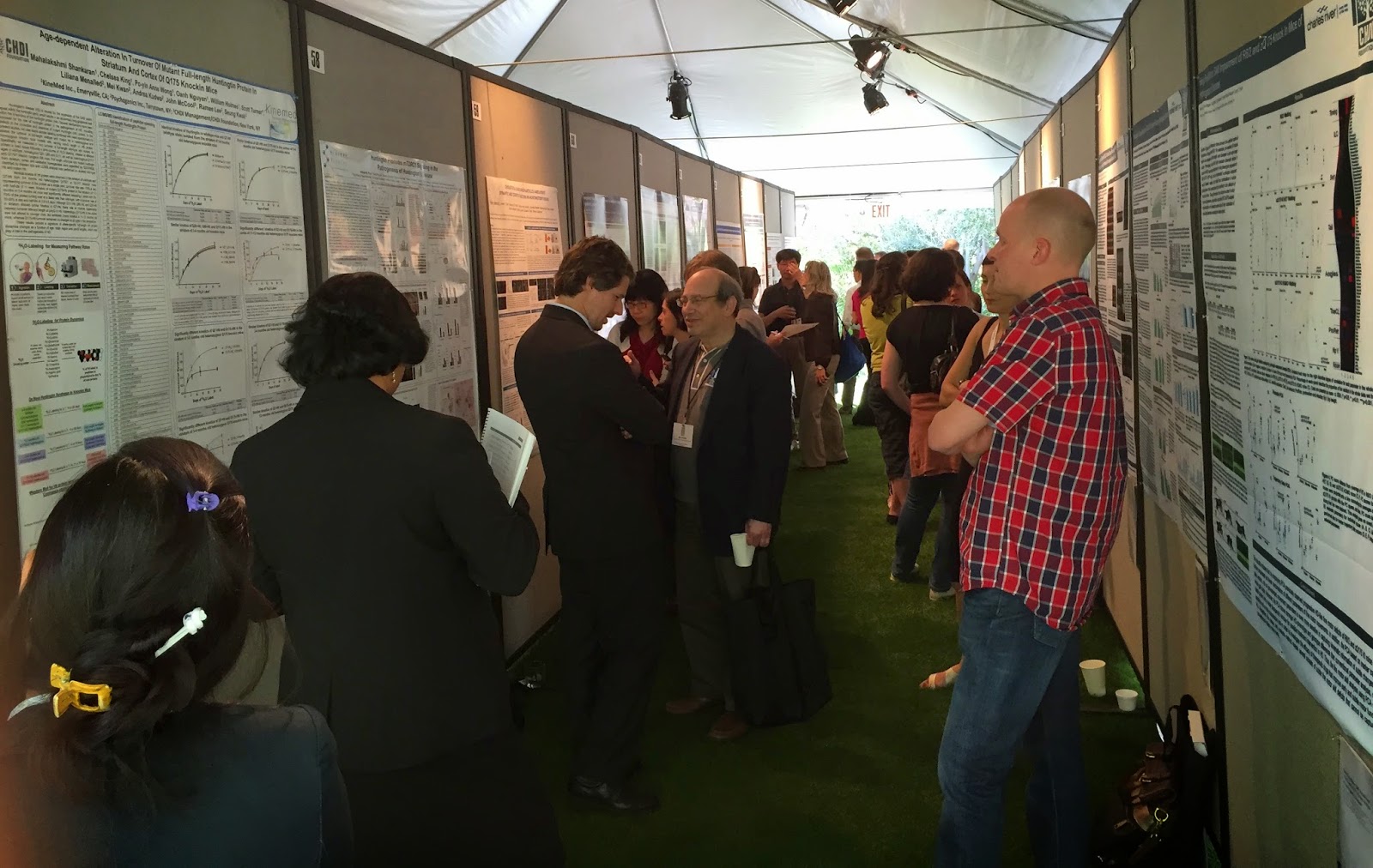
The conference also featured some 90 posters detailing cutting-edge HD research projects.


Conference attendees view posters of Huntington's disease research projects (photo by Gene Veritas)

“Obviously we’re a time-motivated organization, and we know patients are waiting,” Dr. Pacifici said. “So the fact that it’s taken us ten years to get to this stage is not necessarily something to celebrate. That said, I think we should pay homage to the progress that’s been made over that period of time.”

Dr. Pacifici observed that with well-designed clinical trials, “it’s really an exciting time” in the quest for treatments.

He said that he was struck by the courage and collaborative spirit of the community, from academia to the private sector to the families. He also thanked HD families and their supporters for their participation in research studies, clinical trials, and other activities.

“This isn’t a competition,” he declared. “This is an opportunity for all of us to enable each other, which I don’t take for granted, because one of the potential downsides of getting to the endgame – which we are – is that’s when people start to be a little more secretive and a little bit more protective. We saw here time and again even multinational pharmaceutical and biotech companies standing up at our conference and presenting new, unpublished findings so that everybody could benefit from them.”

Along the way, failures will occur, because drug discovery is a very inefficient process, he emphasized. (Only one in ten clinical trials results in a marketable drug.)

“That’s frustrating,” he recognized. “Don’t be disheartened. Know that we have a large and deep portfolio [and] that we’re going to learn from each one of these failures. I think, and I have every confidence, that we’re going to start getting real positive signals that then we can build on. And that’s when the fun starts.

I hope we’re sitting here together again next year for the eleventh conference, but I also hope we’re not sitting down here for too many more. And I mean that in a positive way.”

* * *

For additional coverage of the conference, visit HDBuzz.net.

(Disclosure: I hold a small number of shares of stock in Isis Pharmaceuticals, Inc.)

Wednesday, March 06, 2013

The Brain Activity Map Project: short- and long-term prospects for Huntington’s disease research


The ambitious, recently announced national effort to map the circuitry of the brain and deepen understanding of its function could bring valuable new knowledge about what goes awry in Huntington’s disease-affected brains. Still, the project likely won’t have a practical impact on the search for effective treatments for years or perhaps even decades.

That’s the initial assessment from three leaders in the search for HD treatments in reaction to reports that the administration of President Barack Obama will include a multi-year, public-private-academic brain mapping project in the next federal budget. The official announcement, following Obama’s February 13 State of the Union remark about the importance of brain mapping, is expected this month, although political wrangling over the budget could cause a delay.

“Anything that teaches us about how the brain works will undoubtedly tell us something about how HD makes the brain dysfunction,” said Simon Noble, Ph.D., the director of scientific communications for CHDI Management, Inc., the firm that furthers the goals of the CHDI Foundation, Inc., the non-profit, multi-million-dollar search for HD treatments. “At the moment, it’s difficult to predict what will come out of this for HD.”

Dr. Simon Noble (photo by Gene Veritas)

Compared by the president and scientists to the $3.8 billion Human Genome Project (1990-2003), which produced a complete map of our genes, the so-called Brain Activity Map Project (BAMP) would aim to record and map the firing of the brain’s 100 billion or so neurons.

Fifteen years to a mouse study

This year marks the 20th anniversary of the discovery of the HD gene, a key step in the Human Genome Project. Initially, scientists thought that discovery would lead to potential treatments just a few years later. However, the task has proved far more complex, although a number of clinical trials are in progress or in planning, including cutting-edge gene-therapy approaches made possible by the discovery of the gene.

The scientists behind the BAMP estimate that mapping a significant part of a live mouse brain would be achieved 15 years into the project. Experiments in humans necessarily would take place years later, after testing in non-human primates.

“While the Brain Activity Map is an important and worthy project, I hope it’s irrelevant to Huntington’s disease,” Robi Blumenstein, the president of CHDI Management and a participant in an August 2012 BAMP planning session at the White House Office of Science and Technology Policy, said of the project. “Because mapping the brain is such a hard problem, the BAMP is a complex project on a long-time scale. I hope that we can deliver treatments before it becomes useful to us.”

Scientists say that the large number of neurons and the complexities of the brain, a living organ, will prove far more difficult to measure and map than the much smaller amount of inanimate material in our genes. Furthermore, because HD is a genetic disease, the Genome Project in general and specifically the discovery of the HD gene have been the major, initial breakthroughs in the search for treatments.

In 1923 one scientist referred to the connections among neurons as “impenetrable jungles where many investigators have lost themselves.” Since then, little progress has occurred. In a June 2012 article, six leading scientists identified as leaders of the BAMP likened the current technology of measuring just a few neurons at a time to watching an “HDTV program by looking just at one or a few pixels on a screen.”

Futuristic tools and techniques

“I think it’s exciting,” said George Yohrling, Ph.D., the director of medical and scientific affairs for the Huntington’s Disease Society of America. “The brain is incredibly complex, as we all know. Once we know the details of how all the different neuronal pathways and networks are talking to each other in the normal and diseased states, it could help guide us to effective treatments. In theory, all of the disease areas  Parkinson's, Alzheimer's, HD – will benefit from the successful brain mapping exercise.”

Dr. George Yohrling (CHDI photo)

However, Dr. Yohrling emphasized that the project’s ability to furnish such information will depend on the development of new research tools. At first, such tools cost enormous sums, but come down over time, he said. The first sequencing of the genome cost billions and took more than a decade, whereas today sequencing takes three weeks and will soon cost just $1,000.

"The point of the tools is key," he explained. "We see it every day in science. You can look back 10, 15 years of how we used to do certain things in the lab and think, wow, this is so archaic!"

Indeed, the BAMP scientists’ article pointed out that the project – with the gargantuan goal of imaging “every spike from every neuron” – will require an entirely new set of futuristic tools and techniques resulting from the “convergence of biotechnology and nanotechnology.” They envision such innovations as three-dimensional imaging, biologically inspired computational devices, nanoprobes, DNA molecules acting as sensors, and “small wireless microcircuits, untethered in living brains, for direct monitoring of neural activity.”

Whether nanoscience can shed light on the HD disease process is a “bit of a black box at the moment,” Dr. Noble observed. “A lot of these things will be done in mice first. Working in a human brain is extremely difficult, if not impossible. We’ll have to rely on other systems and post-mortem brains.”

If such technology becomes feasible, it might help “identify early biomarkers (signs)” of HD, Dr. Yorhling said. Biomarkers are crucial for conducting clinical trials of potential treatments.

Keeping HD in the loop

Despite the likely minimal impact of the BAMP on HD research in the short run, both CHDI and HDSA plan to carefully track its progress and seek opportunities to apply its findings and even potential inclusion in some facet of the project.

“CHDI is keeping a close eye on how these grand projects develop and always considering ways that we might be involved,” said Dr. Noble, referring to the BAMP and also a new brain-research initiative co-founded by former Rep. Patrick Kennedy known as One Mind for Research.

As Dr. Noble noted, the idea of brain mapping intersects with CHDI’s new emphasis on systems biology.

“The brain is a system, just as the body is a system,” he said. “Brain mapping is a really difficult problem, but one that’s well worth pursuing. The brain is the final frontier. It’s the least understood system in the human.”

If the BAMP came to include disease-specific mapping, HDSA would advocate for the inclusion of HD, Dr. Yohrling said. He also held out the possibility of the HD research community someday teaming with patients to carry out an HD-specific brain-mapping project, which could become feasible as the techniques advance and become accessible to more researchers.

Saturday, February 16, 2013

Pope Benedict XVI’s resignation: a witness to aging, a signal for a new bioethics


Undoubtedly, history will most remember Pope Benedict XVI not for any accomplishment or lack thereof, but for his courageous and humble decision to become the first head of the Roman Catholic Church to abdicate in seven centuries – and only the fifth in 2,000 years of Catholicism.

One cannot fail to be moved by the 85-year-old leader’s recognition that he no longer possesses sufficient “strength of mind and body,” leaving him unable “to adequately fulfill the ministry entrusted to me.”

He made the announcement on February 11. He will leave his post on February 28. Shortly thereafter, a conclave of cardinals, the top leaders of the Church, will meet to select a new pope from among themselves.

Benedict XVI’s resignation is a witness to aging and human mortality.

No matter what our beliefs about religion, this simple but profound action gives us pause to reflect on how we can accept our own human limitations.

For the Huntington’s disease community, it also provides an opportunity to recall the ethical, social, and spiritual dimensions of our collective struggle.

Turning over the keys

In a world with many governments and institutions ruled by old men unwilling to release their grip on power, Benedict XVI has voluntarily relinquished control of the Church – the epitome of male dominance – to go live in a building that has until now served as a cloistered convent.

Pope Benedict XVI 

In a global, image-conscious youth culture offering plastic surgery and hair implants to the middle-aged and elderly, Benedict XVI has said that it’s okay to age.

Many elderly people resist giving up freedoms such as the pleasurable and powerful experience of driving a car until an adult child worried about safety takes away the keys or gets a court order to declare the parent incompetent.

Benedict has turned in the keys on his own, saving others from potentially embarrassing and even dangerous predicaments and opening the door to potentially more youthful leadership in greater tune with today’s world.

According to the New Testament of The Bible, Jesus gave the Apostle Peter the keys to the Kingdom of Heaven. The historical successor to Peter, Benedict XVI will pass on those spiritual keys to a new pope, another illustration of the profound humility of his abdication.

Each day, HD-affected people and their caregivers strive together to strike a balance between the individual patient’s desires and the need for proper care. We, too, face the terrible burden of wondering about the right moment for the caregiver to take over the keys.

Gene-positive, asymptomatic people like me and those with early symptoms wonder how long we can hold onto our keys, and we worry greatly about burdening our families.

Ultimately, those keys represent our lives and our hopes for a peaceful death and the possibility of a hereafter – a place without the suffering of Huntington's disease.

Revealing frailty

Rather than leave the world the spectacle of a pope struggling to hold onto the reins of power while ensconced in the palatial papal dwellings, Benedict XVI may instead ultimately provide the world the image of a retired pope hospitalized or sheltered in what could effectively become a nursing home, with caregivers assisting him with basic needs.

If Benedict XVI develops or already has Alzheimer’s or some other neurodegenerative disorder, rather than be hidden behind a Vatican bureaucracy nervous about a transition of power and the Church’s image, his condition will become known to the world.

His predecessor, Pope John Paul II, suffered from Parkinson’s disease. Despite his symptoms, John Paul II kept up his busy schedule of trips and public appearances. He also advocated for greater research towards a cure.

The HD community has long understood the similarities between the frailties caused by Huntington’s and those of Alzheimer’s, Parkinson’s, and other disorders. We can stand with Benedict XVI as he faces the possibility of his own neurodegenerative symptoms, and we will continue to advocate for remedies for HD, still untreatable but the focus of intense research efforts.

Revising bioethics

The social impact of Huntington’s disease and the efforts to understand and treat it have thrust our community into the forefront of the biotechnological revolution.

As I recently wrote, “The story of Huntington's is the story of our time. Huntington's was one of the very first diseases for which a genetic test was developed. As knowledge increases about numerous other health risks, medical ethics must undergo profound revision, and a genetic-rights movement must arise. To borrow one scholar's phrase, disease-gene carriers like me are ‘moral pioneers’ on the genetic frontier.”

Benedict XVI’s witness to aging and mortality comes at a time when the Church hierarchy, Catholic believers, and society in general have struggled mightily with other life-and-death issues such as birth control, abortion, embryonic stem cell research, and mercy killing.

Benedict XVI shored up traditional Church teachings on these matters, but he also belonged to a generation of Church thinkers faced with the challenge of formulating a system of Catholic bioethics to meet both the ever-expanding promise and dangers of the biotechnological era.

Thus, Benedict’s witness to aging could help the Church forge ahead with a carefully conceived and balanced bioethics.

By suddenly opening up the Church to the selection of a new pope, Benedict XVI has created potential space for new ideas regarding bioethics.

If a pope can humbly resign, perhaps the Church can humbly admit the need for greater flexibility.

Responding to challenges

Pope John XXIII (1881-1963, pontiff 1958-1963), a simple man of peasant origins not expected to make waves, surprised the world in 1959 by calling the Second Vatican Council, which took place from 1962-1965. This June 3 marks the 50th anniversary of John XXIII’s death.

Vatican II brought the Church into the modern world by carrying out the most sweeping reforms in the history of Catholicism. Those reforms included the end of the universal Latin Mass (in favor of the Liturgy in local languages), initiation of dialogue with other religions as well as with antagonistic political creeds such as Marxism, and greater participation by laypersons in the Mass and administration of the Church.

Vatican II responded to a great malaise in the Church in the 1950s caused by censorship of innovative ideas and an exaggerated dependence on tradition and ecclesiastical authoritarianism. Today a similar malaise – created by the current sex-abuse scandals and cover-ups involving priests, bishops, and even cardinals – plagues the Church.

In the late 1960s, powered by the energy of Vatican II, the Church seemed on the rebound.

Future reforms

As is well known, Benedict XVI worked hard to contain and even reverse the trends unleashed by Vatican II.

However, unlike the 1960s, when so much seemed possible for the Church, today the institution suffers from a crisis of credibility.

Liberal Catholics like me have again begun to urge that the Church call for a Vatican III to address such issues as the sex-abuse scandal and the ordination of women (for another example, click here). The Church also needs reform on issues such as obligatory priestly celibacy, the ordination of married men, and hypocrisy about homosexuality in an institution with large numbers of mainly closeted gay clergy.

A Vatican III was virtually impossible under Benedict XVI as active pope. However, his radical departure into retirement has now made a council possible. It may not matter if the new pope is another conservative, because Benedict XVI’s powerfully symbolic resignation, his witness to aging, has signaled to the leadership that it can and should explore new avenues, new modes of action.

Bioethics could and should become the centerpiece of a Vatican III.

As the Church clamored for peace and social justice in the 1960s, today it can take a new and invigorating leadership role in helping the world adapt to the challenges of the genome, the environment, new forms of human relationship, and the immense caregiving burden created by science and medicine’s ability to prolong the life of the body ahead of the mind.

In its long and often wise history the Church has evolved gradually and deliberately. It can now begin to embrace the postmodern world.

We in the HD have also born witness – to immense suffering, to an ambitious scientific effort to improve the lives of people through the search for treatments and cures, and to hope. We have much of our own wisdom to offer the Catholic Church, and the world, in the quest for a new bioethics.

(A similar version of this article appeared today in Portuguese in the Brazilian newspaper O Estado de S. Paulo.)