Friday, May 19, 2017

Pope Francis declares: Huntington’s disease should be ‘hidden no more’

Wow! In a stirring speech at the Vatican transmitted globally, Pope Francis declared to the world on May 18 that Huntington’s disease should be “hidden no more!”

“It is not simply a slogan, so much as a commitment that we all must foster,” the head of the Catholic Church said of the idea embraced by the roughly 1,500 HD family members and supporters gathered at the Paul VI Audience Hall just a few yards from St. Peter’s Square. They had gathered for "HDdennomore: Pope Francis's Special Audience with the Huntington's Disease Community in Solidarity with South America."

“The strength and conviction with which we pronounce these words derive precisely from what Jesus himself taught us,” the pope continued in Italian, as Spanish and English speakers listened to a simultaneous translation on headsets. “Throughout his ministry, he met many sick people; he took on their suffering; he tore down the walls of stigma and of marginalization that prevented so many of them from feeling respected and loved.”

Click here to read the full text of the speech in English.

After the speech, the highly popular and charismatic Pope Francis stopped to greet, hug, kiss, console, and have selfies taken with about 300 HD family members, HD researchers, pharmaceutical company representatives, and dignitaries seated in the front rows of the auditorium.

Overtaken with the pope’s powerful presence, some people cried uncontrollably as he stood before them.

The emotional charge traveled across the crowd. I welled up with tears as he got closer to my family and me in the third row.

After greeting my wife Regina and daughter Bianca and putting his hands on the head of my 78-year-old mother-in-law Lourdes, Pope Francis arrived at my place.

As I had planned, I showed the pope a picture of my mother Carol Serbin and father Paul Serbin, well-dressed and smiling in a formal pose, a photo taken after she had already been diagnosed with HD.

“My mother died of Huntington’s,” I told the Pope in his native tongue of Spanish. “My father cared for her for twenty years.”

I gave Francis a copy of each of my main books on the history of the Church in Brazil, explaining the theme of each with a brief phrase: priestly training and the Church’s struggle against the dictatorship in Brazil. I knew the themes were dear to him as the leader of the world’s Catholic clergy, respected colleague of Brazilian Catholic leaders and their flocks, and untiring proponent of social justice.

Francis said nothing, but he looked me in the eyes.

Somehow, my hands were now firmly holding the pope’s, and I told him: “Many thanks for supporting our community!”


Gene Veritas (aka Kenneth P. Serbin) with Pope Francis, May 18, 2017. In foreground, with back to camera, Bianca Serbin (photos by Regina Serbin).

Then Francis moved on to the next person.

When he finished circulating among the people, Francis returned to the stage, looked back at us and waved, and then exited with his papal entourage.

After listening to some closing music by performers from HD families, we filed out of the auditorium.

As I wrote in a blog note my cell phone, I felt “drunk with excitement” as I left with my family, hugging and taking a selfie with event co-organizer and HD global advocate Charles Sabine, greeting fellow advocates from South America, and at one point becoming disoriented and nearly tumbling to the ground. Regina became concerned that I would injure myself.

We had done it! We had witnessed Pope Francis decisively place Huntington’s disease on the world agenda.


Above, the audience at the May 18, 2017, papal audience on Huntington's disease. Below, Gene Veritas and Charles Sabine (photos by Gene Veritas).


(Click here to watch the audience on the Vatican’s YouTube channel. In my next article I will comment further on Francis’s HD speech and explore in detail the event and its impact.)

(My trip to Rome was made possible by the College of Arts and Sciences, the Frances G. Harpst Center for Catholic Thought and Culture, the International Center, and the Department of History of the University of San Diego. I am grateful for the institutional and moral support of my colleagues and students.)

Wednesday, May 17, 2017

Fear not, Huntington’s disease families – Pope Francis has our backs


In just a few hours, at a historic meeting at the Vatican, Pope Francis will offer words of encouragement to the Huntington’s disease community, aiming to make this deadly, incurable neurological disorder “hidden no more.”

Francis is scheduled to arrive at the Paul VI Audience Hall, just a few yards from St. Peter’s Basilica in Vatican City, at 11 a.m. Rome time.

The organizers of “HDdennomore, Pope Francis’s Special Audience with the Huntington’s Disease Community in Solidarity with South America,” have enlisted the pope’s leadership in removing the shame and stigma associated with HD.

The event will be streamed lived in English at www.HDdennomore.com and on the Vatican’s YouTube channel, www.youtube.com/vatican. (There will also be Vatican broadcasts in Italian, Portuguese, and Spanish.)

(Click here and here for background and details of the event).

A global meeting

The event will focus especially on four impoverished HD families from Argentina, Colombia, and Venezuela. They arrived in Rome on May 15 and have been touring the city, with some experiencing delights such as ice cream for the first time. The president of the Italian Senate gave the families a welcoming speech in the Senate chamber.

More than 30 HD family members have also arrived from Brazil.

Open to the entire HD community, HDdennomore has drawn advocates and supporters from more than 20 countries.


Gene Veritas (aka Kenneth P. Serbin) in St. Peter's Square (family photo)

A commitment to the marginalized

I arrived in Rome with my family late on the night of May 10, feeling great anticipation about the papal audience.

On the plane, I continued reading historian Austen Ivereigh’s biography of Francis, The Great Reformer: Francis and the Making of a Radical Pope.

“Francis’s deep commitment to the poor and marginalized has increased my expectation that he will lift the spirits of the HD community and help pave the way for new and better ways of caring for the HD-stricken and their families,” I reflected in a May 11 Facebook posting. “No matter what our faith, Francis’s words echo the struggle of the HD community to care for our loved ones and to make this disease ‘hidden no more.’”


A graffiti artist's rendition of Pope Francis as Superman (photo by Gene Veritas)

Getting ready for the big moment

We arrived more than a week before the audience in order to become acclimated to Rome and to recover from the nine-hour jet lag between San Diego and Italy. I hope I’ve minimized the risk to my brain.

HDdennomore will start at the moment I would normally be going to bed in California. Huntington’s disease sufferers experience problems with their circadian rhythm, which regulates sleep and other bodily functions. Researchers recommend that HD people and even HD gene carriers like me avoid jet lag and go to sleep around the same time each night.

My wife Regina, daughter Bianca, and I have spent part of the time leisurely touring Rome, a bustling yet highly welcoming city with some of the world’s greatest artistic and archeological treasures, a culinary paradise, and, of course, the seat of world Catholicism. Regina's mother Lourdes has also joined us from Rio de Janeiro.

Now we’re getting ready for the big moment: we will meet Francis personally and hope to share with him our family’s HD struggles.


Regina Serbin (left), Bianca Serbin, Maria de Lourdes Alves Barros (Regina's mother), and Gene Veritas at the Roman Forum (family photo)

Forging important new bonds

This afternoon I visited the Passionist fathers’ monastery, where the Argentine, Colombian, and Venezuelan HD families are lodging, as well as some of the Brazilians.

After greetings and introductions, I met with Associação Brasil Huntington (ABH) president Vita Aguiar de Oliveira and several HD families to answer questions about the historic Ionis Pharmaceuticals gene-silencing clinical trial. We discussed the difficult challenges facing HD families such as genetic testing.

We also began planning for ways to take advantage of the “onda do papa,” the “papal wave” of publicity and renewed advocacy hopefully to be initiated by the audience with Francis.

One of the participants, Samila Cristina, pointed out the importance of a network of support in families’ efforts to cope with HD. (Her family won an ABH drawing that provided a patient and caregiver with airfare to Rome.)

Indeed, after the 90-minute encounter I felt as if I had attended my local HD support group in San Diego: once again I recalled the fact that I carry the deadly HD gene, but I also felt strength from the new bonds forged with these fellow members of the extended HD family.

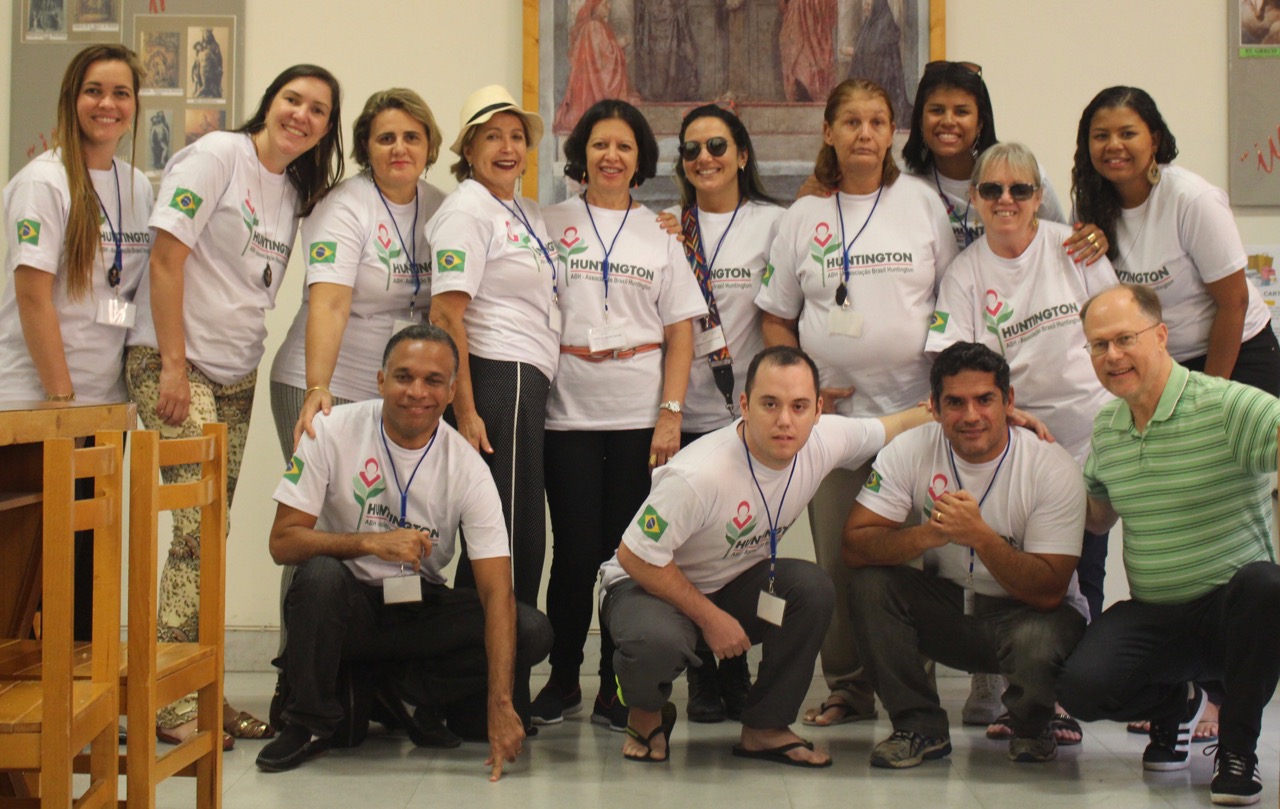
Afterwords Samila’s HD-afflicted mother Teresinha presented me with two ABH/HDdennomore t-shirts.


Above, Gene Veritas (in green shirt) and the Brazilian HD families at the Passionist fathers monastery. Below, Teresinha presents Gene Veritas with an ABH/HDdennomore t-shirt (personal photos).


Entering the spotlight, inspiring the world

As the moment approaches for the HD community to enter the world spotlight, it’s time to overcome the fear that has blocked our community from coping with and finding the cure to HD.

“We face a myriad of challenges, including genetic testing, family planning, family tensions, shame, the devastating symptoms, and the huge caregiving burden,” I wrote in a May 15 Facebook posting. “Be not afraid! Pope Francis has our backs! HD must be ‘hidden no more!’”

With so many unable to attend because of the distance, cost, and challenges of HD, I am enormously privileged to have been invited to the audience.

On Facebook, I also recalled how another, non-HD-related health crisis in our family in late April nearly led me to cancel our trip.

As that crisis was successfully resolved, I was reminded of the many other people suffering from difficult diseases, including genetic disorders. My family and I will take a small religious keepsake to the papal audience for the friend of a friend in the U.S., a young woman who suffers from two rare genetic disorders.

Indeed, I hope that Pope Francis’s gesture to the Huntington’s community can inspire those suffering from all diseases to strive for a world where care and cure trump stigma and, perhaps even worse, indifference.

(My trip to Rome was made possible by the College of Arts and Sciences, the Frances G. Harpst Center for Catholic Thought and Culture, the International Center, and the Department of History of the University of San Diego. I am grateful for the institutional and moral support of my colleagues and students.)

Sunday, April 09, 2017

Preparing for the meeting with Pope Francis, a heartening milestone in the Huntington’s disease movement


Ever since I received the electrifying invitation to meet Pope Francis I, my adrenaline has not stopped flowing.

I will be one of 50 credentialed guests at the historic May 18 papal audience with Huntington’s disease families at the Vatican.

After global HD activist and papal event organizer Charles Sabine called with the news on March 3, I immediately shifted my own advocacy into high gear.

That night I dreamt vividly of walking alongside the pope, the leader of the world’s 1.2 billion Catholics.

Over the next ten days, which coincided with my spring break at the University of San Diego (USD), I dropped everything – even exercise some days – to write a detailed post on the event (click here to read more).

Sabine and other organizers have christened it “HDdennomore: Pope Francis’ Special Audience with the Huntington’s Disease Community in Solidarity with South America,” to involve families primarily from Argentina, Colombia, and Venezuela. The name means HD “Hidden No More” or “Oculta Nunca Más” in Spanish.

I have also helped coordinate efforts to include families and advocates from Brazil, which has the world’s fifth largest population and an estimated 20,000 HD patients. My wife Regina, who is from Brazil, and our daughter Bianca will accompany me to Rome. So far, about 30 Brazilians plan to participate, including my mother-in-law, who resides in Rio de Janeiro. The Brazilian advocates will also invite to the audience key Catholic bishops from their country.

Ty, #PopeFrancis!

On March 13, the day HDdennomore was officially announced, I shared the news with colleagues and administrators at USD, a Catholic institution that welcomes people of all faiths and emphasizes the quest for social justice.

“Because of the stigma associated with the disease, HD families often remain in the terrible and lonely ‘HD closet,’” I wrote in an e-mail. “With the pope's blessing and recognition, we can liberate HD sufferers from the shame and stigma and move on to finish the hard work of developing a cure!”

I later shared with them my tweet to Francis: “Ty, #PopeFrancis! Meeting #Huntingtonsdisease victims 5/18. End stigma, shame. #HDdennomore @HDdennomore http://bit.ly/2nnqAnR @Pontifex.”


On April 4, I briefly explained the significance of the papal audience during a CCTC-sponsored faculty-student roundtable on Catholic news. In September, I will give a public, CCTC-sponsored presentation on my trip and HD’s profound bioethical and faith-related implications.

I have also reached out to the Diocese of San Diego in the hopes of fostering collaboration with the San Diego Chapter of the Huntington’s Disease Society of America.

HD’s spiritual ramifications

As I write this article, I still can’t believe that I’m actually going to meet Pope Francis! I feel great personal satisfaction about meeting a person who wields both great religious and political influence – and who can bring unique, global attention to HD.

Many Catholics hope to at least see a pope in their lifetimes. In 1979, from a distance, I saw the highly charismatic Pope John Paul II during a speech he gave in New York City. In 1990, I attended a Catholic Church symposium in Rio featuring then Cardinal Joseph Ratzinger, the future Pope Benedict XVI.

This time, if all goes as planned, I will meet the pope in person.

In the coming weeks, I will contemplate what I want to tell Pope Francis.

As an introduction and sign of appreciation, I will give Francis copies of my two main books on the history of the Brazilian Church.

I’ll also be thinking about the long-term ramifications of this event for the HD cause, Catholicism, and human solidarity both in and out of the context of religious faith. As Francis himself stated recently, many Catholics act hypocritically, failing to follow the teachings of their faith. “How many times have we all heard people say ‘if that person is a Catholic, it is better to be an atheist,’” he said.

HD affects men, women, and children from all parts of the world. As a medical condition, it devastates with no correlation to any religion.

At the same time, the fight against HD clearly involves spiritual questions for which people hunger for answers.

Although blog viewership statistics can mean many things, those for this blog provide some interesting indicators of that hunger. Until my previous posting, on the papal audience, the all-time leading article was my 2010 piece titled “God, Huntington’s disease, and the meaning of life,” with more than 20,000 views – more than double the next most popular article, about the historic launching of the Ionis Pharmaceuticals, Inc., gene-silencing clinical trial in 2015.

In less than four weeks, the article on Francis has had more than 28,000 views.

I’ll revisit the theme of the HD movement’s spiritual dimension in future articles.

Remembering the HD warriors

Most importantly, in meeting Pope Francis I want to bear witness to my experience as “Gene Veritas,” the HD gene carrier who remained painfully hidden from public view for nearly two decades and lost his mother, Carol Serbin, to the disorder in 2006 at the age of 68.

I also want to recognize the valuable contributions of – and the need to increase support for – caregivers such as my father Paul Serbin, the “HD warrior” who daily looked after my mother during her nearly two-decade struggle. He died with a broken heart in 2009.

I’ve been channeling my parents a lot. I imagine them standing beside Regina, Bianca, and me, all of us smiling as we meet Francis. As devout Catholics, they would have been thrilled to meet him.

They’ll be there in spirit.

I will present Francis with a photo of my parents and ask him to pray for their souls.


Paul and Carol Serbin (family photo)

Ending shame and stigma

The HDdennomore organizers expect as many as 2,000 members of the HD community from around the globe to take part in the audience, and they hope for even more.

The event will take place in the Paul VI Audience Hall, just a few yards from St. Peter’s Basilica in Vatican City. It seats 7,000. The event starts at 10 a.m. Doors open at 8 a.m. All potential attendees should register at http://HDdennomore.com, which is providing updates via e-mail, Twitter, and Facebook.

The site also has videos featuring the South American families invited to meet the pope, as well as information about HD, discounted lodging, and other aspects of the event.

The organizers revealed that 15-year-old juvenile HD patient Brenda, a native of Buenos Aires, Francis’s birthplace, will hand a vellum scroll to the pope during the meeting. It will contain a pledge in English, Spanish, and Italian:

Huntington’s is a fatal genetic disease. It has no cure.

For too long, shame and stigma have afflicted HD families, forcing them to hide the illness to the detriment of the health, hope and dignity of those affected by the disease.

Nobody should feel shame about the existence of Huntington’s disease in their family.

It is time for Huntington’s to be HDdennomore!


Brenda and her aunt (personal photo) 

A time for joy

Huntington’s disease forces families to face a grim reality. Like so many other HD gene carriers and untested at-risk individuals, I saw my own future when looking into the genetic mirror represented by my mother’s condition.

HDdennomore will mark a milestone in the HD cause.

It will provide a stark contrast to the anguish felt by so many.

For the first time in my family’s long fight against HD, I feel joyful. I’ve smiled a lot about the fact that my family and I will meet Pope Francis.

More importantly, I’m thrilled that our HD community will receive recognition and new hope in its struggle to overcome the disease and assist scientists in the search for badly needed treatments.

Who knows? Perhaps Francis, through his kindness, wisdom, and faith, will help bring all HD families out of the terrible and lonely HD closet – and provide new momentum for the scientific progress necessary for the miracle of a cure.