Showing posts with label Gene Veritas. Show all posts

Saturday, January 04, 2025

Savoring 20 years of my Huntington’s disease blog


This month I am celebrating the 20 years of this blog.


I began At Risk for Huntington’s Disease on January 10, 2005, wanting to “squeeze as much life into my days as possible” before experiencing the debilitating HD symptoms that led to my mother’s death a year later. Because I lived in what I called the “terrible and lonely HD closet” – fearful of genetic discrimination – I used the pseudonym “Gene Veritas,” “the truth in my genes.” That name reflected the fact that I had tested positive for the HD gene in 1999.


My mother died at 68, after two decades of debilitating symptoms, which was very painful to watch.


I turned 65 last month. By this age, I had expected to have full-blown HD, which would have left me unable to work, drive, or write.


But, according to my latest neurological checkup, I don’t yet have apparent HD symptoms!


In general, the more abnormal the gene, the earlier the age of disease onset. My mother and I have the same gene mutation, suggesting a similar disease path. However, although my mother’s symptoms started in her late 40s, one or more modifier genes, the functions of which were discovered a decade ago, have perhaps delayed my disease onset.


This article is number 336. Each day of good health is a blessing.


Gene Veritas (aka Kenneth P. Serbin) with his blog (photo by Regina Serbin)


The impact


In 2012, I exited the HD closet by publishing an essay – and using my real name, Kenneth P. Serbin – in The Chronicle of Higher Education. It was titled “Racing Against the Genetic Clock.” Going public opened new vistas of advocacy and enabled me to blog with greater transparency.


In December 2022. I published a detailed analysis of the blog in “Striving for a Realistic and Unapologetic View of Huntington’s Disease” in the Journal of Huntington’s Disease. It described how the blog has helped give voice to the HD community by exploring the major challenges faced by HD families, becoming a key reference for those families, and chronicling the quest to defeat the disorder.


As I observed, the blog has also “helped document the new and harrowing experience of living in the gray zone between a genetic test result and disease onset.”


At Risk for HD has addressed multiple topics including advocacy, caregiving, family trauma, coping strategies, genetic testing, discrimination, leaving the HD closet, participation in research and clinical trials, as well as religion, faith, and spirituality.


When my mother was diagnosed with HD in 1995 – two years after the discovery of the gene – little hope existed for treatments that could slow the progression of HD. However, in the past decade, advances in academic labs and biopharma firms have led to key clinical trials that show potential for affecting the course of HD and perhaps even a cure (click here to read more).


Telling the story of those complex developments has become a major focus of At Risk for HD. With the growing number of research projects, I have necessarily highlighted those that appear closest to producing actual drugs such as the Roche gene silencing program, which I have covered extensively.


In 2021, the first Roche trial showed lack of efficacy. In 2023 Roche started enrolling volunteers in a more focused trial to see if the drug might work at least in some patients. Other key trials are in progress or being planned.


Hoping for an HD-free world, savoring life


Writing the entries of At Risk for HD has given me great meaning and purpose, which researchers have identified as increasing well-being and positively impacting the course of the disease.


For now, I plan to continue blogging as long health permits – and until the quest for a cure is complete.


In February, I hope to attend the crucial 20th Annual HD Therapeutics Conference at the Parker Hotel in Palm Springs, CA. The conference is sponsored by CHDI Foundation, Inc., the largest private funder of HD research.


In 2011, I delivered the conference keynote speech before 250 scientists, physicians, and biopharma reps – a decisive step towards my complete exit from the closet in 2012 and chronicled in this blog.


I have described the conference as the “Super Bowl of HD research,” covered in many blog articles and videos of scientists (see, for example, this one).


With the rest of the HD community, I hope for the announcement of effective treatments. I very much look forward to reporting on progress.


Just as important is the need to savor life – another key lesson of my journey with the HD community, this blog, and my friends and family.

Thursday, November 10, 2022

Ten years out of the terrible and lonely Huntington’s disease closet, as new research and investments offer hope for treatments


Ten years ago this month, I exited the “terrible and lonely Huntington’s disease closet” by publishing an essay on my plight and advocacy as an HD gene carrier in The Chronicle of Higher Education.


Fortunately, asymptomatic as I near 63, I continue to teach, research the history of the HD cause, and enjoy family milestones such as my gene-negative daughter Bianca’s graduation from college and my wife Regina’s and my 30th anniversary celebration – events that I feared HD would prevent me from appreciating.


As we approach Thanksgiving, my favorite holiday, I feel a profound gratitude to my family, friends, and colleagues at work and in the HD cause.


So I want to reflect on my journey since exiting the closet. I also want to report on new paths of research that could offer hope for what we in the HD community (and beyond) desperately await: effective therapies (treatments).


Becoming a more effective – and convincing – advocate


I started this blog in January 2005 under the pseudonym Gene Veritas. Having told my family’s story using my real name (Kenneth P. Serbin) in a widely read publication has enabled me to become a more effective – and convincing – advocate. I could now speak with full transparency about HD, provide an example for others still hiding in the closet, and build new partners in the fight to raise awareness and funds.


Before exiting the closet, I was sheepish about fundraising and other aspects of my advocacy, restricting my efforts to relatives and close friends who knew about my family’s struggles. After my exit, I became more self-assured.


In 2013, the Serbin Family Team in the annual Hope Walk of the Huntington’s Disease Society of America (HDSA) became the top fundraiser nationwide, taking in more than $16,000 in donations from dozens of generous supporters.


Collaborating with work colleagues


I most feared the consequences of revealing my story at my workplace, the University of San Diego (USD), because of concerns about discrimination. I knew HD gene carriers had been fired by their employers. My USD colleagues were shocked by my revelation.


However, those colleagues ultimately showed great solidarity. By advocating about HD at work, I attracted new allies, boosted awareness, and served as a bridge to resources for those facing HD (click here to read more).


My advocacy reached a milestone in May 2017, when I traveled with my family to Rome to help represent the U.S. HD community at HDdennomore: Pope Francis’ Special Audience with the Huntington’s Disease Community in Solidarity with South America. My trip was sponsored by several USD units, including the Frances G. Harpst Center for Catholic Thought and Culture, directed by Jeffrey Burns, Ph.D. Later that year, the center hosted a talk by me exploring the social, scientific, and religious meaning of this extraordinary the papal event.


Francis became the first world leader to recognize HD, declaring that it should be “hidden no more.”


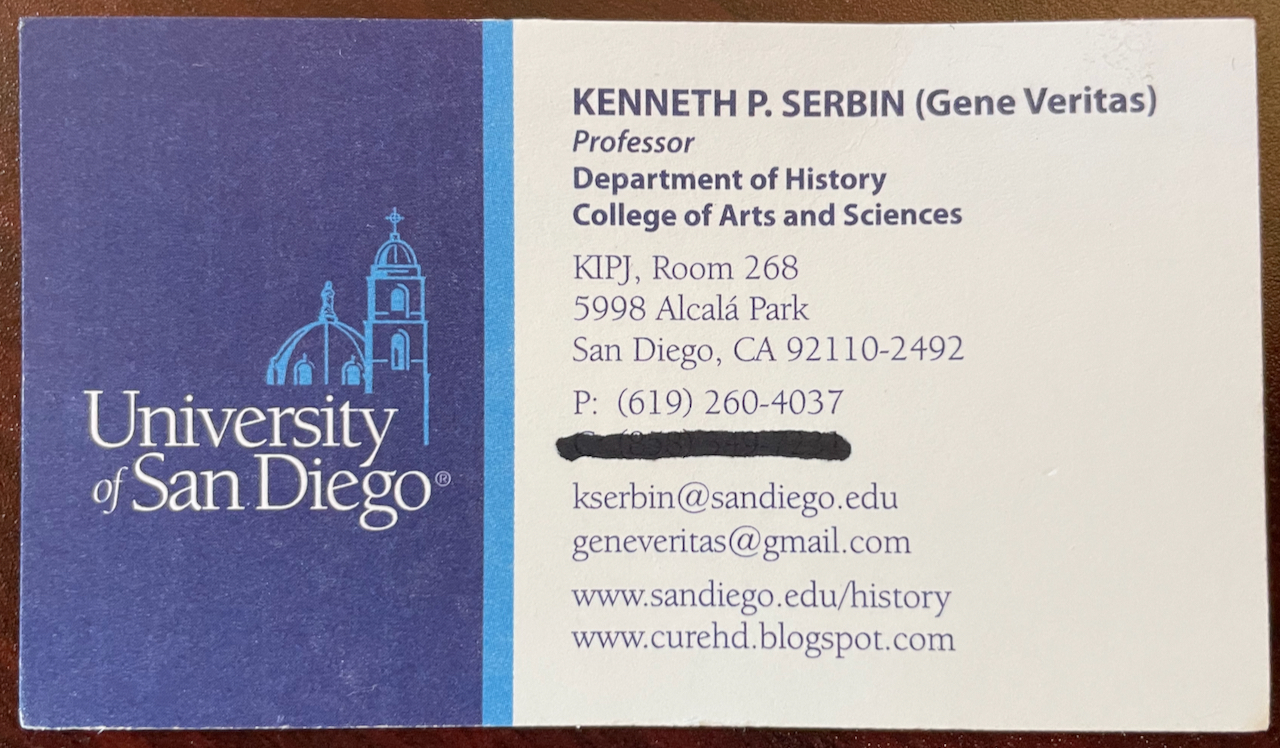
Business card of Kenneth P. Serbin (aka Gene Veritas) shared at scientific conferences and with anyone interested in learning about the HD cause (photo by Gene Veritas)


In early 2020, before the coronavirus pandemic exploded in the U.S., Dr. Burns and I collaborated in a screening at USD of the short documentary Dancing at the Vatican, which features HDdennomore. In late 2020 I helped promote the launch of the film online.


This year, I fulfilled one of the long-term goals outlined in my 2012 coming-out essay: shifting my academic focus from my beloved Brazil to the history of the quest for HD therapies.


With support from USD and The Griffin Foundation, I submitted the project for funding to the National Science Foundation. Although I was not granted funding initially, the foundation’s program officers encouraged me to reapply.


PTC’s helpful infusion of new capital


We all anxiously await effective therapies. Over the past ten years, I have increased my attention to the intensification of the efforts by labs and biopharma companies to achieve success.


The last several years of such efforts have felt like an emotional roller coaster for the HD community, though that’s not unusual for a difficult endeavor like drug development, which involves both positive and negative clinical trial results and cumulative learning.


Last month, I reported on the abrupt shutdown of the firm Triplet Therapeutics, Inc., which had explored a much-awaited proposed therapy. I also noted that the U.S. Food and Drug Administration (FDA) had requested that PTC Therapeutics, Inc., provide further information before allowing a clinical trial of its HD drug, PTC518.


But there was also potential good news.


Despite the FDA-imposed delay in a U.S. trial, PTC has reached a financing deal with the investment firm Blackstone, based on PTC’s plans to expand its drug pipelines to other diseases. The deal, which in the best-case scenario could infuse $1 billion of investment, puts “PTC in a strong position to continue to execute our mission,” Emily Hill, PTC’s chief financial officer, stated in an October 27 press release.


PTC518, a so-called splicing molecule, is also classified as a small molecule drug. It is thus taken as a pill – in contrast with riskier, less convenient delivery methods used by other HD programs, which include brain surgery and spinal injections. Early next year, PTC will furnish an update on the PTC518 trial. The trial continues in several European countries and Australia.


Roche diversifies its approach


In March 2021, Roche reported disappointing news: its gene silencing drug tominersen (an antisense oligonucleotide, or ASO) failed to improve symptoms in volunteers in the firm’s GENERATION HD1 Phase 3 (large-scale testing of effectiveness and safety) trial. This September, Roche announced GENERATION HD2, a less ambitious, Phase 2 (effectiveness, dosage, and safety) retesting of tominersen to start in early 2023.


In its presentation of GENERATION HD2 at the annual Huntington Study Group annual meeting in Tampa, FL, on November 3, Roche revealed that it has expanded its pursuit of HD therapies by embarking on two preclinical (nonhuman) projects.


Whereas tominersen targeted both the normal and abnormal (expanded) huntingtin gene, Roche will now seek to develop a drug that aims at just the abnormal gene. (Wave Life Sciences already reported in September that it had successfully targeted the abnormal gene in an early stage clinical trial, although yet without evidence of impacting symptoms.)


Like PTC’s program, Roche’s second preclinical program will aim at developing a splice modifier that would be taken orally.


“The medical need in the HD community is clear and we recognize that a range of different therapeutic approaches are likely to be required,” Mai-Lise Nguyen, of Roche’s Global Patient Partnership, Rare Diseases, wrote me in a November 3 e-mail.


A slide from the Roche presentation at the 2022 Huntington Study Group meeting illustrating the firm's three approaches to attacking Huntington's disease (slide courtesy of Roche)


Another ten years?


After the major disappointment in the shutdown of Triplet, I was heartened to learn of Blackstone’s massive investment in PTC, which indicates that both firms see PTC’s potential treatments as viable and profitable.


I was also encouraged to see how Roche, in the words of its Huntington Study Group presentation (see photo below), has augmented its HD research portfolio, reflecting a “commitment to advance scientific understanding and drug development in HD through continued collaborations” with HD organizations.


With the ingenuity of HD scientists and the dedication of HD family members to participation in research, the march towards potential therapies continues. I hope to chronicle continuing progress over the coming years not only free of the “HD closet,” but, thanks to new therapies, free of significant HD impacts, as well.


A slide from the Roche presentation demonstrating the commitment and collaborations involved in the quest for HD therapies (slide courtesy of Roche)

Saturday, May 21, 2022

Surfing through life with the spirit of aloha

To persevere against neurological diseases such as Huntington’s and the aging we all face, I have learned that it is essential to develop meaning and purpose and perform mental exercise.


In May 1997, just seventeen months after learning that my mother had the devastating symptoms of Huntington’s, I confided for the first time in a medical professional who was outside my local support group. Explaining my family’s predicament, I revealed to a physician in Brazil, my second home, that I had a 50-50 chance of having inherited the HD mutation.


Thomaz Gollop, M.D., an OB-GYN, knew about the harm caused by genetic disorders such as HD and the enormous potential for psychological trauma involved when a family learned it was at risk: in Brazil he helped pioneer genetic counseling and testing, particularly for families who wanted to conceive.


I had gone to interview Dr. Gollop at his São Paulo clinic about abortion, a topic I was researching. Though Brazil, a fervently Catholic country, had outlawed abortion, millions of women found ways to terminate their pregnancies, often in precarious circumstances.


The disturbing history of this underground practice provides a cautionary tale for the U.S. as our Supreme Court prepares in June to apparently renounce five decades of protecting legal abortion. An affiliate of the American Society of Human Genetics and member of the American Association for the Advancement of Science, Dr. Gollop has been a leading advocate in Brazil for women’s health and legalization of abortion, emphasizing the medical – as opposed to religious ­– nature of the procedure.


I had not yet tested for HD. Because of my risk, my Brazilian wife Regina and I had postponed having children. I saw Dr. Gollop as a shoulder to lean on. I poured out my heart about my mother’s struggles and my fear of becoming like her.


Dr. Gollop told me: just keep doing what you like to do until the disease hits.


In my journey of risk – I tested positive for the mutation in 1999, followed by our daughter Bianca’s negative test in 2000 – I have frequently reflected on Dr. Gollop’s advice by imagining the simultaneous challenge and beauty encountered by a surfer riding a wave.


“Just keep surfing through life!” I tell myself.


Celebrating our 30th anniversary in Hawaii


During this, Huntington’s Disease Awareness Month, we must recognize the enormous caregiving and financial burdens imposed by HD. As a result, affected families must often relinquish their dreams. Regina and I did not have more children. We gave up buying a vacation condo in Brazil. I turned down an offer of a better job at a research university in another state so that, if I were unable to work, we could rely on Regina’s secure salary and pension from her job as a public school teacher.


My risk of becoming disabled means we have focused on saving, to bolster my long-term care insurance policy. So we usually take modest vacations.


This year, though, we splurged a bit. To celebrate our 30th wedding anniversary – which I had never expected to reach with the HD-free health I have enjoyed – we traveled to Hawaii for the first time. In late March we visited the islands of Kona (the Big Island) and Oahu.


We found Hawaii wondrous with its primordial, balmy setting: we saw molten lava flow in the crater of a volcano and heard a resounding chorus of birds sing at sunset. Along with newlyweds and other couples marking anniversaries, we were called to the stage at a luau to slow dance to a Hawaiian love song in celebration of “ohana,” the Hawaiian word for family.


Keeping alive the joy


I was introduced to the story of the father of modern surfing, Duke Kahanamoku (1890-1968), a native of the Waikiki neighborhood of Honolulu. A dark-skinned man competing in a world dominated by white athletes and sports officials, Kahanamoku impressed the world by winning gold and silver medals in swimming at the 1912, 1920, and 1924 Olympics.


Also active in rowing and water polo, Kahanamoku was one of the greatest athletes of his era. Always around beaches and pools, throughout his life he also saved many people from drowning.


I first read about Kahanamoku in a guidebook praising the popular Honolulu restaurant that he owned, Duke’s Waikiki. Powerful local interests had always capitalized on Kahanamoku’s fame to promote Hawaii as a tourist mecca but frequently abandoned him to struggle for economic stability on his own. He opened Duke’s late in life as a way to supplement his income


Regina and I visited Duke’s. It has Kahanamoku memorabilia, including one of his large wooden surfboards. Outside the restaurant Regina took a picture of me in front of a giant wall photo of Kahanamoku poised to take a dive.


Gene Veritas, aka Kenneth P. Serbin, standing in front of photo of Duke Kahanamoku in Honolulu (photo by Regina Serbin)


I was intrigued by Kahanamoku. Returning home to San Diego, I wanted to keep alive the joy I had felt in Hawaii. Exploring Hawaiian culture and history, I thought, might build for me new dimensions of meaning and purpose.


Surfing king Duke Kahanamoku and aloha


I delved into journalist David Davis’ Waterman: The Life and Times of Duke Kahanamoku, the first comprehensive biography of Kahanamoku (and the source of my observations here). By coincidence, the moving documentary Waterman, based on Davis’ book, premiered in theaters in April. I saw it on opening day.


In Hawaii Regina and I were frequently greeted with “aloha,” and people used “mahalo” to say “thank you.”


As an official greeter of visiting dignitaries (including President John F. Kennedy) and global ambassador for Hawaiian culture, Kahanamoku spent his life spreading the spirit of aloha.


Davis writes that Kahanamoku “suffused” visitors “with aloha because he believed that promoting Hawaii was beneficial for fellow Hawaiians.”


Regina Serbin at Chief's Luau with flowers presented in celebration of our 30th wedding anniversary (photo by Gene Veritas)


Kahanamoku printed his personal philosophy on his business card:


In Hawaii we greet friends, loved ones or strangers with ALOHA, which means with love. ALOHA is the key word to the universal spirit of real hospitality, which made Hawaii renowned as the world’s center of understanding and fellowship. Try meeting or leaving people with aloha. You’ll be surprised by their reaction. I believe it, and it is my creed.


(I have also frequently encountered sincere hospitality in my years of traveling and residing in Brazil and other Latin American countries.)


Although highly competitive in athletic contests, Kahanamoku’s embodiment of aloha gained him a reputation as a humble victor and cooperative teammate.


He refused to respond to the many racist epithets he endured. He suppressed his feelings when personally attacked or taken advantage of by others so much that he developed ulcers.


Nevertheless, with his athletic prowess and aloha, Kahanamoku entered areas of society normally reserved for whites.


As Davis observes, “Many years before nonwhite athletes like Joe Louis, Jesse Owens, and Jackie Robinson fought racism with courageous performances, Kahanamoku was a groundbreaking figure who was able to overcome – some would say transcend ­– racism.”


The wisdom of a waterman and his people


For Native Hawaiians, Kahanamoku’s plight symbolized the unwanted but steamroller-like annexation of the independent nation by the U.S. (in 1893); the adulteration of the environment by settlers from the mainland; the imposition of mainland culture and language on the locals; and, ultimately, the commercialization of society in favor of tourism, plantation agriculture, and the establishment of Hawaii as a major military installation.


In the words of another fine documentary, Hawaii is a “stolen paradise.”


Not surprisingly, Kahanamoku’s extended family retained no ownership in Duke’s Waikiki, which expanded to include restaurants on two other Hawaiian islands and also in three California coastal cities.


Despite this history, Hawaii fortunately has maintained much of its connection to nature and cultural traditions. With aloha and their intimate ties to the land and water, Kahanamoku and his fellow Native Hawaiians (along with natives elsewhere) offer a connection to premodern humanity and the importance of solidarity.


That spirit resonates with the fight for human well-being fundamental to the Huntington’s cause. As I tweeted in March, “Fortitude, collaboration of #HuntingtonsDisease movement embody opposite of aggression of war in @Ukraine: caregiving, alleviation of suffering, and harnessing of science for cures. #IStandWithUkraine.”


A “waterman,” Kahanamoku felt most at home in the sea, the source of life and the substance inhabiting our inner parts.


In a time of global warming, political strife, and warfare, the world has much to learn from the wisdom of aloha and Hawaiians’ immersion in nature.


Kenneth and Regina Serbin with Waikiki Beach and Diamond Head volcanic cone in the background (family photo)


Negotiating the waves of life


Modern surfing emerged from Hawaii. The greatest surfer of his time and global popularizer of the activity, Kahanamoku did not see it as a sport. It was about his love for, and relationship with, the sea. And about pure fun.


“The best surfer out there is the one having the most fun,” he said. After World War II, with the worldwide explosion in surf culture, competitions, and surfboard technologies, Kahanamoku marveled at ­– and was deeply proud of ­– how it took hold. He did want to see it included in the Olympics, which finally occurred in the 2020 games.


I tried surfing once in my 20s but did not pursue it. At 62 and still healthy, and with the example of Kahanamoku, I have thought of perhaps trying again, if I can find a patient instructor!


More importantly, Dr. Gollop’s advice rings true: to stave off Huntington’s onset, I need to keep doing what I like ­– including exploring Hawaiian culture and history.


The thought of Kahanamoku flawlessly negotiating the waves on his board also reminds me of the need ­– with aloha ­– to find in life “the right balance between striving and chilling.”


This week I am balancing my disappointment over a professional roadblock with the joyous celebration of Bianca’s graduation from the University of Pennsylvania.


I hope that those of us in the Huntington’s community and beyond can all learn to surf through life like Duke Kahanamoku ­– and always with aloha.


Regina (left), Bianca, and Kenneth Serbin during graduation weekend at the University of Pennsylvania in Philadelphia (family photo)


Sunday, March 14, 2021

Blog article No. 300: who exactly is Gene Veritas?


On January 10, 2005, I began the first post in this blog with a simple but consequential sentence: “My name is Gene Veritas and I am at risk for Huntington’s disease.”


Today, 16 years and two months later, after my mother’s death from Huntington’s at age 68 in 2006 and my own long struggle to avoid disease onset, I am writing my 300th post.


Now 61, I never expected to get this far. Starting in her late 40s, my mother’s symptoms left her progressively unable to care for herself and ultimately bedridden. And I inherited from her the same degree of mutation in the huntingtin gene – which I long thought portended the same fate.


As I have noted often in recent years, I feel extremely lucky to remain asymptomatic. Although there is (as yet) no genetic test available to individuals to pinpoint the reason, researchers have discovered key modifier genes that slow or hasten onset among people with identical mutations (click here to read more). Also, as doctors and researchers have observed, my efforts to lead a healthy lifestyle likely have also helped.


In the early years of the blog, writing under the protection of my Gene Veritas pseudonym, I focused mainly on my family’s struggles with the many medical and psychosocial ramifications of HD. More recently, with the tremendous advances in HD research of the past decade, I have emphasized the science and the advent of crucial clinical trials. Those trials have brought unprecedented hope for the HD community.


However, in the whirlwind of HD advocacy and writing, I have not paused to reflect on the deeper meaning of my alias. Even after I went fully public as Kenneth P. Serbin nine years ago in an article in The Chronicle of Higher Education, I am still widely known in the HD community as Gene Veritas.


I have relished explaining a pen name that has become my trademark. In my HD work, I actually prefer the pseudonym, which not only intrigues people but also instantly focuses our interaction on the profound implications of Huntington’s.


To mark my blogging milestone, I thus want to clarify two things: who exactly is Gene Veritas? And what does that name mean?


A college professor and family man


Huntington’s, as a 100-percent genetic disorder, always involves stories about families.


After the news of my mother’s diagnosis blindsided my wife Regina and me in late 1995, our life plans changed dramatically. A future as my potential caregiver has loomed over Regina ever since. She is ever thankful about my delayed onset.


We forged ahead as best we could. Over the past two decades, we have brought our HD-free daughter Bianca to the threshold of adulthood. Bianca expects to graduate from college in 2022.


I am in my 28th year as a history professor at the University of San Diego, and Regina works as an instructional coordinator for the San Diego Unified School District.


As a family, we have been active in the local chapter of the Huntington’s Disease Society of America. In 2017, we traveled to Rome for one of the most extraordinary moments in our journey with HD, “HDdennomore: Pope Francis’ Special Audience with the Huntington’s Disease Community in Solidarity with South America.”


In the doctor-recommended enrichment and exercise that I practice, I have included the canine member of our family, our cockapoo Lenny, with long walks on diverse routes through our neighborhood.


Gene Veritas (aka Kenneth P. Serbin) with wife Regina, daughter Bianca, and dog Lenny (family photo)


Representing our common struggles


I began this blog under “Gene Veritas” because I lived in the “terrible and lonely HD closet,” fearing discrimination on the job and in healthcare and insurance matters. I built what I have described as an “absolute firewall” between my HD reality and the rest of my life.


In February 2011, I took a major step out of that closet by delivering the keynote speech at the “Super Bowl” of HD research, the Sixth Annual Huntington’s Disease Therapeutics Conference, sponsored by CHDI Foundation, Inc., the nonprofit virtual biotech solely dedicated to finding HD treatments. It was held in Palm Springs, CA.


About 250 prominent scientists, physicians, drug company representatives, and others listened to my speech, which was titled “Blog Entry 85 … Unmasking the World of Gene Veritas: An Activist Copes with the Threat of Huntington’s Disease.” (I referred to an “entry” instead of “post,” because of the diary-like nature of the blog in the early, anonymous years. Now I use the term “article,” because the posts have become more in-depth and sometimes run several thousand words or more.)


As I wrote in an article about that key moment, despite revealing my real name to the audience, my penname “‘Gene Veritas’ will still live on in cyberspace.[…] Through its anonymity and universality, it symbolizes the common struggles of families threatened by HD and numerous other neurological and genetic diseases.”


Indeed, in many talks since then I have introduced myself with both my real name and pseudonym.


‘The truth in my genes’


I explain to people that “Gene Veritas” means “the truth in my genes.”


A “gene” is a sequence of DNA, the code that programs our development as humans and gives us particular characteristics. “Veritas” is Latin for “truth.”


The truth of my future lies in the mutant huntingtin gene that I inherited from my mother.


I also have a personal connection to “veritas”: it forms part of the motto “lux et veritas” (light and truth) on the seal of my alma mater, Yale University.


The connection to Yale bubbled up from my subconscious while I was searching for a pseudonym. Surely Yale also came to mind because of the solidarity, advice, and assistance I have received from fellow alumni (click here, here, and here to read more).


As one observed, because of the devastation caused by HD, the pseudonym can also represent a grim pun on the school motto.


We are all Gene Veritas


On March 8, I participated in an online interview conducted by HD global advocate Charles Sabine and Simon Noble, Ph.D., CHDI’s communications director. They wanted to learn more about the Gene Veritas facet of my life.


Dr. Noble asked me whether I had an alter ego and other identities, in line with the ideas of 2010 keynoter and graphic novelist Steven Seagle, who has addressed his family’s way of confronting Huntington’s by juxtaposing the reality of disabling HD with the fantasy of Superman.


“Gene Veritas” is my alter ego, I said.


So, Dr. Noble wanted to know, how did the Gene Veritas alter ego protect me? Did it allow me to do other things? Did I become a different person in some respect? Were there positives to being Gene Veritas?


“Absolutely,” I responded. “Being anonymous for so many years allowed me to be completely honest about Huntington’s disease. Those first years of the blog were a complete explosion of HD honesty – talking about the feelings, talking about the discrimination, talking about the anger, the hurt, the pain, worrying about my mother, seeing my mother die from the disease. Those early years were really, really hard.”


This blog and “Gene Veritas” have also served as coping mechanisms, I added, and they allowed me to build awareness about HD.


“But how to build awareness anonymously?” I continued. “It’s like a contradiction in terms. That’s why ‘Gene Veritas’ became so important, because I was somebody. I couldn’t be Ken Serbin, but I could be Gene Veritas.”


Pondering further the universality of my pseudonym, I observed: “It’s my story, but it’s really the story of the HD community. Anybody could be Gene Veritas in the HD community. Because I think we’ve all been at one point or another a kind of Gene Veritas, at least when we first find out about Huntington’s. It’s representative. It’s something that has a broad meaning to it.”


Writing the history of the HD movement


In this blog, my CHDI keynote, and other speeches, I have documented the new and harrowing human experience of living in the gray zone between a genetic test result and onset of a disease.


In my CHDI speech, I showed a slide with a simple breakdown of main blog topics to that point. Information about the disease and research was the leading topic, followed by articles on my mother, fear of onset, and coping.


I will do a more fine-grained content analysis of posts for an academic article on the blog as a coping mechanism, fount of information for the HD community, and source of insight into the fight against HD and the search for therapies. I will submit the article to a scientific or medical journal.


I am also planning a book on the history of the Huntington’s disease cause, tentatively titled “Racing Against the Genetic Clock: A History of the Huntington’s Disease Movement and the Biomedical Revolution.” The blog will serve as a considerable primary source (a document or other material produced by a participant in a historical event) for my research and/or future historians of the HD cause.


In academic year 2021-2022, I will dedicate an expected sabbatical (a leave from teaching and other on-campus duties) to the book project. I will consult researchers, physicians, and members of the HD community about the key themes.


I earnestly hope to recount in this blog and my book the achievement of effective treatments for HD.

Tuesday, November 03, 2020

Annual Huntington Study Group meeting reveals an HD community energized to aid families, develop treatments


Moved online because of the COVID-19 pandemic, the 27th Annual Huntington Study Group Meeting nevertheless revealed an HD community committed to aiding affected families and developing cutting-edge treatments.

Originally scheduled for Atlanta, GA, the virtual conference took place from October 29-31, with more than 800 scientific and medical participants from around the world. The meeting featured two days of presentations concerning care of HD-afflicted individuals, as well as updates on key clinical trial programs, aimed at producing drugs.


On Family Day, which drew an estimated 180 additional people, the affected, caregivers, and advocates heard both expert presentations on coping with HD and highlights regarding research.


Research moving full steam ahead


Martha Nance, M.D., a long-time member of the Huntington Study Group (HSG) and the director of Family Day organizing committee, kicked off that event with a reflection on the “highlights and lowlights” of 2020 so far. A neurologist and frequent sounding board for this blog, Dr. Nance is also the medical director of the Huntington’s Disease Society of America (HDSA) Center of Excellence at Hennepin County Medical Center in Minneapolis, MN.


We all know the lowlights, Dr. Nance said: the COVID-19 pandemic, the death of George Floyd in Minneapolis, the 2020 election with its uncertainty, and climate change.


“For me, a highlight of this entire year was this meeting,” Dr. Nance said, referring to the great progress in HD research. “The last two days we heard about more things than you can shake a stick at.”


Dr. Nance listed the important developments detailed in the scientific talks, including several innovative ways to potentially block the harmful effects of the mutant huntingtin gene. Both the scientists and family members got updates on GENERATION HD1, the historic, in-progress gene silencing clinical trial by Roche aimed at reducing the amount of toxic huntingtin protein in the brain.


At the conference, several speakers referred to temporary slowdowns in research programs because of the new safety protocols resulting from COVID-19. Dr. Nance also noted difficulties in accessing some HD community members because of the pandemic in the U.S. and abroad, although she also has observed a helpful “explosion” in telemedicine.


However, despite the uncertainty about overall scientific research funding because of the COVID-19 crisis, “research is alive and well in Huntington’s disease,” Dr. Nance stated. “If what happened at this meeting continues, research in Huntington’s disease is moving full steam ahead.”


“I found the meeting to be energizing,” Dr. Nance concluded in an e-mail to me on October 31.


For detailed reports of the research presentations, see HDBuzz’s coverage by clicking here and here.


For the next year, HSG is providing access to on-demand recordings of the conference talks and other events. Click here to register for access.


‘Heroes,’ and a thank-you for me


Dr. Nance devoted most of her Family Day introduction to counterpoising the difficulties of 2020 with the stories of “heroes” who have stepped up to assist others in the HD community by exercising their unique skills.


“We need to hear about some people who’ve done good things,” she explained. “I hope that you can emboldened, empowered by some of these heroes.”


Dr. Nance – to my surprise and appreciation – began with the example of me, Gene Veritas (aka Kenneth P. Serbin), the author of this blog, now in its sixteenth year. Dr. Nance recalled how she and I had worked together on our college newspaper (click here to read more). She said that I use my journalistic skills to help inform the HD community, and to be “very up front about my struggles and fears” as a carrier of the HD mutation.


I write in this article about myself because Dr. Nance stressed how important it is for the HD community to be informed about its social ramifications.


‘I can’t breathe’


Dr. Nance recalled my September 2014 report on Jeffrey Bane, a West Virginia man arrested because the police misunderstood his HD symptoms to be the result of narcotics abuse (click here to read more).


Dr. Nance replayed the video of a bystander who had filmed Jeff suffering injuries as the police held him to the ground, thinking that, with his involuntary, HD-caused movements, he was resisting arrest. “I can’t breathe,” Jeff said desperately as he asked the officers for help.


Jeff only received the help of paramedics after the police had held him to the ground for almost ten minutes, Dr. Nance pointed out. 


Then she asked the attendees “to just take a deep breath, pause, and think for a minute.”


After 54 seconds elapsed, she resumed her presentation. “Hopefully you took a deep breath,” she said. “I think probably you felt anger, hate, sorrow, sadness, fear, anxiety.”


She continued: “We can’t change something that happened six years ago. What we can do is try as hard as we can to keep events like this from happening against in the HD community.”


Dr. Nance noted that HDSA has a toolkit for educating first responders, police officers, and fire personnel about HD. The organization provides other resources (such as a special HD ID card) to help HD-affected individuals and their families prepare for potential encounters with the police, she added.


(I have explored these crucial themes in other articles. Click here to read more.)


‘Your life matters’


In examples surely moving to the audience, Dr. Nance presented the stories of several other HD “heroes.” 


Inducted into the Minnesota Auctioneers’ Hall of Fame in 2005, Joe, whose wife and daughter died of HD, took “his grief, his sadness, his sorrow” and raised money and bought electric toothbrushes for hundreds of HD-afflicted people, Dr. Nance recalled.


As a ten-year-old watching his mother face HD, B. J. Viau started an annual basketball hoop-a-thon that over the years raised some $750,000 for HD research. Among other things, B. J. went on to become one of the founders of the highly active international Huntington’s Disease Youth Organization


Diagnosed at ten with juvenile HD, Elli started kickball tournaments to support the cause. She became an internationally recognized HD advocate.


Dr. Nance also recognized the 791 “heroes” who are taking part in the GENERATION HD1 clinical trial.


With HD, she said, it’s easy to become angry, sad, and depressed. However, people can also “stand up tall” to help others. We need more everyday heroes, she added.


“Your life matters – not to take away from anybody else whose life matters,” Dr. Nance said in closing. “What you do makes a difference.”


Dr. Martha Nance (left) praises the advocacy of juvenile Huntington's disease-affected Elli Hofmeister (in images at right) at the virtual 2020 HSG Family Day (screenshot by Gene Veritas).