Showing posts with label Hope Walk. Show all posts

Monday, April 04, 2016

Just living life: a focus on what matters most in coping with the risk of Huntington’s disease


As a carrier of the Huntington’s disease gene who’s reached the age of 56 without apparent HD symptoms, I believe that the emotional release associated with this blog – sharing my fears, hopes, and advocacy – has helped me stave off the inevitable onset of the disorder.

Ideally, I’d like to write in this blog weekly.

However, I don’t always have time, as evidenced by my taking nearly a month to post an update.

I regret the delay, because I have a growing list of critical developments in advocacy and research to report on, for example, the results of the 11th Annual HD Therapeutics Conference, held in February.

However, like so many people in this harried world, I juggle multiple demands involving family, career, and community.

Beyond that, those of us in the HD movement (and in other disease communities) have the added responsibility of caregiving, multiple forms of advocacy, and/or living with the disease or its threat.

Ever more conscious of life's brevity and my good fortune in remaining asymptomatic, I’ve been focusing on what matters most.

Being there for the family

One of my deepest fears about HD concerns losing the ability to support my family. Having seen my mother decline terribly because of HD, I long worried that I would become a financial and medical burden for my wife Regina and daughter Bianca, or, worse, that I might not see Bianca graduate from high school.

In my current stable health, I devote time and energy to helping Bianca transition from teenager to young adult.

A few weeks ago, I acquired a third family car so Bianca can drive my “old” Nissan Altima when she gets her license. While we’re fortunate to afford an extra car, it’s no luxury; it will allow her to drive to school, freeing Regina and me each from several hours of driving weekly. We also recognize that having a car is a rite of passage in America, especially in the auto-oriented culture of Southern California.

Once again, HD factored into our family decision-making: seeking to economize and plan prudently, we bought a used 2013 Honda Accord in good enough condition that, as Regina put it, could last me until retirement.

As my trusted mechanic put it, the four-cylinder Accord’s engine is “God’s gift to humanity” because of its reliability. As a teenager, I had always admired the Accord and daydreamed about owning one. Lately, I’ve come to detest driving because of the crazy Southern California traffic – I long for a mass-transit system like those in European cities – but the Accord has brought back some of the enjoyment.

Priority over the blog

I had planned on buying a car only when Bianca received her license later in the year, but a major connection in my HD journey saved me the headache of shopping for one by alerting me to the availability of the low-mileage Accord.

Rob Millum, a friend whom I met while serving on the board of the San Diego Chapter of the Huntington’s Disease Society of America (HDSA) and also a former member of the HDSA national board, works as a consultant for Affinity Development Group and administers the Costco Auto Program.

Rob’s a natural leader who cares about serving humanity. With his auto dealer’s license he helps people save money on nearly new cars and recreational vehicles. He doesn’t need to work full-time but does so to help support the HD community and other causes.

Rob and I have had deep conversations about HD, this blog, and life in general. When I couldn’t attend the 2011 HDSA convention to receive the HDSA Person of the Year Award, Rob accepted the honor in my name.

And Rob’s a darn good car guy, too!


At 2011 HDSA national convention, HDSA Chairman of the Board Don Barr (left), Rob Millum, and HDSA CEO Louise Vetter as Rob accepts HDSA Person of the Year Award for Kenneth P. Serbin (aka Gene Veritas) (photo by Ashley Miller).

In 2010, Rob helped me purchase my 2011 Altima through Costco’s no-hassle program; his nephew was the salesman. I then parted with my 1999 Corolla, my so-called “DNA car,” which had those highly symbolic letters on the license plate and which had carried me through many miles of HD advocacy (click here to read more).

We had upgraded to the bigger, sturdier Altima for safety reasons. Now it will become Bianca’s car.

Dealing with my credit union’s loan department, figuring out the high-tech gadgetry of the Accord (the owner’s manual is 595 pages long!), and other details of the purchase took priority over this blog.

Other aspects of my HD advocacy have also reduced the time for the blog, for example, raising funds for the 2016 HDSA-San Diego Hope Walk, set for April 10 (click here to donate to our team). Support for HDSA is essential in the quest for treatments.

Just living life

Despite the new financial load of car payments along with our mortgage and other payments, I felt grateful about handling the details of the Accord purchase for my family.

It’s reminded me how quickly our “miracle baby” – who tested negative for HD in the womb in 2000 – is growing up. The toddler I used to push in a stroller at the zoo now practices driving the Altima on the freeway. We’re starting the search for colleges.

I also remind myself to focus on the basics to help avoid HD onset: a healthy diet, good sleep habits, and regular, vigorous exercise. I can get lackadaisical about all three!

Spending more time on the essentials, as well as enjoying life more fully, takes time away from HD advocacy and blogging.

I feel that I need a break from the din of the Internet, the 2016 presidential campaign, the TV commercials, the political crisis in Brazil (the country I research), the e-mails and Facebook postings concerning HD, and all the other things that diminish my peace of mind.

The Easter Vigil Mass I attended on March 26 provided a respite, with two hours of chanting and scriptural readings, a stark contrast with our daily lives outside the sanctuary.

Knowing how many of my symptomatic "HD brothers and sisters" valiantly cope with the disease, I’m thankful for the chance to just live life.

Friday, March 11, 2016

Billboards: an old – but also new – way of projecting the Huntington’s disease cause


The San Diego Chapter of the Huntington’s Disease Society of America (HDSA-San Diego) has taken its advocacy to a new level with billboards announcing a chapter fundraiser, the Fifth Annual Team Hope Walk on April 10.

At five high-traffic locations in the San Diego area, the billboards went up on March 7 and will remain up for 30 days, according to Misty Daniel, the HDSA-San Diego vice president. Misty originated the billboard idea, the first time it’s been used in the San Diego chapter, one of the most active in the country.

The billboard calls on the public to “register today” for the Hope Walk at the website www.TeamHopeWalk.com.


The HDSA-San Diego 2016 Team Hope Walk billboard on Mission Gorge Road south of Twain Avenue in San Diego (photo by Gene Veritas, aka Kenneth P. Serbin)

“As a group, we’re not very good advocates for ourselves,” Misty said of the HD community in a phone interview. “This disease affects as many people as cystic fibrosis, but you’ve heard of cystic fibrosis.”

Huntington’s disease still lacks such instant public recognition, Misty observed.

“It’s not just that it’s a rare disease, but it’s rarely known,” she explained. “I’m tired of educating physicians and telling people that I have this in my family and them not having a clue about what it is.”

Misty said she wants the billboards to bring awareness of HD to the “point where I say, ‘I lost my mom to Huntington’s disease,’ and they’ll say, ‘I know what that is. I’m sorry.’ It’s getting harder and harder to use Woody Guthrie as my person to reference. More and more people are saying: who is Woody Guthrie?”

Guthrie – one of the greatest American folk singers of the 20th century and the composer of “This Land is Your Land” – died of HD in 1967, at 55. That year his wife founded a network of HD support groups and advocates that would become HDSA.

Billboards are a traditional, “old media” way of generating publicity. However, in this case they project a 21st-century imperative: the need to cure neurological diseases. They reflect the ongoing high level of creativity in a community facing one of the most devastating of those disorders (click here to read more).

A passionate, resilient advocate

At 38, Misty is a passionate, resilient veteran of the HD cause.

She became an advocate for HDSA-San Diego when she was just 19. She lost her mother Rosie Shaw to the disease in 2007. Misty tested negative for HD two years later. A brother with HD died in a motorcycle accident, losing control of the vehicle perhaps because of the disease. Her sister Brooke, 46, has HD symptoms. Three other siblings remain untested.

Misty speaks at HD events such as the chapter’s second annual convention, held March 5. (I’ll have more on this event in a future article.) She advocates for the passage of the Huntington’s Disease Parity Act, a bill in Congress to update the Social Security Administration’s long outdated definition of HD as a disease causing only involuntary movements. That situation prevents people affected by psychiatric and cognitive symptoms from qualifying for Social Security disability payments. In addition, she assists drug makers involved in HD clinical trials and other HD research.

Misty also helps organize the local Hope Walks. About a year ago, she started thinking about the possibility of billboards.

“HDSA does not spend any money on advertising – not nationally or locally – because we want as much of the dollars raised to go to HD care, advocacy and research as possible,” HDSA CEO Louise Vetter said in an e-mail. “This is an important policy and principle in how we steward the funds raised for our fight.”

So Misty and other advocates raised the $2,000 needed to pay for the billboards. One of Misty’s untested siblings donated $1,800. The Clear Channel media company, the owner of the billboards, charged a nonprofit rate.

She pointed to key participants in the effort: HDSA-San Diego board secretary Jamie Jirik; HDSA staffer Stephanie Alband; former Clear Channel Radio employee Sherry Toennies; and board member Paul June, whose branding firm designed the billboard.

“At the end of the day, this is what HDSA-San Diego is all about: grass roots efforts,” Misty said.


Misty Daniel at the 2014 San Diego Hope Walk (photo by Gene Veritas)

Catching families’ attention

“Huntington’s disease has carried a stigma for so long,” Misty said of the need for the billboards. “We continue to perpetuate the stigma generation after generation.”

The fear in HD families is “overwhelming,” she continued. That fear “is not only palpable but it is a real reason to control how we talk about” HD and share about it.

However, Misty has sensed a change in the community.

“With the launch of the Internet and social media, more and more people are confident about sharing their stories and talking publicly about Huntington’s disease,” she said. “This is what’s going to whittle away that stigma, more and more people talking about it.”

Misty hopes that the billboards will catch the attention of other HD-affected families in the San Diego area who until now have had no contact with the chapter, events, and support group.

According to Vetter, advocates in the Upper Midwest used billboards in the early 2000s. In addition, some national ad campaigns have run in magazines like TIME.

“Billboards are a great way to raise visibility of the Team Hope program and HD to the broad San Diego community,” she said. “They can spark curiosity to learn more about HD, as well as fuel engagement to take part in the Walk.

“Additionally, these billboards can validate the participation of those who are already part of our fight to help HD families. When you see an ad or a billboard about something you are involved in, it breeds pride and a deeper connection to the cause. For the HDSA San Diego Chapter, this can mean new volunteer leaders and the ability to have a greater impact.”

More than a logo

To stir broad interest, the billboards portray a family at a previous Hope Walk in another city.

Unidentified, the family has a sign with the words “I’m walking for: Ray Jacks – our brother.” (On the billboard it’s not clear whether the surname is “Jacks” or “Jackson.”)


Another angle of the billboard (photo by Gene Veritas)

As of this writing, I was unable to identity neither the family nor the person for whom they were walking. Regardless, Misty stressed that including the photo was highly important. (All HDSA walkers sign a waiver permitting use of their photos, she noted.)

“We wanted to make sure that the billboard had actual people on it, because this is a disease that has been faceless for too long,” she said. “We felt that if it had only a logo, we would be doing the Huntington’s disease community a disservice.

“No, this is not a clipart. It’s a real family.”

Later Misty hopes to reach out to the family.

“I want them to know they’re on this billboard,” she continued. “This generation is walking on behalf of those who can no longer walk for us.”

It strives for a cure, she said, to prevent another generation from suffering from HD.

Please support my family’s team, the "Serbin Family Team," in the 2016 HDSA-San Diego Hope Walk by clicking here to join us and/or make an online donation.

Featuring music, prizes, food, family fun, and more, the walk will take place at Coronado Tidelands Park, 2000 Mullinex Drive, Coronado, CA, 92118. Walk registration starts at 8 a.m. and the event at 9 a.m. Proceeds benefit HDSA.


A selfie of Gene Veritas, aka Kenneth P. Serbin, at the billboard

Sunday, April 13, 2014

Reshaping my career and life in the face of Huntington’s disease (and a note of hope)

In the second half of the 1990s, after learning of my mother’s diagnosis for Huntington’s disease, the 50-50 chance of having the genetic mutation unsettled me greatly. One way I dealt this was to throw myself into my career.

The fear that I would follow in my mother’s footsteps and lose my ability to work frequently caused me to panic. I was just 36, but the future seemed bleak because I witnessed in my mother and other HD patients the terrible devastation of the disease. She was declining rapidly. I thought my own decline could occur at any time and was convinced that, at best, I wouldn’t get very far into my 40s before HD hit.

Striving to achieve the academic milestone of my first book – the gold standard for recognition for professional historians – I sometimes wrote as many as 14 hours per day.

The quest for success – I was already thinking about my professional legacy – served as a powerful form of denial.

Family first

During that now seemingly crazy but certainly understandable response, I often neglected my relationship with Regina, my wife. Regina had stood by my side throughout our ordeals with HD, but the long hours I worked meant fewer hours to grow with her in the marriage.

After my initial impulse to get tested for HD right after my mother’s diagnosis in late 1995, I had sensibly postponed testing to gather information about the disease and avoid the risk of genetic discrimination. Regina agreed that we should delay starting a family until we sorted out all the issues HD presented for conceiving and raising children.

However, after a few years of waiting, and approaching her mid-30s, Regina wanted a child badly.

My decision to get tested in 1999 to prepare for having a family, my subsequent positive test result, our daughter Bianca’s negative result in the womb, and her birth the following year grounded me again in the basics of life and sealed my commitment to my family.

As Bianca grew, my mother headed towards death.

Soon, rather than working overtime on professional  issues, I stepped up my HD advocacy, although always behind the scenes because of the enduring fear of genetic discrimination.

I still spent much time away from Regina and Bianca, yet I also learned to manage my week more efficiently. I reserved special moments for them, especially on the weekends.

Raising Bianca along with Regina and watching her grow into a teenager have brought me great pride and joy. There is no more important task for parents.

Although no life is risk-free, we are profoundly relieved and grateful that she will never have HD.

In my work as chair of the history department at the University of San Diego (USD), I always say “family first” to co-workers needing time off to attend to critical matters such as an ill child.

A clear purpose

In the 18 months since I exited the “HD closet” and announced the adoption of a second academic field, I’m once again reshaping my career.

I’ve reflected deeply on what professional ambition means for me. Whereas career was once top priority, today I think a lot more about human solidarity.

At home, this means keeping the focus on family. In the academic venue, it’s about viewing career as a service to students, the profession, and society. In HD advocacy, it’s a collaborative effort to speed up the discovery of treatments to save tens of thousands of people like me from the disease.

My shift in attitude results partially from my experience as a parent and the perspective on life maturity provides.

However, the fight against HD also plays a very significant role.

I especially comprehend the importance of HD when I attend conferences such as last February’s Ninth HD Therapeutics Conference, sponsored by the CHDI Foundation, Inc.

With hundreds of participants focused on the single goal of defeating HD, the feeling in the room was electric – indeed, almost surreal. The atmosphere was so intense and the connections among the participants so strong that I felt as if I were communicating telepathically with some of them.

Similarly, learning that yet another person has died from HD or juvenile HD strikes me in the pit of the stomach and redoubles my sense of urgency as an advocate.

My academic career began as a search for professional and personal fulfillment fueled with a passion for Latin America and its history. My investigation into the history of science, technology, and medicine – which includes my HD advocacy and, in this blog, an ongoing, firsthand account of living at risk – transcends the professional and the personal. It builds awareness about the global, cutting-edge efforts to improve brain health.

In short, I now have a clear purpose.

Melding career and activism

My reshaped career melds my professional training with my advocacy work. As I wrote recently, at work I raised concerns about the long-term effects of head injuries suffered by college football players.

On April 3, I attended a USD-sponsored panel discussion on ethics and genetic testing, with a focus on the direct-to-consumer genetic testing service 23 and Me. Last November the federal Food and Drug Administration ordered the company to stop selling its saliva connection kit and genome service because the agency said it had failed to demonstrate the tests’ accuracy. I made an audio recording of the USD event and took photos of the participants, who included fellow faculty members as well as two deans. I plan to report on the event in this blog. This is the first time that I have covered a USD event as an HD blogger.

During the 2014-2015 academic year, I will be on sabbatical, that is, freed from teaching and administrative duties to focus exclusively on research and related projects. During that period I plan to work on a long-gestating book on former Brazilian revolutionaries who have come to positions of power. I also aim to continue my HD advocacy, and I will prepare a new course tentatively titled “A History of the Brain,” a subject not being taught in our History department nor in any science department.

I hope that course, to be taught after I return from leave, will inspire students to become historians and to build awareness of the centrality of the brain in our lives, as well as produce more humanistic, historically-oriented science majors.

In general, I feel a growing desire to help guide young people – surely a function of being a father of a teenager and a veteran professor, but also of my solidarity work in the HD movement.

Riding a whipsaw, but content

On April 10, I flew to Providence, RI, to take part in a conference at Brown University marking the 50th anniversary of the U.S.-supported Brazilian military overthrow of the democratically elected President João Goulart.

This was the first meeting related to Brazilian studies I had attended in more than four years. The long hiatus was caused by my growing interest in the history of science, technology, and medicine.

It was also the first time I took part in a Brazilian studies event where people knew about my HD status. I received words of encouragement from several colleagues, including some who have made donations to the cause. I felt very much at ease, and I was thrilled to feel some of my old passion for Brazil return and to catch up with my colleagues.

I also brought to the conference a much sharper mental focus, obtained thanks to my participation in events such as the HD Therapeutics conferences, which, because they represent completely new and highly complex material about a life-or-death matter, require enormous concentration, energy, and openness to different perspectives.

By sheer coincidence, on April 12 the Rhode Island chapter of the Huntington’s Disease Society of America (HDSA) held its inaugural family education day at Butler Hospital, also in Providence. I took part, giving a presentation titled "Opportunities for HD Advocacy."

You can watch my presentation in the video below. For other presentations from the education day, click here to visit my Vimeo video album of the event. (I'll be adding additional presentations from the event in the next few days, so be sure to refer to the album again.)


Immediately after the family education event I got a ride to the airport with Connecticut HD activist Laura Kokoska, who updated me on her HD-stricken mother, who is 71, and her own advocacy activities.

On the morning of April 13, I led the Serbin Family Team in the third annual Team Hope Walk of HDSA-San Diego.

Flying coast-to-coast twice in less than 72 hours (with connections in Chicago), jumping from one event to another in Providence, presenting talks on both Brazilian history and HD advocacy, arising early on the 13th for the Hope Walk – it all felt like riding on a whipsaw.

No matter! I was excited to thrive and make yet wider and deeper connections in both spheres of my career.

As I've learned, my life must not serve my career, but my career my life.

A successful Hope Walk

The Hope Walk was a success, raising approximately the San Diego chapter goal of $44,000. Lead corporate sponsor Auspex Pharmaceuticals, a San Diego-based company conducting HD research, donated $10,000 to the event. Other major corporate donors included pharmaceutical firms Vertex and Lundbeck, both of which also have an HD focus.

For the second straight year, the Serbin Family Team was the top team fundraiser, with a total of more than $4,600. I wish to thank the 44 donors (individuals, couples, and families) who gave to the cause, as well as the team members who walked with us at Tidewater Park in Coronado, CA.

As in past years, the support of HD-focused firms and the participation of more than 300 people, including some of the scientists seeking treatments, lifted my spirits.

You can view the Serbin Family Team and other scenes from the Hope Walk in the photos below.


The Serbin Family Team of the 2014 HDSA-San Diego Team Hope Walk: from left to right, Dory Bertics, Bianca Serbin, Jane Rappoport, Gary Boggs, Yi Sun, Kenneth Serbin, Regina Serbin, Allan Rappoport (photo by Bob Walker)


Gene Veritas (aka Kenneth Serbin) presents 16-year-old juvenile HD patient Terry Leach with the iPad mini won by the Serbin Family Team for being the top Hope Walk team fundraiser (photo by Misty Oto).


HDSA-San Diego President George Essig addresses the crowd just before the Hope Walk begins (photo by Gene Veritas).


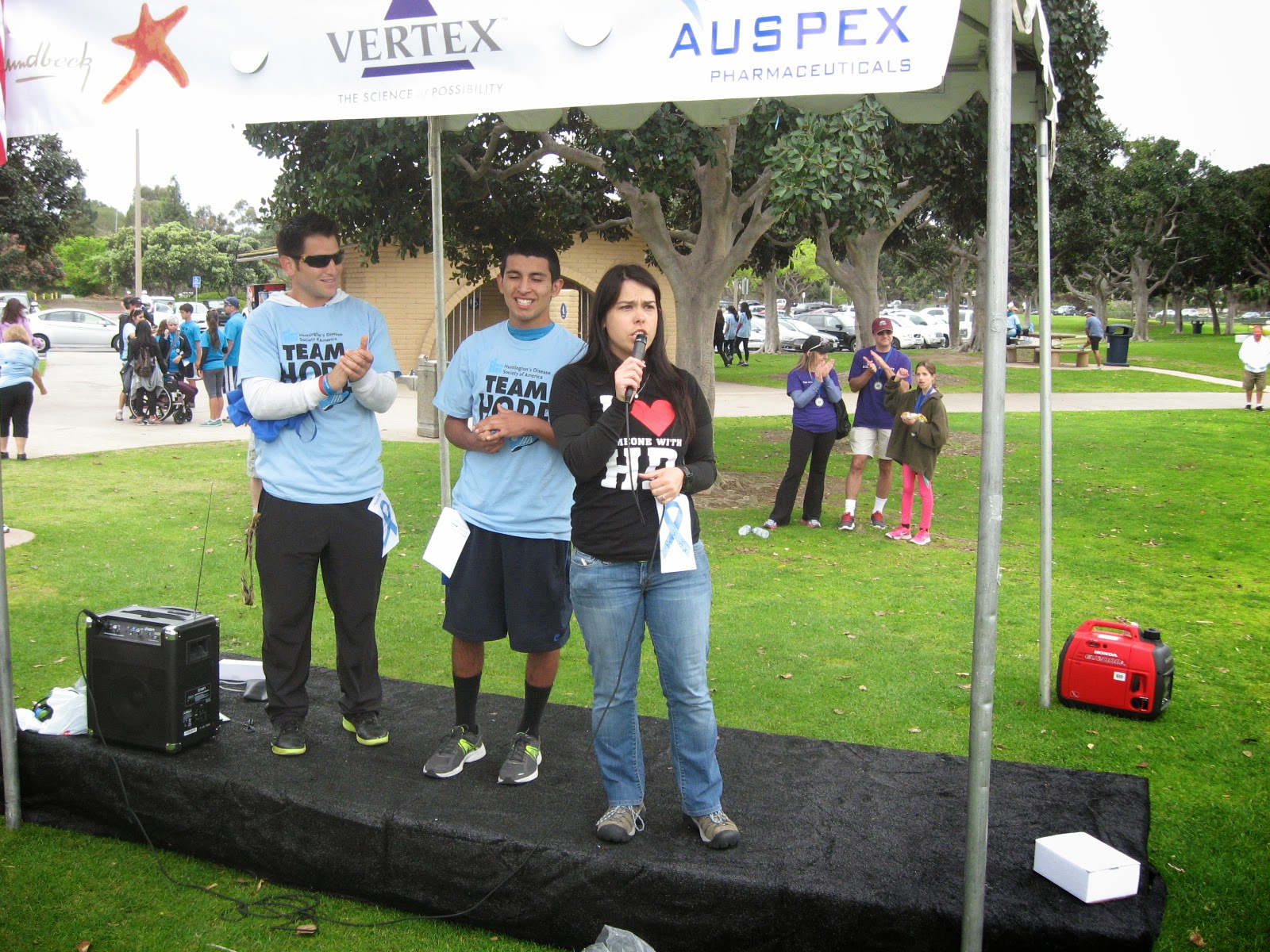
Hope Walk co-organizer Misty Oto addresses the crowd alongside Christian Rodriguez (left) and Terry Lopez, organizer of a Poway High School student group established last year to support the local HD community (photo by Gene Veritas).


Tim Schroeder (left), Gene Veritas, and HD support group facilitator Sandy Grofcsik


Walk participants LaVonne and Paul Cashman (left) and Jim Stone (photo by Gene Veritas)

Hope Walk participants await the start of the event (photo by Gene Veritas).