Showing posts with label fundraiser. Show all posts

Friday, March 11, 2016

Billboards: an old – but also new – way of projecting the Huntington’s disease cause


The San Diego Chapter of the Huntington’s Disease Society of America (HDSA-San Diego) has taken its advocacy to a new level with billboards announcing a chapter fundraiser, the Fifth Annual Team Hope Walk on April 10.

At five high-traffic locations in the San Diego area, the billboards went up on March 7 and will remain up for 30 days, according to Misty Daniel, the HDSA-San Diego vice president. Misty originated the billboard idea, the first time it’s been used in the San Diego chapter, one of the most active in the country.

The billboard calls on the public to “register today” for the Hope Walk at the website www.TeamHopeWalk.com.


The HDSA-San Diego 2016 Team Hope Walk billboard on Mission Gorge Road south of Twain Avenue in San Diego (photo by Gene Veritas, aka Kenneth P. Serbin)

“As a group, we’re not very good advocates for ourselves,” Misty said of the HD community in a phone interview. “This disease affects as many people as cystic fibrosis, but you’ve heard of cystic fibrosis.”

Huntington’s disease still lacks such instant public recognition, Misty observed.

“It’s not just that it’s a rare disease, but it’s rarely known,” she explained. “I’m tired of educating physicians and telling people that I have this in my family and them not having a clue about what it is.”

Misty said she wants the billboards to bring awareness of HD to the “point where I say, ‘I lost my mom to Huntington’s disease,’ and they’ll say, ‘I know what that is. I’m sorry.’ It’s getting harder and harder to use Woody Guthrie as my person to reference. More and more people are saying: who is Woody Guthrie?”

Guthrie – one of the greatest American folk singers of the 20th century and the composer of “This Land is Your Land” – died of HD in 1967, at 55. That year his wife founded a network of HD support groups and advocates that would become HDSA.

Billboards are a traditional, “old media” way of generating publicity. However, in this case they project a 21st-century imperative: the need to cure neurological diseases. They reflect the ongoing high level of creativity in a community facing one of the most devastating of those disorders (click here to read more).

A passionate, resilient advocate

At 38, Misty is a passionate, resilient veteran of the HD cause.

She became an advocate for HDSA-San Diego when she was just 19. She lost her mother Rosie Shaw to the disease in 2007. Misty tested negative for HD two years later. A brother with HD died in a motorcycle accident, losing control of the vehicle perhaps because of the disease. Her sister Brooke, 46, has HD symptoms. Three other siblings remain untested.

Misty speaks at HD events such as the chapter’s second annual convention, held March 5. (I’ll have more on this event in a future article.) She advocates for the passage of the Huntington’s Disease Parity Act, a bill in Congress to update the Social Security Administration’s long outdated definition of HD as a disease causing only involuntary movements. That situation prevents people affected by psychiatric and cognitive symptoms from qualifying for Social Security disability payments. In addition, she assists drug makers involved in HD clinical trials and other HD research.

Misty also helps organize the local Hope Walks. About a year ago, she started thinking about the possibility of billboards.

“HDSA does not spend any money on advertising – not nationally or locally – because we want as much of the dollars raised to go to HD care, advocacy and research as possible,” HDSA CEO Louise Vetter said in an e-mail. “This is an important policy and principle in how we steward the funds raised for our fight.”

So Misty and other advocates raised the $2,000 needed to pay for the billboards. One of Misty’s untested siblings donated $1,800. The Clear Channel media company, the owner of the billboards, charged a nonprofit rate.

She pointed to key participants in the effort: HDSA-San Diego board secretary Jamie Jirik; HDSA staffer Stephanie Alband; former Clear Channel Radio employee Sherry Toennies; and board member Paul June, whose branding firm designed the billboard.

“At the end of the day, this is what HDSA-San Diego is all about: grass roots efforts,” Misty said.

Misty Daniel at the 2014 San Diego Hope Walk (photo by Gene Veritas)

Catching families’ attention

“Huntington’s disease has carried a stigma for so long,” Misty said of the need for the billboards. “We continue to perpetuate the stigma generation after generation.”

The fear in HD families is “overwhelming,” she continued. That fear “is not only palpable but it is a real reason to control how we talk about” HD and share about it.

However, Misty has sensed a change in the community.

“With the launch of the Internet and social media, more and more people are confident about sharing their stories and talking publicly about Huntington’s disease,” she said. “This is what’s going to whittle away that stigma, more and more people talking about it.”

Misty hopes that the billboards will catch the attention of other HD-affected families in the San Diego area who until now have had no contact with the chapter, events, and support group.

According to Vetter, advocates in the Upper Midwest used billboards in the early 2000s. In addition, some national ad campaigns have run in magazines like TIME.

“Billboards are a great way to raise visibility of the Team Hope program and HD to the broad San Diego community,” she said. “They can spark curiosity to learn more about HD, as well as fuel engagement to take part in the Walk.

“Additionally, these billboards can validate the participation of those who are already part of our fight to help HD families. When you see an ad or a billboard about something you are involved in, it breeds pride and a deeper connection to the cause. For the HDSA San Diego Chapter, this can mean new volunteer leaders and the ability to have a greater impact.”

More than a logo

To stir broad interest, the billboards portray a family at a previous Hope Walk in another city.

Unidentified, the family has a sign with the words “I’m walking for: Ray Jacks – our brother.” (On the billboard it’s not clear whether the surname is “Jacks” or “Jackson.”)


Another angle of the billboard (photo by Gene Veritas)

As of this writing, I was unable to identity neither the family nor the person for whom they were walking. Regardless, Misty stressed that including the photo was highly important. (All HDSA walkers sign a waiver permitting use of their photos, she noted.)

“We wanted to make sure that the billboard had actual people on it, because this is a disease that has been faceless for too long,” she said. “We felt that if it had only a logo, we would be doing the Huntington’s disease community a disservice.

“No, this is not a clipart. It’s a real family.”

Later Misty hopes to reach out to the family.

“I want them to know they’re on this billboard,” she continued. “This generation is walking on behalf of those who can no longer walk for us.”

It strives for a cure, she said, to prevent another generation from suffering from HD.

Please support my family’s team, the "Serbin Family Team," in the 2016 HDSA-San Diego Hope Walk by clicking here to join us and/or make an online donation.

Featuring music, prizes, food, family fun, and more, the walk will take place at Coronado Tidelands Park, 2000 Mullinex Drive, Coronado, CA, 92118. Walk registration starts at 8 a.m. and the event at 9 a.m. Proceeds benefit HDSA.


A selfie of Gene Veritas, aka Kenneth P. Serbin, at the billboard

Tuesday, December 09, 2014

Sharon’s inspirational journey with CrossFit in the fight against Huntington’s disease

With her indomitable spirit Sharon Shaffer has not given up the fight against Huntington’s disease, despite a decade of struggling with symptoms that forced her to quit her job and stop driving, and which hamper her ability to speak.

On December 7, Sharon starred in her own HD educational fundraiser, “Sharing Sharons CrossFit Journey” (#CureHuntingtons and #SharingSharonsJourney). The event raised nearly $2,000 to support Sharon and her family’s plans to hold a much larger fundraiser for the Huntington’s Disease Society of America (HDSA).

More importantly, it gave several dozen participants and onlookers in the CrossFit gym insight into Sharon’s practice of regular, intense exercise as a strategy for slowing the inevitable progression of her untreatable condition.

“I believe that CrossFit has helped me bounce back from major falls and accidents that I have had,” Sharon, assisted by daughter Alexa, said in a speech before CrossFit trainers led her and participants through a regimen of exercises. “Although my balance, swallowing, and speech are worsening, I am confident that without exercise my symptoms would be worse.”

You can watch Sharon tell of her struggles with HD and her involvement with CrossFit in the video below, with an introduction by Lee Razalan, the owner of Stay Classy CrossFit, the gym that sponsored the event.


A rigorous workout

The trainers at Stay Classy CrossFit, a central San Diego outlet that is part of a national network of gyms, designed a program for the Shaffers’ event. It was geared specifically for HD-affected individuals.

Along with the other participants, I jumped on a box, lifted weights, swung on a pull-up bar, and did pushups and squats.

We rotated among the five exercise stations every 90 seconds, moving through the entire sequence three times over about 17 minutes.


The #CureHuntingtons WOD (workout of the day) (photo by Taylor Shaffer)

I found the workout very rigorous. Indeed, I had to stop several times to catch my breath.

Over the next couple of days, my muscles felt considerably sore. But it was a good soreness, the kind you get from using neglected muscles. Today one of my doctors gave me the go-ahead to stick with CrossFit, but only as long as I don’t overdo it.

It occurred to me that HD people and presymptomatic gene carriers such as I need more events such as this to help us refocus on exercise and holistic approaches to the disease.

For Sharon, CrossFit has not just served to stimulate her brain and strengthen her muscles, but also linked her to a whole new network of friends who literally support her as she sometimes stumbles through the exercises.

In addition to Stay Classy Crossfit, the event received support from Lululemon and Sushi on a Roll.

You can watch the CrossFit participants, including me, in the videos below.


Racing Across America again

The Shaffers put on “Sharing Sharons CrossFit Journey” in preparation for their fourth participation in the Race Across America (RAAM), a coast-to-coast, non-stop bicycle race from the pier in Oceanside, CA, to the boardwalk in Annapolis, MD. The Shaffers’ participation in the June 2015 event requires donations in kind and funds to cover such costs as a motor home to accompany the riders.

The Shaffers’ “Team 2 Cure Huntington’s Disease” participated in RAAM in 2006, 2007, and 2010, anchored by Renato. He also led a team in the Race Across the West in 2008.

These and affiliated events such as annual RAAM golf tournaments have raised more than $110,000 for HDSA. “Team 2 Cure HD” has also increased awareness about HD across the nation.

In addition to Renato, the 2015 team includes RAAM veterans John Sylvester and Jason Tate and newcomer Mikel Clementi. Their 2015 goal is to net $40,000 or more.


Renato Shaffer (photo by Gene Veritas)

Inspiration

Renato and his three team members have completed past RAAM events in less than ten days. To call RAAM grueling is a gross understatement, especially since Renato turns 50 today, December 9.

In their RAAM donation request letter, the Shaffers describe the race as “both physically and emotionally taxing” but that pales before “the realities that HD patients suffer from on a daily basis. Over the past ten years our family has changed drastically with the progression of Sharon’s symptoms. Nonetheless we live with purpose, hope and gratitude. Our purpose is to shed light on HD, to maintain realistic hope despite Sharon’s circumstances and always remain grateful for the selflessness of others who have helped us.”

Renato, the RAAM team members and support staff, the extended Shaffer family, and supporters and friends of the HD cause draw deep inspiration from Sharon.

My goal […] is to try to succeed at things that people would deem impossible given my condition,” said the 48-year-old Sharon, who has practiced CrossFit for five years. She believes that all HD-affected individuals can discover an activity or hobby for keeping active.

“Huntington’s does not define us,” she said. “It’s just another fork in the road.”

At the conclusion of the CrossFit program, we participants all gathered around Sharon and one of the trainers as he reflected on the purpose and the lessons gained.

I touched Sharon’s shoulder. She and her thoughtful event for HD families had motivated me to recommit to exercise and healthy living as I face my own inevitable onset. Once again, I acquired strength from my HD sister.

We all put our arms in the middle of the circle. Then we raised them as we cheered: “Cure Huntington’s!

(Stay tuned to this blog for updates on RAAM 2015 and how you can help. Scroll down for other photos from Sharon's event. Photos by Gene Veritas.)


Race Across America veteran and 2015 repeat participant John Sylvester


2015 Race Across America initiate Mikel Clementi


Alexa (left) and Taylor Shaffer


Sharon Shaffer and mother Fran Walker


Andrew Herndon, coordinator of the HDSA Center of Excellence for Family Services and Research at the University of California, San Diego


HD advocate and support group member Amy Anderson (left) and HD support group facilitator Sandy Jerkins

Wednesday, April 17, 2013

Feeling the hope


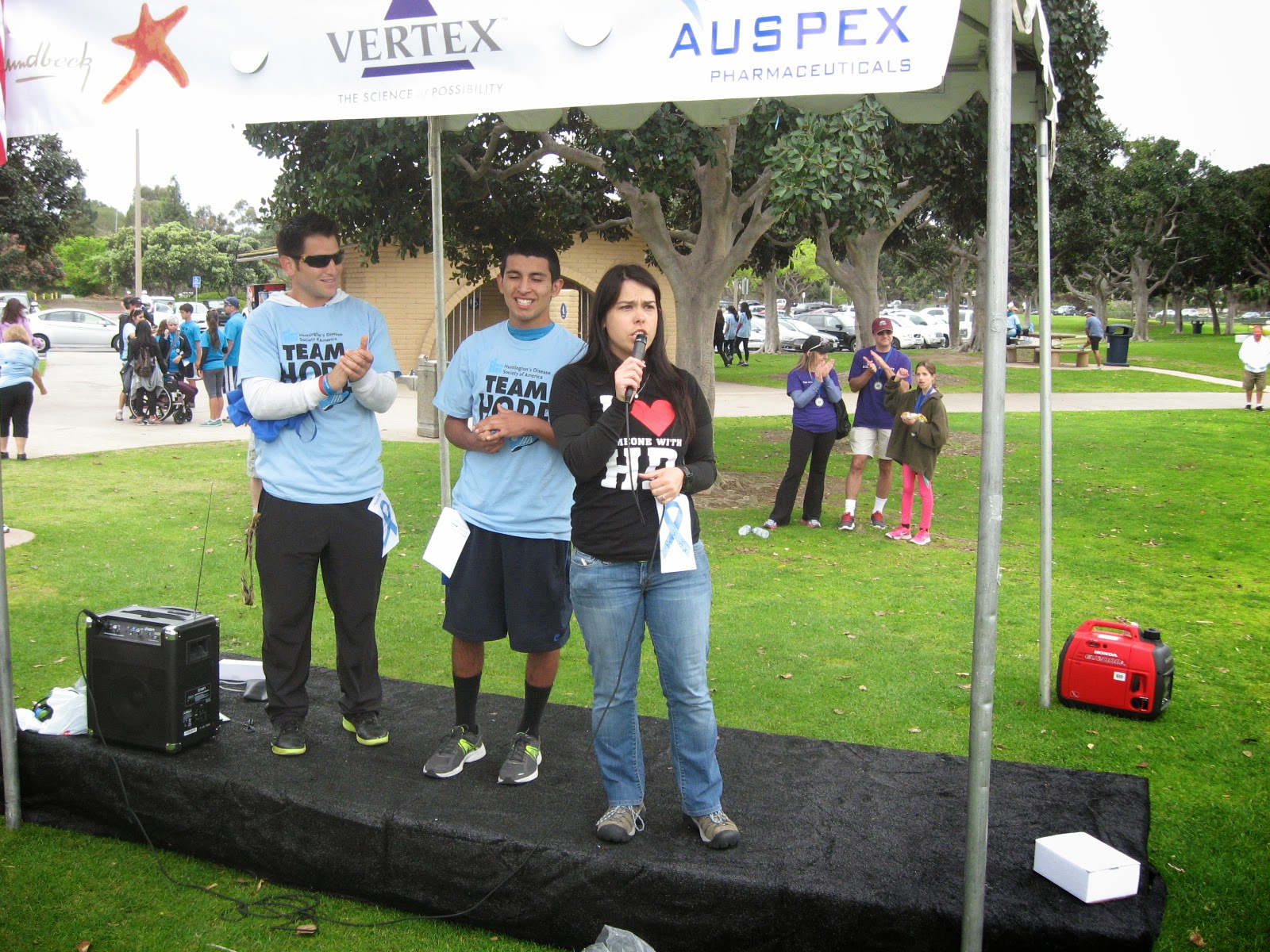
(I dedicate this article to the dozens of people who joined or supported the “Serbin Family Team” on April 14 in the 2013 Team Hope Walk-San Diego of the Huntington’s Disease Society of America, HDSA.)

Lately, I’ve been feeling great hope  even as my genetic clock ticks ominously  that researchers will find an effective treatment for Huntington’s disease and save me from following in the footsteps of my mother, who struggled against this so-called “devil of all diseases” for nearly 20 years before succumbing at age 68 in 2006.

Because the underlying causes of HD are untreatable, I’ve rarely permitted myself to have all-out hope during my 15 years of advocacy and personal fight to avoid the inevitable symptoms. I’ve braced myself for the impact of onset, even as I keep advocating for the cause on full throttle until our community, together with the scientists working overtime for effective treatments, achieves victory.

Hope is a precious commodity to be savored when breakthroughs occur. I’ve saved a couple bottles of Hangtime Pinot Noir, the wine served at the Parker Palm Springs hotel in 2011 at a reception after my first major speech on HD, delivered at the Sixth Annual HD Therapeutics Conference, sponsored by the CHDI Foundation, Inc., in February 2011. I’m keeping at least one to celebrate on the day a treatment is announced.

Big news, a sense of relief – tempered by reality

In recent weeks, the science news and advocacy milestones have left me feeling particularly buoyant.

On April 2, I was thrilled with President Barack Obama’s announcement of the BRAIN (Brain Research through Advancing Innovative Neurotechnologies) initiative, which will spend hundreds of millions of dollars over the next decade to map the mysterious circuitry of the brain. Although HD researchers hope to find treatments before the potential benefits of BRAIN become available in a decade or more, the announcement of the project finally brings brain health and research to a long-overdue prominence in American politics.

The very next day, HDSA held a symposium at the U.S. Senate to mark the 20th anniversary of the discovery of the HD gene. Dr. Francis Collins, the director of the National Institutes of Health and one of the scientists who helped find the gene, keynoted the meeting, which included presentations by key HD researchers about the prospects for treatments. As I watched the live streaming video of the event, I could feel the sweep of history as I reflected on the scientists’ words and my family’s odyssey with HD, beginning with my mother’s genetic test in 1995 and my own test in 1999.

Just a few days later, on April 8, the Swiss pharmaceutical giant Roche and Carlsbad, CA-based Isis Pharmaceuticals, Inc., announced a multi-million-dollar partnership to bring Isis’s potentially revolutionary HD gene-therapy drug into clinical trials, with a projected start date of the first half of 2014. I have followed the Isis project closely since 2008, visiting the company’s labs, interviewing its scientists, writing detailed articles about the research, and, in speeches to the HD community, citing the project as a great sign of hope.

As I prepared an article on this latest phase of the project, I felt a profound sense of comfort and elation as I pondered how the deal with Roche should accelerate the research, increase the potential for effective results for symptomatic HD people, and, for the very first time, allow scientists to envision ways of preventing presymptomatic people like me from ever developing the disease!

I let out a long sigh of relief – as I do again now in writing these words – and imagined a future without HD for me and the tens of thousands of families around the world devastated by the disorder.

However, since then I’ve tempered my enthusiasm with reality. Although scientists express genuine optimism about developing treatments, only one in ten clinical trials leads to a drug.

As I race against my genetic clock and past my mother’s age of onset, a treatment may not arrive in time to prevent my symptoms.

Nevertheless, the great feeling of hope lingers and brightens my days!

Our generous supporters

In the midst of these events, my wife, my daughter, and I sought fundraisers and walkers for the April 14 Team Hope Walk.

In the wake of my definitive exit from the “HD closet” (in an article in The Chronicle of Higher Education and an interview on the website of my employer, the University of San Diego), nearly 70  friends, colleagues, and other supporters donated more than $16,000 to the “Serbin Family Team” – more than three times our goal. (Overall, local HDSA board members expected the event to net more than $40,000 for the organization.)

Twelve volunteers joined us in the 5K walk at Tidewater Park in Coronado, CA, to help raise awareness about HD.

Members of "Serbin Family Team" at 2013 Hope Walk-San Diego (photo by Vince Margetta)

I felt enormous pride in my family, my friends and supporters, and the HD cause.

Love and humility

I was moved most by donations from individuals and families themselves hit with serious illnesses, all of them with at least a partial genetic basis: breast cancer, colon cancer, young onset Parkinson’s disease, fragile X syndrome, and multiple sclerosis.

My family and I learned of these other families’ struggles, including, in one case, a harrowing decision about genetic testing.

I was deeply moved by this outpouring of generosity and love.

For me, it was also a lesson in humility, a reminder that so many others suffer from disease, an opportunity to become more sensitive to others’ needs, including the need to support other causes.

Above all, the immense display of support for the “Serbin Family Team” stirred in me the same feeling of hope that I experienced in contemplating the Roche-Isis project.

Hope wins out

Sadly, just two days before the walk, I learned of the death of a fellow HD support group member, a 20-year Navy veteran and airline pilot whose career and life were cut short by Huntington’s disease. He was just 65.

“Damned disease finally won,” his mournful wife wrote me in an e-mail.

As on countless occasions in my battle against HD, I had to overcome a sense of hopelessness, which threatened to overpower all of the good feelings about the research and the Hope Walk.

At the Hope event, I hugged our departed friend’s wife. Everybody held a moment of silence for him.

Before setting out on the walk, I guided one of our team members, a ninth-grader with a passion for science and technology, over to the area where employees from walk co-sponsor Vertex Pharmaceuticals were congregating.

I introduced him to Paul Negulescu, the Vertex vice president of research, and mentioned that he aimed to become a researcher.

Paul invited him to visit the Vertex facility and, in the future, perhaps contribute as an intern.

“I want to cure diseases,” the budding scientist told me during the walk.

Our cause had lost a warrior, but the Hope Walk had helped prepare another to do battle.

(Below see other photos from the Hope Walk.)


"Serbin Family Team" members (left to right): friends Sofia, Jessica, Alejandro, and Victoria along with Ken Serbin, with San Diego skyline in background


"Serbin Family Team" members James Kohn (left), Ami Carpenter, and Ken Serbin at finish line


Vertex Vice President of Research Paul Negulescu (left), Ken Serbin, and Vertex Vice President, Biology, Beth Hoffman


"Team Vertex" and friends with San Diego-Coronado Bridge in background