Showing posts with label cystic fibrosis. Show all posts

Friday, March 11, 2016

Billboards: an old – but also new – way of projecting the Huntington’s disease cause


The San Diego Chapter of the Huntington’s Disease Society of America (HDSA-San Diego) has taken its advocacy to a new level with billboards announcing a chapter fundraiser, the Fifth Annual Team Hope Walk on April 10.

At five high-traffic locations in the San Diego area, the billboards went up on March 7 and will remain up for 30 days, according to Misty Daniel, the HDSA-San Diego vice president. Misty originated the billboard idea, the first time it’s been used in the San Diego chapter, one of the most active in the country.

The billboard calls on the public to “register today” for the Hope Walk at the website www.TeamHopeWalk.com.


The HDSA-San Diego 2016 Team Hope Walk billboard on Mission Gorge Road south of Twain Avenue in San Diego (photo by Gene Veritas, aka Kenneth P. Serbin)

“As a group, we’re not very good advocates for ourselves,” Misty said of the HD community in a phone interview. “This disease affects as many people as cystic fibrosis, but you’ve heard of cystic fibrosis.”

Huntington’s disease still lacks such instant public recognition, Misty observed.

“It’s not just that it’s a rare disease, but it’s rarely known,” she explained. “I’m tired of educating physicians and telling people that I have this in my family and them not having a clue about what it is.”

Misty said she wants the billboards to bring awareness of HD to the “point where I say, ‘I lost my mom to Huntington’s disease,’ and they’ll say, ‘I know what that is. I’m sorry.’ It’s getting harder and harder to use Woody Guthrie as my person to reference. More and more people are saying: who is Woody Guthrie?”

Guthrie – one of the greatest American folk singers of the 20th century and the composer of “This Land is Your Land” – died of HD in 1967, at 55. That year his wife founded a network of HD support groups and advocates that would become HDSA.

Billboards are a traditional, “old media” way of generating publicity. However, in this case they project a 21st-century imperative: the need to cure neurological diseases. They reflect the ongoing high level of creativity in a community facing one of the most devastating of those disorders (click here to read more).

A passionate, resilient advocate

At 38, Misty is a passionate, resilient veteran of the HD cause.

She became an advocate for HDSA-San Diego when she was just 19. She lost her mother Rosie Shaw to the disease in 2007. Misty tested negative for HD two years later. A brother with HD died in a motorcycle accident, losing control of the vehicle perhaps because of the disease. Her sister Brooke, 46, has HD symptoms. Three other siblings remain untested.

Misty speaks at HD events such as the chapter’s second annual convention, held March 5. (I’ll have more on this event in a future article.) She advocates for the passage of the Huntington’s Disease Parity Act, a bill in Congress to update the Social Security Administration’s long outdated definition of HD as a disease causing only involuntary movements. That situation prevents people affected by psychiatric and cognitive symptoms from qualifying for Social Security disability payments. In addition, she assists drug makers involved in HD clinical trials and other HD research.

Misty also helps organize the local Hope Walks. About a year ago, she started thinking about the possibility of billboards.

“HDSA does not spend any money on advertising – not nationally or locally – because we want as much of the dollars raised to go to HD care, advocacy and research as possible,” HDSA CEO Louise Vetter said in an e-mail. “This is an important policy and principle in how we steward the funds raised for our fight.”

So Misty and other advocates raised the $2,000 needed to pay for the billboards. One of Misty’s untested siblings donated $1,800. The Clear Channel media company, the owner of the billboards, charged a nonprofit rate.

She pointed to key participants in the effort: HDSA-San Diego board secretary Jamie Jirik; HDSA staffer Stephanie Alband; former Clear Channel Radio employee Sherry Toennies; and board member Paul June, whose branding firm designed the billboard.

“At the end of the day, this is what HDSA-San Diego is all about: grass roots efforts,” Misty said.
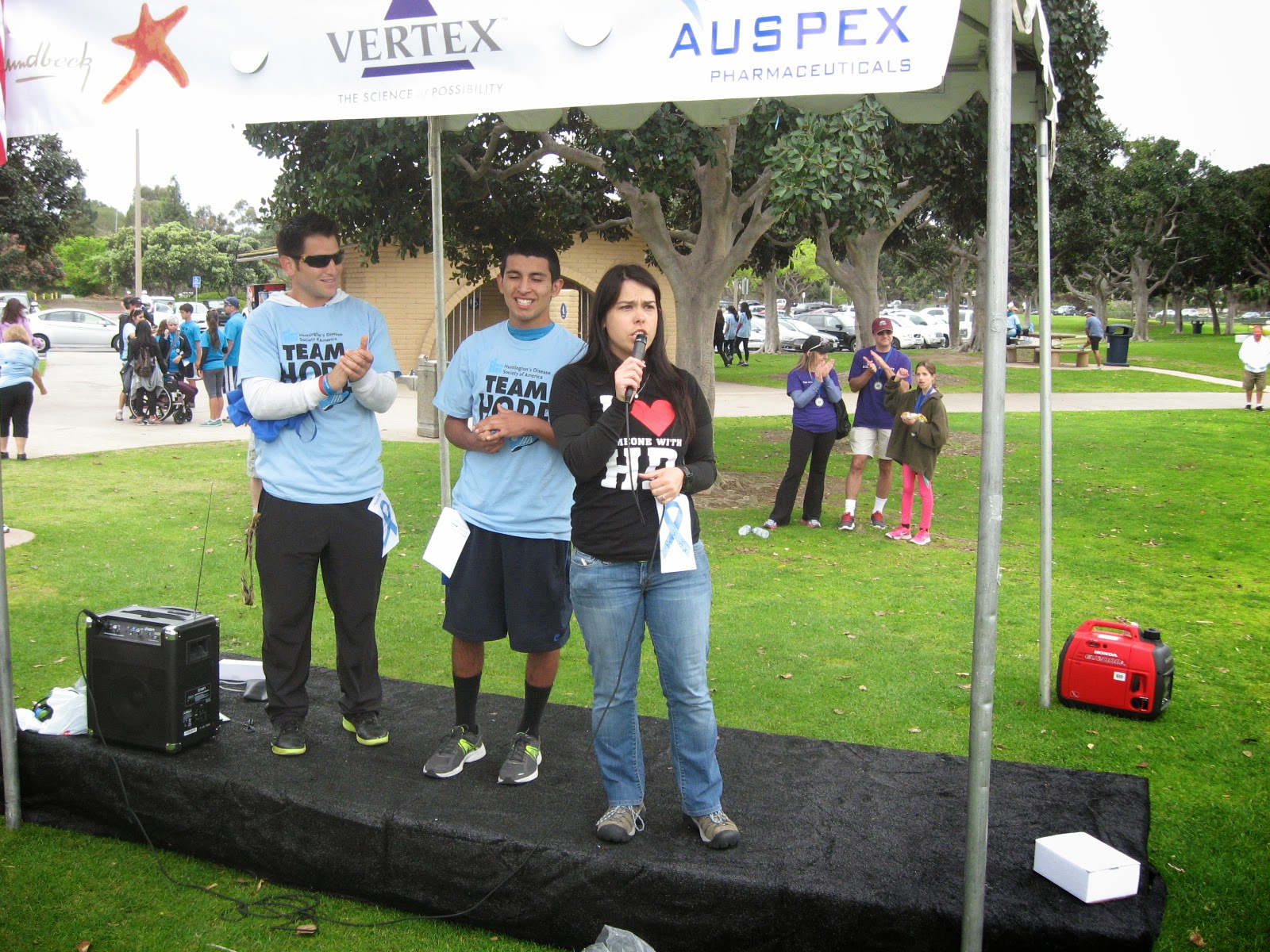

Misty Daniel at the 2014 San Diego Hope Walk (photo by Gene Veritas)

Catching families’ attention

“Huntington’s disease has carried a stigma for so long,” Misty said of the need for the billboards. “We continue to perpetuate the stigma generation after generation.”

The fear in HD families is “overwhelming,” she continued. That fear “is not only palpable but it is a real reason to control how we talk about” HD and share about it.

However, Misty has sensed a change in the community.

“With the launch of the Internet and social media, more and more people are confident about sharing their stories and talking publicly about Huntington’s disease,” she said. “This is what’s going to whittle away that stigma, more and more people talking about it.”

Misty hopes that the billboards will catch the attention of other HD-affected families in the San Diego area who until now have had no contact with the chapter, events, and support group.

According to Vetter, advocates in the Upper Midwest used billboards in the early 2000s. In addition, some national ad campaigns have run in magazines like TIME.

“Billboards are a great way to raise visibility of the Team Hope program and HD to the broad San Diego community,” she said. “They can spark curiosity to learn more about HD, as well as fuel engagement to take part in the Walk.

“Additionally, these billboards can validate the participation of those who are already part of our fight to help HD families. When you see an ad or a billboard about something you are involved in, it breeds pride and a deeper connection to the cause. For the HDSA San Diego Chapter, this can mean new volunteer leaders and the ability to have a greater impact.”

More than a logo

To stir broad interest, the billboards portray a family at a previous Hope Walk in another city.

Unidentified, the family has a sign with the words “I’m walking for: Ray Jacks – our brother.” (On the billboard it’s not clear whether the surname is “Jacks” or “Jackson.”)


Another angle of the billboard (photo by Gene Veritas)

As of this writing, I was unable to identity neither the family nor the person for whom they were walking. Regardless, Misty stressed that including the photo was highly important. (All HDSA walkers sign a waiver permitting use of their photos, she noted.)

“We wanted to make sure that the billboard had actual people on it, because this is a disease that has been faceless for too long,” she said. “We felt that if it had only a logo, we would be doing the Huntington’s disease community a disservice.

“No, this is not a clipart. It’s a real family.”

Later Misty hopes to reach out to the family.

“I want them to know they’re on this billboard,” she continued. “This generation is walking on behalf of those who can no longer walk for us.”

It strives for a cure, she said, to prevent another generation from suffering from HD.

Please support my family’s team, the "Serbin Family Team," in the 2016 HDSA-San Diego Hope Walk by clicking here to join us and/or make an online donation.

Featuring music, prizes, food, family fun, and more, the walk will take place at Coronado Tidelands Park, 2000 Mullinex Drive, Coronado, CA, 92118. Walk registration starts at 8 a.m. and the event at 9 a.m. Proceeds benefit HDSA.


A selfie of Gene Veritas, aka Kenneth P. Serbin, at the billboard

Tuesday, July 22, 2014

Can we afford the costs of orphan disease treatments?

Millions of people in America suffer from rare, or “orphan,” diseases, conditions defined by the government as affecting fewer than 200,000 people. With an estimated 30,000 affected individuals, Huntington’s disease is one of the more common of these disorders.

The pharmaceutical industry has largely ignored these diseases, which number several thousand, because each disease promises too few customers/patients to enable companies to recoup investments in drug research and development and therefore generate a profit. The market usually doesn’t work for people with these diseases.

News about a lawsuit by Arkansas cystic fibrosis (CF) patients against the state’s Medicaid program for its refusal to pay for a highly effective but extremely expensive drug – Vertex Pharmaceutical’s Kalydeco – shined light on this predicament.

In an article titled “The $300,000 Drug,” New York Times columnist Joe Nocera recognized Kalydeco as a “wonder drug” but questioned whether the country can afford the personalized medicine approach that enables scientists to design specialized treatments for very small and specific groups of patients.

With an annual wholesale cost of $311,000, Kalydeco was developed for a subgroup of about 1,100 CF patients with specific genetic mutations. The subgroup numbers about 2,150 patients worldwide in an overall CF population of 70,000 individuals.

“Because patients will likely be taking the drug for the rest of their lives, it could cost millions of dollars to keep just one patient on Kalydeco,” Nocera speculated. “That raises another important question about the coming of personalized medicine. How are we, as a society, going to pay for it?”

Same question for the HD community

The HD community could face this very same question. Because the U.S. has only 30,000 HD patients and 150,000 to 250,000 people at risk of carrying the gene, a potential treatment could cost a lot.

Boston-headquartered Vertex has sought to develop HD treatments since mid-2008. Though the company has made a substantial effort, it doesn’t yet have plans for a clinical trial. (Click here to read more.) Isis Pharmaceuticals, Inc., of Carlsbad, CA, has also worked about as long and is planning to launch a clinical trial in the next year or two.

It’s still too early to project the costs of treatments that have yet to be tested or even fully designed. Other potential remedies are in trials but at best likely remain years from reaching the market.

Furthermore, an HD treatment regimen will likely involve a cocktail of remedies, meaning that patients – via their insurers – will probably have to pay for more than one drug.


Vertex vice president of research Paul Negulescu (left), Gene Veritas (aka Kenneth P. Serbin), and Vertex vice president of biology Beth Hoffman at the company's San Diego facility, September 2010 (photo by Heather Farr, Vertex)

Patient assistance programs

The HD community must remain vigilant regarding the cost of potential treatments. However, failing to consider a number of factors, the coverage of the Kalydeco costs was perhaps too pessimistic about the future.

First, as I commented regarding the impatience with California’s stem cell institute after ten years of operation without a drug, biomedical research is slow by nature. And it’s expensive, with the average cost of developing a new drug in the U.S. at $1.2 billion. Only one in ten clinical trials results in a marketable drug, although the research from the unsuccessful projects provides highly valuable information on what does not work.

In the case of CF, Vertex is at work on another treatment that would reach thousands more patients with different kinds of mutations.

As Nocera himself noted, Vertex provides Kalydeco for free to patients without insurance.

Lundbeck, the pharmaceutical firm that markets Xenazine, which diminishes some of the involuntary movements caused by HD (chorea), provides financial assistance to patients who qualify. Depending on the dosage, the annual wholesale cost of this treatment can reach $50,000 or more, but, according to the Lundbeck website, “85 percent of U.S. patients taking Xenazine have a monthly co-pay of $50 or less before requesting co-pay assistance.”

It’s highly conceivable that the developers of future HD treatments will provide similar kinds of assistance – especially because these firms will have relied on the good will and extensive cooperation of HD families who participate in research studies and clinical trials. However, it’s not clear what the drug companies will charge insurers.

CHDI and pharma giants

After the founding in 2003 of the CHDI Foundation, Inc., a non-profit virtual biotech firm backed by wealthy donors who wish to remain anonymous, pharmaceutical firms small and large started to gain interest in developing Huntington’s treatments.

As a result, the network of firms working on HD now includes pharmaceutical giants such as Pfizer, Roche, and Medtronic.

As a non-profit with the sole purpose of finding HD treatments, CHDI promotes research on Huntington’s and the diffusion of scientific knowledge about the disease. With more researchers and firms involved, the chances for treatments have grown. Having more options could very well mean that treatments would cost less.

By pouring hundreds of millions of dollars into HD drug research, CHDI has created an incentive to produce cheaper drugs.

As it states on its website, CHDI seeks to connect academic research, drug discovery, and clinical development in order to avoid “costly delays to therapeutic development” and make potential treatments a “good investment” that will result in “full clinical development, including licensure and marketing to get drugs to HD patients.”

Similarly, the Hereditary Disease Foundation and the Huntington’s Disease Society of America (HDSA) have supported research that could yield yet additional drugs.

Patient-driven medicine

Thanks to this level of support for HD research, the HD community stands in perhaps a better position than those facing even more rare diseases.

Nevertheless, orphan disease communities in general have reason to feel optimistic about both the development of treatments and their cost, if the vision of one key medical leader becomes reality.

Lee Hood, M.D., Ph.D., one of the scientific giants behind the Genome Project and the recipient in 1987 of the Lasker Basic Medical Research Award (the American equivalent of the Nobel Prize), has developed a plan for more effective and affordable medicine. In 2000, Dr. Hood founded the Institute for Systems Biology (ISB). Located in Seattle, the non-profit ISB teams scientists and technologists from many disciplines to pioneer the future of research in biology, biotechnology, medicine, environmental science, and science education.

In a 2012 speech at the Seventh Annual HD Therapeutics Conference, sponsored by CHDI, Dr. Hood outlined the importance of systems biology – what I think of as the “big picture” of disease – for HD research. Dr. Hood also advocated for the adoption of P4 medicine: predictive, preventive, personalized, and participatory. (Click here to read more.)

“Patients and consumers will be a major driver in the realization of P4 medicine through their participation in medically oriented social networks directed at improving their own healthcare,” Dr. Hood and Mauricio Flores, J.D., wrote in the March 2012 issue of the journal New Biotechnology.

ISB and several collaborating organizations have run some pilot programs in P4. If it is implemented on a wide scale, Dr. Hood predicts that it will revolutionize our healthcare system. Everybody will carry a health-monitoring device, and diseases will be predicted and prevented long before onset as the result of tiny blood samples taken from a pin prick, the article states.

Predicting falling medical costs

Significantly, costs could plummet.

“P4 medicine will require that all healthcare companies rewrite their business plans in the next 10 years or so,” Dr. Hood and Flores wrote. “Many will not be able to do so and will become ‘industrial dinosaurs.’ There will be enormous economic opportunities for the emergence of new companies tailored to the needs and opportunities of P4 medicine.”

The authors projected that savings will result from a series of factors, including earlier and more effective diagnosis of disease; better matching of drugs with diseases and their subtypes; better identification of genetically based adverse reactions to drugs; the ability to “re-engineer” disease-affected biological networks within people in order to reduce the cost of drug development; an increasing ability to deal effectively with cancer; the use of stem cells for replacement therapy and diagnostics; the routine extension of effective mental and physical health into people’s 80s and 90s; an improved understanding of microbes in the body; a deeper understanding of neurodegeneration (the cause of HD, Alzheimer’s, Parkinson’s, and other disorders); and the digitalization of medical and genetic information.

“On another tact, our prediction is that there will be a ‘wellness industry’ that will emerge over the next 10-15 years that will in time far exceed the size of the healthcare industry,” Dr. Hood and Flores affirmed. “P4 medicine is an area replete with economic opportunities.”

Dr. Hood and Flores believe that P4 medicine will “democratize” healthcare.

“The patient (consumer), through social networks, will drive the emergence of P4 medicine,” they wrote. “Because of intrinsic conservatism and sclerotic bureaucratic systems, physicians, healthcare specialists and the healthcare industry will take a back seat to the power of patient-driven social networks in bringing change to the healthcare system. Indeed, patients may be the only driving force capable of truly changing our contemporary healthcare system to the proactive P4 mode.”

This scenario serves as a serious alternative to the dim view that orphan disease communities will remain relegated to high-cost solutions.

Guaranteeing proper care standards

Indeed, a “revolution” has occurred over the past two decades in how patients have related to their doctors and the pharmaceutical industry (click here to read more).

Nowadays, people enter the healthcare system as both patients and advocates for their well-being.

This outlook led the Arkansas patients to sue for the right to have their Kalydeco costs covered.

Their lawsuit offers a striking similarity with the HD community’s pressure on the Social Security Administration and Congress to update the decades-old, inaccurate government criteria for determining disability benefits for Huntington’s patients (click here to read more). The Arkansas plaintiffs in effect have demanded that the state recognize Kalydeco as the standard treatment for their type of CF.

Negotiating the price

The competition of the marketplace, greater efficiency in drug development, and the revolution in medicine outlined by Dr. Hood should put downward pressure on the cost of drugs.

Patient advocates must play a crucial role in this process.

As the late San Diego biotech leader Duane Roth had told me during a dinner with California stem cell leaders in 2008, patient advocates must find ways to appeal to pharmaceutical companies’ primary interest in profits. Advocates need to lobby and court these business leaders.

At the same time, disease organizations such as HDSA and its network of advocates can pressure pharmaceutical companies and government agencies to assure new drugs’ accessibility and affordability.

In some circumstances, government can join in the process of persuasion and even play hardball, as the Brazilian Ministry of Health did in the 1990s in order to convince multinational pharmaceutical firms to dramatically reduce the price of HIV/AIDS medications. The Brazilian government provides HIV/AIDS drugs for free.

“Local production of generics, the possibility of breaking patents, and the offer of technology transfer became instruments for price negotiations with other countries and the pharmaceutical industry, leading to a real reduction in prices on the Brazilian and international markets,” wrote the coordinator of the country’s National STD/AIDS Program.

The marketplace exists, but it is susceptible to politics.

The rhetoric about the $300,000 drug can scare a lot of people. But in the long run, such a cost is not a foregone conclusion.