The natural human tendency toward denial presents one of the biggest obstacles to strengthening the Huntington’s disease movement, including the recruitment of individuals for the observational studies and clinical trials crucial for developing effective treatments and a cure.
How do we more proactive members of the HD community influence those living in denial? How do we convince them that they need to inform themselves about HD and join the effort to defeat it?
I have wrestled with these important questions, as well as my own multiple forms of denial, ever since learning in late 1995 that my mother had HD and that I had a 50-50 chance of inheriting the condition. My denial, and feelings about others’ denial, became dreadfully more complex after I tested positive for HD in 1999.
I remained deeply in the “HD closet” for many years because of the fear of genetic discrimination, but became vocal via this pseudonymous blog. In mid-2010, I began to speak publicly about my condition.
A year ago, I “unmasked Gene Veritas” and revealed my story to some 250 prominent scientists and other observers at the Sixth Annual HD Therapeutics Conference, sponsored by the CHDI Foundation, Inc., informally known as the “cure Huntington’s disease initiative.” I made other presentations at my local support group, an HDSA chapter convention, a pharmaceutical company aiming for a revolutionary clinical trial, and a symposium on clinical trials.
Now I want to tackle the problem of denial head-on.
Yes, we rely on denial to face the daily fear of HD symptoms, as well as the stigma accompanying the condition, but we ultimately must overcome it if we are to win the battle against HD.
And, yes, each family situation differs. In some cases, it may be easier than others. But by looking at my own family as an example, I aim to analyze some of the causes of denial, how it plays out in HD families, and how it maintains its insidious grip.
A powerful firewall
Denial often shadows my family life.
Despite my dramatic exit from the HD closet, I continue to maintain a firewall between, on the one hand, my HD activism and, on the other, the workplace and my neighborhood.
I would like to break down the neighborhood barrier, but my wife, who has lovingly stood by me through the entire trauma of the HD experience, has resisted the idea of expanding my advocacy beyond the HD community
After being named the 2011 Person of the Year of the Huntington’s Disease Society of America (HDSA) last June (click here to read more), I wanted to solicit an article in the community newspaper as a way to build awareness and support for HDSA locally. I hoped the prestige could help take my advocacy to a new level.
My wife said no. “I don’t want this in our house,” she stated adamantly, referring to HD and all of its implications, including the impact such a newspaper article might have on our daughter, now in her first year of middle school.
My daughter knows that I am gene-positive and that she tested negative in the womb, and she even has read some of my blog articles. However, my wife does not want to see her constantly exposed to HD, and she wants her to enjoy her final moments of childhood without having to worry about my health and the future impact on the family of HD when my inevitable symptoms begin.
I respected my wife’s wishes – I know she will shoulder the burdens of HD in the long run – but I was deeply frustrated. “This is such a HUGE accomplishment in my life,” I wrote in my blog notes at the time. “The greatest recognition I have received to this point – one that is about changing the world. And I can’t celebrate it!! Because of the stigma. I need to talk more, get HD out there more.”
My wife initially didn’t want to display my HDSA award plaque in our hallway of family photos, but she later changed her mind.
A bittersweet award
I wrote in my notes:
I will show plaque to [my daughter]. Families that deal with [HD] naturally and up front are the ones that have the best outcome in the long run. Denial necessary in life, but when carried to extremes, or used as the main way of dealing with life…. It becomes harmful/pernicious.
Nothing is ever simple with HD! This just can’t be a great award. [Instead] it’s got to be a reminder of my situation – and of our entire community’s situation.
Ends up being bittersweet.
If it were any other award, we’d be celebrating. No celebration. No mention. No discussion.
I hate denial!
‘Mental problems’
The HD community is filled with sad stories about denial among family members. People from HD families viscerally bond regarding the feelings of frustration, hurt, and anger over relatives’ denial.
My mother’s brother and his wife hid Huntington’s from their two children and their spouses. They explained away my mother’s behavior as “mental problems” (click here to read more). Only in the days before my mother died – six years ago this month – did my aunt tell my cousins the real cause. My cousins weren’t close to my family, but at the wake they were still so shocked by the news of HD that they cried much more than my sister, my father, and I.
Over the years I nudged my uncle, a successful small businessman and active in his community, to join the cause against HD. Many years ago, before my mother’s death, I wrote him a long and heartfelt letter outlining ways to help.
I never got a response.
To this day, I don’t know if he ever tested for HD. In his mid-70s, he has apparently showed no symptoms. Out of sight, out of mind, perhaps.
Jealousy over testing
For more than a decade, I have clashed with my sister and her family over their own denial, lack of involvement with my parents, and refusal to join the cause (click here to read more).
My sister, who to my knowledge remains untested, had her three sons before we learned of HD. Although we have never discussed it, she has undoubtedly agonized about whether she inherited the gene and, worst of all, passed it on.
She became extremely jealous of my wife and me for two big reasons: we had a daughter, and our child had tested negative.
Around that time, in 2001, my sister started to cut herself and her family off from me and my family.
Isolation
I tried to keep in contact, but she showed little interest in learning more about HD. While I have long taken doctor-approved supplements and lived with the hope that treatments could save me from developing symptoms, from what I can tell, she has chosen not to learn about such potential solutions.
As my mother declined, although I lived thousands of miles away in California, I strived to find a good care regimen for her and to assist my father with suggestions and gentle exhortations. My sister, who lived only a couple miles away in Ohio, would visit my parents but took very little initiative to improve their situation.
She became angry and resentful about my offers of assistance and suggestions. I grew increasingly frustrated with the lack of communication with the family member geographically and personally closest to my parents.
In the midst of our family’s increasing difficulties with my mother’s condition, my sister told me on the phone, “You’re not really a brother.”
I was stunned, perplexed, and offended. I had traveled regularly to my hometown to visit not just my parents, but my sister, her husband, and my three nephews. My wife and I had also offered to fly out my oldest nephew to San Diego and take him to Disneyland, Sea World, the San Diego Zoo, and other California attractions, but my sister never responded.
Failed communication
In 2005, after several years without speaking, I insisted that we reestablish communication to help my father admit my mother to a nursing home. We became close again during the final months of our mother’s life and, when she died, my sister planned the wake and funeral so that my wife, daughter, and I could fly out in time.
However, as my father rapidly declined in the wake of my mother’s death, my sister and I again disagreed about a plan of care for him. When dialogue became impossible, I asked my father’s attorney to serve as an intermediary and to assist her with his affairs, including the transition to a memory care unit in an assisted living facility.
My father died in September 2009. I learned of his death in an e-mail from the lawyer after I participated in an intense, day-long HD observational study. However, my sister did not delay the funeral, making it practically impossible to get to Ohio on time. (Click here to read more.)
I was so distraught about the situation that I also concluded I might suffer a heart attack if I attempted to attend the funeral. I organized a private memorial service for my father at our San Diego home.
I have not spoken to my sister since August 2008. In 2010 we both attended a memorial luncheon for a deceased aunt, but we did not speak or even acknowledge each other’s presence. I was still livid about her lack of compassion in failing to delay my father’s funeral so that I might participate.
Keeping a distance
At this point, the anger and resentment are so deep that I believe my sister and I may never speak again.
While I have fought to combat HD, my sister has preferred to ignore it. That has compounded the kind of intense family disagreements that sometimes accompany inevitable life-and-death issues.
After so many failed attempts at establishing a relationship with my sister, I have concluded that, because of denial and other reasons, she and her family simply have no interest in me and my family. I concluded that it would be foolish to insist.
I am a firm believer in love as a solution to many of the world’s problems, including personal hatred and misunderstanding.
In my interpretation, love means keeping one’s distance from people who don’t want a relationship.
Advocacy in my home state
On May 14, I’m tentatively scheduled to speak on my experience with HD at an HDSA event in Northeast Ohio, where I grew up and where my parents are buried side by side.
Returning to my home state to speak out as an HDSA advocate will surely stir powerful and difficult emotions.
Many questions are running through my head. Should I invite my uncle and my sister – and their families – to attend? Would they even show up after so many years of conflict and denial? Would we talk and, if so, what would we say? Part of me doesn’t want them to attend, because I fear my anger at them might diminish the effectiveness of my activism.
Frankly, I don’t think they want to hear what I have to say, especially because I advocate activism. Years ago, my sister used to read at least some of my blog, but now I have no idea whether she follows it. I doubt my uncle even knows I have a blog. Should I continue to chalk them up as a lost cause? Or, in the name of the movement, should I make the extra effort to bring them into the cause?
As an advocate, I feel obliged to reach out. However, as a member of an HD family, I feel forlorn about the prospects for action by people such as my uncle and sister.
How to untie this knot?
I am reaping the fruits of my family’s long denial of HD.
The great irony is that my sister, my uncle, and their families probably don’t even know that I was named the HDSA Person of the Year.
The easy solution is to do nothing about the May event. Despite my award and my long years in the HD trenches, I feel powerless to change them.
My fellow HD activists, family members, and friends, what would you do?
How do we untie this terribly complex knot of denial?
I am in quandary about how to act – and to overcome this problem that threatens our march to treatments and a cure.
Continuing to speak out
Denial is like an added curse on HD families already so overwhelmed with the disease’s medical burdens.
My family’s story pales in comparison to other examples of denial and insensitivity.
As I reflect on these stories, I’m struck by the immensity of the stigma surrounding HD.
Perhaps I can take comfort in the fact that, no matter what my uncle or sister or anybody else thinks, I will speak out again about HD on May 14. In the final analysis, that is all I can do.
Someone will be listening, and that is good.
(Next: further reflections and concrete suggestions for overcoming denial.)
Showing posts with label testing. Show all posts
Showing posts with label testing. Show all posts
Thursday, February 09, 2012


Sunday, December 18, 2011
Kate's untested baby (Huntington’s disease and abortion – Part II)
Kate Sandbulte, a 20-year-old woman who lives in Iowa, long lived life to the fullest.
Her mother, Tara Hansen, recalled that Kate was “was always doing ten different things at one time.” For example, as Tara has written, Kate was a “very fast learner and was able to capture the hearts of anyone who crossed her path. She learned to walk at nine months of age and was speaking in full sentences by the time she was a year old. She grew into a feisty little girl.... She was very smart and was often found to be a peacemaker and could be found defending anyone who was hurt or sad” (click here to read more).
Kate loved painting, played basketball and the clarinet in junior high, and adored the 1960s, from Janis Joplin and heavy metal to peasant blouses and flare jeans. She helped raise three half-brothers.
“She’s always been the kind of kid who can roll with the punches,” Tara added with pride. “She never gets too upset about anything.”
Two big blows
However, Kate has faced some of the biggest blows that life could possibly level. For the past five years, Kate has had juvenile Huntington’s disease. Now she is pregnant with an unexpected child, who has a 50% chance of being gene-positive.
Although Kate could test the first trimester fetus for HD, she has decided not to. She plans to have her baby, even though both she and the child might not live beyond their mid-30s, and she and the baby’s father do not plan to marry. Fortunately, Kate can rely on her mother, who’s still in her 30s and has pledged to do all she can to take care of Kate and the child.
“She was on two forms of birth control, and it was not planned,” Tara told me in a Facebook message after I had seen her November 26 post announcing Kate’s pregnancy. “She always said that if she had HD, she didn’t want a baby because of the chance of passing it on. She cried for a week after reading the pregnancy test. She worried just as any mom would about the baby’s health and the effects of the (HD) meds she was on.”
“But then she saw the heartbeat of the baby,” Tara continued. “She cried tears of joy and is now taking better care of herself and now has hope for her baby. She said, ‘Perhaps this child can offer you comfort when I am gone, Mom.’ She knows God gives life for a reason. And no matter what – HD or not – this child will be loved, just as she is.”
Her mother, Tara Hansen, recalled that Kate was “was always doing ten different things at one time.” For example, as Tara has written, Kate was a “very fast learner and was able to capture the hearts of anyone who crossed her path. She learned to walk at nine months of age and was speaking in full sentences by the time she was a year old. She grew into a feisty little girl.... She was very smart and was often found to be a peacemaker and could be found defending anyone who was hurt or sad” (click here to read more).
Kate loved painting, played basketball and the clarinet in junior high, and adored the 1960s, from Janis Joplin and heavy metal to peasant blouses and flare jeans. She helped raise three half-brothers.
“She’s always been the kind of kid who can roll with the punches,” Tara added with pride. “She never gets too upset about anything.”
Two big blows
However, Kate has faced some of the biggest blows that life could possibly level. For the past five years, Kate has had juvenile Huntington’s disease. Now she is pregnant with an unexpected child, who has a 50% chance of being gene-positive.
Although Kate could test the first trimester fetus for HD, she has decided not to. She plans to have her baby, even though both she and the child might not live beyond their mid-30s, and she and the baby’s father do not plan to marry. Fortunately, Kate can rely on her mother, who’s still in her 30s and has pledged to do all she can to take care of Kate and the child.
“She was on two forms of birth control, and it was not planned,” Tara told me in a Facebook message after I had seen her November 26 post announcing Kate’s pregnancy. “She always said that if she had HD, she didn’t want a baby because of the chance of passing it on. She cried for a week after reading the pregnancy test. She worried just as any mom would about the baby’s health and the effects of the (HD) meds she was on.”
“But then she saw the heartbeat of the baby,” Tara continued. “She cried tears of joy and is now taking better care of herself and now has hope for her baby. She said, ‘Perhaps this child can offer you comfort when I am gone, Mom.’ She knows God gives life for a reason. And no matter what – HD or not – this child will be loved, just as she is.”
 Kate (left) and Tara at the HDSA national convention in Minneapolis in June (family photo)
Personal thoughts
Kate’s decision to risk passing on juvenile HD represents the other side of the coin of the wrenching decision made by the Wright family of Florida to abort their gene-positive, premature infant son and donate his brain for research towards treatments and a cure.
The first of this two-part series on HD and abortion – my article on Christina, Michael, and Timothy John Wright – provoked the most heated reaction by readers since the blog’s inception some seven years ago. (Click here to read the article and reader comments.)
Both families cited deep religious convictions as guideposts for their decisions. The Wrights are Catholic, and Kate and her family belong to a non-denominational Christian church that stresses love and the equality of all people.
As I interviewed and wrote about the two families, it stirred difficult memories of my wife’s and my decision to test our daughter in the womb in the winter of 1999-2000, just six months after I had tested positive. Luckily, our “miracle baby” tested negative. She is a thriving sixth grader now applying to college-prep schools.
I told the Wrights that I supported their decision.
I also support Kate’s decision. During my phone interview with Tara, I congratulated her and her family on the pregnancy and expressed my wishes for a healthy baby.
Kate can still talk but preferred that her mother answer my questions. HD has already compromised her ability to communicate clearly, Tara said. “I’m kind of like her safety net,” she added.
Along with the rest of the HD community, I sincerely hope Kate’s child is HD-free.
“Both stories need to be told,” Tara said. “They bring up a lot that people don’t want to talk about.”
Rejecting rigid views
My support for both families may appear contradictory to some with rigid or black-and-white views, but, as I pointed out in the previous article, “the disabling, ultimately deadly nature of HD further complicates” decision-making. As my wife put it, “Nobody knows for sure until they’re actually faced with the decision.”
Indeed, all of our stories reveal the tragedy of HD and touch on larger controversies about abortion, suicide, and mercy killing.
One participant in the debate over the Wrights subsequently recalled on Facebook the case of Carol Carr, a Georgia woman who in 2002 shot dead two sons who had been confined to a nursing home with late-stage HD. She was convicted of assisted suicide and released on parole two years later. (You can view a documentary about the Carr case by clicking here.) The Facebook commentator seemed to become less rigid in her critical view of the Wrights.
Dead at 33
Living in a small town, Tara and her ex-husband Jeff Sandbulte had Kate when they were, respectively, just 18 and 16. Jeff had told her that his parents had died. In reality, Jeff’s father was already in a nursing home with HD, Tara said. He would eventually die in his forties.
Jeff also had juvenile HD. “We started dating,” Tara said. “I got pregnant with Katelyn. I didn’t know a whole lot about the disease. I had never even heard of it.”
Tara didn’t perceive Jeff’s symptoms at the time, but in hindsight she now understands that he clearly had HD. “Knowing what I (now) know about HD, yes, he did show signs, like lack of impulse control, losing weight, sleeping a lot, and loss of temper,” she said.
Jeff and Tara married in 1993, but the relationship became rocky, and she left him a year later. According to Tara, Jeff went to prison for a number of years and had virtually no contact with Kate and Mikey, the couple’s second child. Mikey, in fact, only saw his dad once. The couple officially divorced in 1996.
In 2000 Tara, a veterinary technician, remarried to Mike Hansen, a cement truck driver. They have three children together, six-year old Landon, five-year-old Shawn, who has Asperger’s syndrome, and four-year-old, Gabe, who was premature but is now thriving. Tara also suffered a miscarriage of twins in 2007.
Jeff died in 2006 at the age of 33. Other members of the extended family have also fallen victim to HD, including a deceased cousin of Kate whose symptoms started at 14 and another cousin, now 30, who resides in a nursing home.
Struggling with risk
More than Kate, Mikey grew up worrying about HD, because of his biological father’s situation. She showed more concern for him than for herself.
“She was very supportive of him as he was going through it,” Tara said. “Her deepest fear was that Mikey would have it. He was sure he had it because his biological father had it.”
Even Mikey’s doctors thought they saw signs of the disease. (Untested, at-risk people often act out symptoms, as do gene-positive, asymptomatic people like me.)
Perhaps because he saw his future compromised, Mikey hung out with people who were bad influences and letting his grades slip. After he became addicted to pain killers, Mikey had to enter a treatment program, Tara said.
An HD-free brother
HD testing centers usually advise against testing minors for HD because of the severe psychological impact of the potentially devastating information. However, in Mikey’s case, the family decided to test him in July 2009, when he was 16, because the prospect of HD had subjected him to enormous psychological pressures.
However, the medical profession has not fully grappled with the need to provide genetic testing information with sensitivity and competence. As I pointed out in the previous article, the Wrights received their baby’s test results in an unprofessional manner. Mikey suffered a similar fate.
A staffer from the doctor’s office called the family and asked for “Mike,” not identifying him by his last name. But it was not Mikey Sandbulte who answered the phone, but Mike Hansen. He was abruptly told his test results were “negative. If you have any questions, please call.” The staffer then hung up.
“They didn’t even make sure they had the right person on the line,” Tara said with indignation, noting that the proper procedure would have involved visiting the testing center and meeting with a geneticist and social worker so that the information – even happy information like a negative test – could be processed in person. The social worker became “irate” when she learned what happened, Tara added.
Luckily, Mikey was still at the drug rehab clinic. The family took his girlfriend Andrea to the clinic so that she could break the good news.
“He hit the ground on his knees and kept saying, ‘Oh, my God!’ He said, ‘I can’t believe it.’ It was like this big weight lifted off his shoulders. His whole demeanor changed – everything.”
Today, free of the spectre of HD, Mikey not only went through rehab successfully but has remained drug-free.
Kate’s onset
Like her brother, Kate also showed symptoms starting at the age of 15. In her case, she wasn’t acting out.
“That’s when her personality changed,” said Tara. “When she turned 16, she went through a terrible weight loss. She was at 130, and she went down to 98 pounds in a three-month period. We as parents are thinking, ‘She has an eating disorder.’ She would eat all the time.”
Her family also noticed periodic tremors in her hands.
HD patients typically lose weight, as did Kate. Scientists suspect the cause stems from energy shortages in the body’s cells caused by the defective huntingtin gene, as well as chorea, the constant shaking and dancelike movements most patients develop. Kate (family photo)
Kate struggled in high school and ended up attending an alternative school. She had difficulty remembering things, too. “Hindsight is 20-20,” Tara recalled, “but at the time we thought Kate was just an airhead.”
“I look back now and I can remember struggling in school and being angry that I could not ‘get it,’” Kate wrote in her blog. “We had meetings with my teachers and I would tell everyone I was trying. I was sleeping a lot and skipping school. I was trying but for some reason it just would not stay with me. I know I was mad about that. I got mad at Mom and Dad for not understanding. Up to this point I had been an honor role student in all but math.”
Still the same person
Just a few months after Mikey’s genetic test, Kate and her family braced themselves for another test.
In October 2009, at the age of 18, Kate received her results, which confirmed the symptoms she had been showing and pointed to an ominous fate. Whereas a normal huntingtin gene has only ten to 29 CAG repeats, Kate’s has 57, a number that most surely will doom her to an early death like her father, grandfather, and other relatives.
However, Kate took the test result in stride.
“‘Hmm. Thanks.’ That is all she said,” Tara recalled. “She said, ‘It doesn’t change anything. I’m still the same person I was yesterday.’ She was working part-time at a local gas station. She went into work. She said that her test had come back positive. They said to take off and go home to be with her family.”
As for the family’s reaction, “we followed Kate’s philosophy,” Tara added.
Experiencing life
It wasn’t that easy, however. Two weeks after her test, Kate lost her job because of her difficulties with memory.
Despite the progression of the disease, Kate graduated from high school.
“She walked across the stage and got her diploma,” Tara said with pride.
After high school, the family helped Kate move into her own apartment so that, in Tara’s words, she could “experience life the best she could” before the symptoms worsened. To avoid the chance of an accident resulting from the loss of coordination typical in HD, Kate started driving less. Yet she still enjoyed being a “typical young adult,” spending time with friends. Shawn (left), Gabe, and Kate (family photo)
Kate and her family then moved into another home equipped with features that would facilitate future caregiving needs, including a large bathroom and wheelchair accessibility.
With the help of Iowa’s Center of Excellence for Family Services and Research of the Huntington’s Disease Society of America (HDSA), the family obtained Social Security disability benefits for Kate. She now receives a monthly payment of $426. Medicare and Medicaid cover her medical bills.
Failed birth control
At a town celebration, Kate met a 29-year-old man named Billy. They started dating.
“The average person wouldn’t know that she’s disabled,” Tara said, explaining how it was natural for Kate to relate to men. “She has chorea and twitches, and she’s terribly forgetful. Other than that, she’s just a typical 20-year-old kid.”
To avoid pregnancy, Kate took Depo-Provera, a birth-control shot. She also took a low dose of a birth control pill in order to help reduce cramping and regulate her menstrual cycle.
Then both Kate and her mother took note of a missed period.
“I pulled into Walgreen’s and got a pregnancy test as a joke,” said Tara. “I didn’t think she was going to take it. She came out of the bathroom. She said, ‘It’s positive,’ and she started crying. I gave her a hug, and we just sat there.”
Kate’s baby is due on July 4, 2012.
‘In God’s hands’
Kate, Billy, and Tara met with a genetic counselor. Tara mainly stayed “in the background,” letting the young couple experience the happiness and worries of first-time parents, she said. The counselor informed them of the 50-50 chance that the baby would inherit the HD gene, but he did not advocate a course of action. The counselor said there was “no right or wrong answer,” Tara recounted.
Kate made a firm decision against both testing and an abortion.
“Even if she did test the baby, she wouldn’t terminate the pregnancy,” said Tara. “It was a struggle at first, after learning of the pregnancy. Once she saw the heartbeat, it was okay.”
Tara reviewed the options with her daughter, including abortion. “I don’t hide things from her,” Tara said. “I tell her that with juvenile HD, it could come on stronger and earlier in the baby.” Kate told her mother she was being “negative,” but Tara responded by emphasizing that she was simply laying out the facts.
“We just leave it in God’s hands,” she continued. “I can’t control HD. We all wish we could, but we can’t. In dealing with my little boy with autism (Asperger’s syndrome), people ask me if I knew, would I terminate my pregnancy. I say no.”
As for how the family will deal with so many potential caregiving burdens, Tara said that “we trust in God. The baby may not have HD. Shawn is high-function and our goal is for him to be a productive member of society. We will deal with the issues as they come up.”
Avoiding another pregnancy
After the baby is delivered, Kate and her family will take decisive action to avoid a future pregnancy.
“Kate is going to be sterilized,” Tara said, explaining that her daughter will undergo a tubal ligation, a procedure Tara also had after her last child’s birth. “She asked for this, and the doctor and I both support her choice – and even agree with it.”
Tara stressed that Kate initiated this plan and was not manipulated in any way. In fact, before Kate got pregnant, the mother and daughter had already discussed this possibility, although Kate declined at the time to have the procedure.
“It’s a choice that she’s making, because of the birth-control failure,” Tara explained. “She doesn’t want to go through the stress again of worrying about another baby."
I wanted to know if, in Tara’s opinion, sterilization violated God’s will in any way. She didn't think so. On this point she agreed with the Wrights, who believe that medical technology and procedures are “instruments” of God.
‘Preparing for war, praying for peace’
I wanted to explore more deeply the risk Kate is taking by not testing the baby. I asked Tara: wouldn’t a negative test put your minds at ease? And, without an abortion, wouldn’t a positive test help Kate and the family provide the best care possible for a diseased child or teenager?
“We did talk about this,” Tara responded. “Kate asked, ‘What would you do to prepare? What would the father do to prepare?’ He said: learn more about HD.”
Tara met with Billy and his mother to discuss the pregnancy and plans for raising the baby, especially because he and Kate will not marry.
“We as a family group need to be able to support that child,” Tara told me. “I said, ‘It doesn’t make a difference if it has HD or not.’ The end result of caring for the child and loving the child is going to be the same.”
In August, Tara obtained legal guardianship and conservatorship over Kate. These legal powers will also allow her to make decisions for the baby.
“In the end, I could force the issue if I wanted to, as her guardian,” said Tara. “But I’m going to respect her. Katelyn had 18 beautiful years without knowing (about HD). Life was what it was. Even now, she doesn’t think every day, ‘Oh, I have Huntington’s.’ That’s the way she wants her child to be raised.”
She summed up their strategy with these words: “We prepare for war, but we pray for peace. We prepare for the worst, but pray for the best.”
A plea for togetherness
After posting the news of Kate’s pregnancy, the family saw messages of support, but also what they termed “unkind remarks.”
For example, the Wrights criticized Kate for not testing the fetus and exploring their options.
Tara believed that the Wrights were “judging Kate.” According to her, they thought Kate was “selfish and hateful to carry a baby to term without getting it tested, that Kate had no right to give birth to a child that may or may not carry the HD gene.
“Kate was angered and hurt, as I was, from the post. When the other lady terminated her baby at 20 weeks, we supported her. We offered our prayers and love.”
When the Wrights received harsh criticism for their decision, Kate and her mother still stood by them. “I don’t agree with their choice but I ask our HD family to show the Wrights the same love you do to those of us who have a child or children living with JHD or HD,” the mother and daughter wrote.
Facing such extremely difficult situations, Tara told me, each family should make its own decision. She felt sad that “people showed anger and almost hatred toward somebody, especially when we’re fighting this horrible disease. The disease affects us all, and we should stick together.”
“In the end, it’s nobody’s business,” she said. “At the end of the day, it is up to the families, and each family has their own set of beliefs and morals. It is really up to the families to make the decisions for their loved ones, with or without society’s okay.
“I just want people to know: there are other options (other than testing and abortion). Do I understand where the Wrights come from? No. But I don’t judge them.”
A special gift from Landon
Kate, Tara, and the rest of the Hansen family are now turning their attention to welcoming a new member. Tara reports that Kate is doing well, although she consults with an obstetrician-gynecologist specializing in high-risk births.
“We’re planning on Kate doing what she can and us helping out where we can,” said Tara of the family’s post-birth plans.
They also hope to raise awareness about the need to cure HD in order to end the suffering endured by Kate, the Wrights, and the thousands of families afflicted by the disease.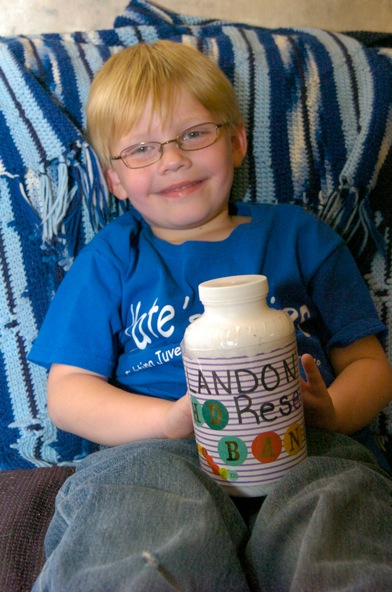 Landon, the "Button Boy Fighting Juvenile Huntington's" (family photo)
Yesterday an early Christmas gift arrived at my home from six-year-old Landon. Landon makes HD bracelets and key chains. He sells them, as well as buttons promoting the HD movement. Last June, he even joined Kate and Tara at the annual HDSA convention in Minneapolis. Since then he’s raised $1,500 for the cause.
Tara told me that Landon is determined that his dollars “will find the cure.”
Landon sent my family a box with a couple bracelets, about a dozen buttons, family photos, and pamphlets and business cards for his work as the “Button Boy Fighting Juvenile Huntington’s Disease.” (You can contact Landon’s family at tanyon_24[at]yahoo.com. To donate, make checks payable to Landon Hansen and mail to 102 1st Avenue, Doon, IA 51235. All proceeds go to juvenile HD research at the University of Iowa.)
My daughter and I inspected the package’s contents.
“How old is he?” she asked incredulously.
“He’s six,” I responded.
She selected for herself a mini-button with the words “I Love Someone with Huntington’s Disease.”
“We have to spread the word,” Landon told his mother about his gift to us. “The more people understand, the better.”
Friday, October 21, 2011
Huntington’s disease and the financial jitters
As I’ve written before, living with the deadly gene for Huntington’s disease is like a high-wire act. Fearful that HD’s terrible symptoms could start any time, I walk the tightrope while juggling job, family, HD advocacy and, along with my wife, our finances.
As I have described in a number of articles since beginning this blog in January 2005, HD is a killer of dreams. Although the threat of HD has caused me to grow in many ways and to enjoy life more fully, it has also led us to abandon many plans, including having a second child after we went through the trauma of testing our first baby in the womb. (She tested negative and today is a healthy eleven-year-old.)
If it weren’t for the specter of HD, which took my mother’s life in 2006, I could have advanced much further in my career. My wife and I could focus on saving for retirement rather than building up an “HD war chest” to compensate for the deep losses in income expected after the onset of symptoms forces me to stop working in the near future.
I’m almost 52, the age at which my mom already had symptoms.
Turning the crisis to our favor
The fear of HD has caused us to fret about our finances. We agonize over big purchases, and even bigger decisions such as refinancing our home turn into weeks- and even months-long discussions.
Our fears increased greatly in the recession that began in late 2007 and got much worse in 2008.
Like many Americans, we were reeling from the stock market crash, which eroded our savings. We were stunned at both the enormity of the crisis and the massive stimulus program, financed with borrowing from foreign sources.
But, hopeful about a recovery, we sought to turn the short-term crisis to our long-term advantage.
In 2009, during the early months of the administration of President Barack Obama, we took advantage of extremely low interest rates to refinance the mortgage, taking out extra money to build a swimming pool and carry out other home improvements. (I jokingly referred to the project as the “Obama stimulus pool.”) The risk was well worth it: the huge savings from the lower interest rate made the pool affordable, and I took up swimming again to bolster my brain against HD onset.
Economic pain
In a state with a real unemployment rate of more than 20 percent, we were thankful to have jobs.
However, we started to feel the economic pain not long after we took our first swim in the pool. For the first time in nearly two decades as a university professor, I received no raise during the 2009-2010 academic year. The next year my wife, a teacher in the San Diego school district, took a 3.7 percent pay cut that remains in effect. Like many others facing pay freezes and cuts, we’re also paying more for benefits.
To compensate for the lost pay, the school district cut five days off the school year and cut hundreds of millions of dollars from its budget. Now, with California sinking ever deeper into crisis and forcing additional school cuts of tens of millions of dollars, the San Diego district leadership may cancel even more classes. Last week, the superintendent declared that the district might need to declare itself insolvent. Teachers will likely face further salary cuts.
As we feared yet another drop in family income, my wife and I also worried about the quality of education our daughter is receiving in the public schools. We quickly became frustrated with the middle school that she entered in September. Class sizes are large (36 per class), and the school does not offer placement tests to ensure that all students have access to the proper level of instruction. It offers only a few honors sections.
Frustrated and convinced that the school crisis will last for many years, my wife and I decided that our daughter will apply to private schools.
Extending beyond our reach?
Annual tuition and other expenses at these schools could cost as much as $30,000. To afford it, we would need to forfeit all saving for retirement – the biggest portion of our HD war chest. Because we put pre-tax dollars into retirement, every dollar we stopped saving would be taxed at about a third. That would make the real cost of the most expensive private school closer to $40,000.
That was getting well beyond our reach, especially when we also need to save for our daughter’s college expenses.
Once again, we decided to refinance our mortgage in order to borrow enough money to pay for about half the cost of six years of private school (grades 7 through 12).
Because we refinanced for the pool, this time we must max out on the mortgage: we will be borrowing about 75 percent of the value of the home. We bought the house in 1999 and saw its value more than double during the real estate boom of the early to mid-2000s. Even in today’s depressed market, it’s still worth about two thirds more than the original price, thus allowing us to take out substantial cash upon refinancing.
In addition, interest rates have dropped to near historic lows. We’ll have a rate below 4 percent – a bargain when compared to forfeiting saving for retirement and the HD war chest.
Risk exposure
Nevertheless, unlike the pool project, this round of refinancing has left me with the jitters. Taking out such a big loan, with a mortgage payment of hundreds of dollars more per month, conjures up memories of how little disposable income we had after our first property purchase in 1994. That was before we learned that my mom had HD.
The future of our economy seems even more uncertain than it did in 2009.
And I worry about exposing the family to too much financial risk precisely as I progress towards the probable onset of HD.
In fact, as I write this article, it seems like sheer lunacy!
How will we pay for private school and a bigger mortgage, save for our daughter’s college and our retirement, build the HD war chest, and run the household if I must go on state long-term disability, which would pay, at most, only 65 percent of my salary (this income, at least, would be tax-free) and run out after age 65? I might be able to supplement disability with Social Security and Medicare benefits, but, as I wrote earlier this year, HD people struggle to obtain, and are sometimes even denied, those benefits.
Helping while I can
It’s a huge gamble – but one that we feel we must take.
It only makes sense when I remember that we are providing for one of the best investments in our daughter’s future: an excellent education.
Born HD-negative, she was our “miracle baby.”
But she is no longer that baby. She stands on the verge of adolescence – and is now only five years away from filling out her college applications.
She is HD-free, but could still feel the disease's impact because of the stark possibility that I could become disabled and therefore less able to support her during her high school and college years
I desperately await news of the key research breakthrough that will save me from the dementia and other devastating symptoms of HD. I want to see my daughter graduate from college and build a life of her own.
If HD prevents me from enjoying those moments, I will at least have done my part to help her get there while I could still help.
As I have described in a number of articles since beginning this blog in January 2005, HD is a killer of dreams. Although the threat of HD has caused me to grow in many ways and to enjoy life more fully, it has also led us to abandon many plans, including having a second child after we went through the trauma of testing our first baby in the womb. (She tested negative and today is a healthy eleven-year-old.)
If it weren’t for the specter of HD, which took my mother’s life in 2006, I could have advanced much further in my career. My wife and I could focus on saving for retirement rather than building up an “HD war chest” to compensate for the deep losses in income expected after the onset of symptoms forces me to stop working in the near future.
I’m almost 52, the age at which my mom already had symptoms.
Turning the crisis to our favor
The fear of HD has caused us to fret about our finances. We agonize over big purchases, and even bigger decisions such as refinancing our home turn into weeks- and even months-long discussions.
Our fears increased greatly in the recession that began in late 2007 and got much worse in 2008.
Like many Americans, we were reeling from the stock market crash, which eroded our savings. We were stunned at both the enormity of the crisis and the massive stimulus program, financed with borrowing from foreign sources.
But, hopeful about a recovery, we sought to turn the short-term crisis to our long-term advantage.
In 2009, during the early months of the administration of President Barack Obama, we took advantage of extremely low interest rates to refinance the mortgage, taking out extra money to build a swimming pool and carry out other home improvements. (I jokingly referred to the project as the “Obama stimulus pool.”) The risk was well worth it: the huge savings from the lower interest rate made the pool affordable, and I took up swimming again to bolster my brain against HD onset.
Economic pain
In a state with a real unemployment rate of more than 20 percent, we were thankful to have jobs.
However, we started to feel the economic pain not long after we took our first swim in the pool. For the first time in nearly two decades as a university professor, I received no raise during the 2009-2010 academic year. The next year my wife, a teacher in the San Diego school district, took a 3.7 percent pay cut that remains in effect. Like many others facing pay freezes and cuts, we’re also paying more for benefits.
To compensate for the lost pay, the school district cut five days off the school year and cut hundreds of millions of dollars from its budget. Now, with California sinking ever deeper into crisis and forcing additional school cuts of tens of millions of dollars, the San Diego district leadership may cancel even more classes. Last week, the superintendent declared that the district might need to declare itself insolvent. Teachers will likely face further salary cuts.
As we feared yet another drop in family income, my wife and I also worried about the quality of education our daughter is receiving in the public schools. We quickly became frustrated with the middle school that she entered in September. Class sizes are large (36 per class), and the school does not offer placement tests to ensure that all students have access to the proper level of instruction. It offers only a few honors sections.
Frustrated and convinced that the school crisis will last for many years, my wife and I decided that our daughter will apply to private schools.
Extending beyond our reach?
Annual tuition and other expenses at these schools could cost as much as $30,000. To afford it, we would need to forfeit all saving for retirement – the biggest portion of our HD war chest. Because we put pre-tax dollars into retirement, every dollar we stopped saving would be taxed at about a third. That would make the real cost of the most expensive private school closer to $40,000.
That was getting well beyond our reach, especially when we also need to save for our daughter’s college expenses.
Once again, we decided to refinance our mortgage in order to borrow enough money to pay for about half the cost of six years of private school (grades 7 through 12).
Because we refinanced for the pool, this time we must max out on the mortgage: we will be borrowing about 75 percent of the value of the home. We bought the house in 1999 and saw its value more than double during the real estate boom of the early to mid-2000s. Even in today’s depressed market, it’s still worth about two thirds more than the original price, thus allowing us to take out substantial cash upon refinancing.
In addition, interest rates have dropped to near historic lows. We’ll have a rate below 4 percent – a bargain when compared to forfeiting saving for retirement and the HD war chest.
Risk exposure
Nevertheless, unlike the pool project, this round of refinancing has left me with the jitters. Taking out such a big loan, with a mortgage payment of hundreds of dollars more per month, conjures up memories of how little disposable income we had after our first property purchase in 1994. That was before we learned that my mom had HD.
The future of our economy seems even more uncertain than it did in 2009.
And I worry about exposing the family to too much financial risk precisely as I progress towards the probable onset of HD.
In fact, as I write this article, it seems like sheer lunacy!
How will we pay for private school and a bigger mortgage, save for our daughter’s college and our retirement, build the HD war chest, and run the household if I must go on state long-term disability, which would pay, at most, only 65 percent of my salary (this income, at least, would be tax-free) and run out after age 65? I might be able to supplement disability with Social Security and Medicare benefits, but, as I wrote earlier this year, HD people struggle to obtain, and are sometimes even denied, those benefits.
Helping while I can
It’s a huge gamble – but one that we feel we must take.
It only makes sense when I remember that we are providing for one of the best investments in our daughter’s future: an excellent education.
Born HD-negative, she was our “miracle baby.”
But she is no longer that baby. She stands on the verge of adolescence – and is now only five years away from filling out her college applications.
She is HD-free, but could still feel the disease's impact because of the stark possibility that I could become disabled and therefore less able to support her during her high school and college years
I desperately await news of the key research breakthrough that will save me from the dementia and other devastating symptoms of HD. I want to see my daughter graduate from college and build a life of her own.
If HD prevents me from enjoying those moments, I will at least have done my part to help her get there while I could still help.
Friday, September 02, 2011
One Man's Story: Entering the Light
(At the invitation of the Huntington’s Disease Society of America [HDSA], I wrote this article for the September 2011 issue of the HDSA support group newsletter We Are HDSA!)
By Gene Veritas, author of At Risk for Huntington’s Disease and recipient of the 2011 HDSA Person of the Year award
As a severely disabling and fatal brain disorder, Huntington’s disease carries a deep stigma that often leads individuals and even entire families to hide the truth about their situation.
In learning of my mother’s diagnosis of HD on the day after Christmas of 1995, I wanted to get tested immediately. However, my mother’s geneticist and the president of the local HDSA chapter warned me against rushing into a test. They pointed out that gene-positive individuals sometimes faced discrimination from employers and insurance companies. So I postponed testing, and I kept my at-risk status private.
I thus entered the “HD closet,” a terrible and lonely place where I struggled with the wrenching fears of HD as I watched my mother decline.
In June 1999, I tested positive for HD. That life-jolting event caused me to retreat even deeper into the closet.
I lived in the grips of a massive contradiction: activism for HDSA and the need to shield myself from discrimination.
Enthusiastically, but anonymously, I served on the board of the San Diego Chapter of HDSA from April 1998 to October 2010.
In 2005 I started the blog At Risk for Huntington’s Disease. To protect my identity, I adopted the pseudonym “Gene Veritas,” the “truth in my genes.” Since then I have written regularly about the many challenges of HD – including the deeply frustrating experience of the HD closet.
But I knew that, if I wanted to truly defeat stigma, I someday would have to exit the closet.
Thanks to a combination of factors, in 2010 I began giving public speeches about my situation, using my real name.
Now in my fifties, I feel I have sufficient gravitas to negotiate the inevitable complications, including discrimination. Crucially, two pieces of federal legislation have given me and other gene-positive people support: the Genetic Information Nondiscrimination Act (GINA) of 2008, which bars certain kinds of discrimination, and the 2010 health-care reform law (the Patient Protection and Affordable Care Act), which, in 2014, will prohibit denial of coverage to people with pre-existing conditions.
Most importantly, HD researchers are making great progress, giving me the confidence that an eventual treatment or cure would end the HD closet forever.
From the scientists, I have begun learning that the closet poses a huge obstacle to their work. Without the active participation of our community in clinical trials and other experiments, the researchers cannot test potential treatments for safety and efficacy.
In my new role as a public advocate and as the 2011 "HDSA Person of the Year," I urge everybody in our community to get involved, summoning up the courage we know we possess to exit the terrible and lonely HD closet.
You can make a difference in many ways: by attending the local HD support group, volunteering for your local chapter or affiliate, and joining in HDSA’s advocacy and fundraising efforts. I also sincerely believe that if you are at risk, you should seriously consider the possibility of genetic testing.
You can also contact your local HDSA chapter or Center of Excellence to learn more about observational and clinical trials.
Above all, as we exit the HD closet hand in hand, it’s time to tell a friend or relative about Huntington’s disease and how it affects your family’s life. Your personal testimony provides the most effective way to fight stigma, inspire others to join the cause, and build awareness about the need to defeat HD.
Monday, March 14, 2011
A cascade of emotions about Huntington’s disease
The world will remember Friday, March 11, 2011, as the day that a devastating earthquake and tsunami overwhelmed Japan and triggered a potential nuclear disaster in a land already scarred by the bombs of Hiroshima and Nagasaki.
I also will remember that day for some very personal reasons: a cascade of difficult feelings about Huntington’s disease nearly overwhelmed me.
My heart goes out to the people of Japan. More than ever, the world needs to show solidarity with the victims of natural and manmade disasters.
I’m also reminded of the need for solidarity with people affected by HD and so many other similar diseases – like an acquaintance, the mother of three, struck down in her prime by multiple sclerosis.
Memories of testing
My own series of difficult feelings began the evening of Sunday, March 6, when I checked one of the HD groups on Facebook and read about a young man in the armed forces who was getting tested for the disease. The young man’s father has HD, and his mother was seeking advice from the group.
The military doctor knew nothing about HD. The clinic drew the serviceman’s blood and sent it to a commercial testing service. The serviceman received none of the pre-test genetic counseling that is mandatory at clinics that follow accepted standards for genetic testing.
The young man’s situation triggered a flood of memories of my own genetic test for HD in 1999. My wife and I received counseling prior to obtaining my result, and, as my support person, my wife was required to be at my side at the moment the doctor revealed the result. The counselor was also present on that day.
I tested positive. My wife and I left the medical office in a daze. As I backed our car out of the space in the parking garage, I swung too far to the right and scraped the right front fender on a column (click here to read more).
I felt deep anger, frustration, and resignation. Now I knew that I would share the HD fate of my mother, who already had full-blown HD and had lost most of her ability to speak and care for herself. She ultimately died of HD in 2006.
Desperately wanting to help
I desperately wanted to help the young serviceman obtain support.
I wrote to the Facebook HD group:
“He should NOT just test instantly like that! There is a protocol that requires counseling from a genetic counselor and a psychologist. … Testing is a huge event in a person's life – whether the result is negative or positive. A counselor or psychological support person should be there when he gets the results, and also a friend, spouse, or other family member.... Also, it's important to remember: a positive test result for HD is NOT a diagnosis for HD. The person can live years or even decades without symptoms.”
I frantically began to work my contacts in the local community to see if we could arrange for a genetic counselor or other professional support person to assist him on the day of his test results.
Driving home our message
Before I got too far, though, his mother notified the group: he tested negative!
What a relief! I thought.
But, also, what a close call! I wondered: how would he have reacted had he tested positive?
This young man’s story once again underscored the message that I and other HD activists must drive home.
Sadly, HD remains a largely unknown disease, even within the medical community. As a society we need to build greater awareness about orphan diseases, provide up-to-date information on the procedures and implications of genetic testing, and be on the lookout for potential genetic discrimination.
Sharing my story (again)
As other HD community members and I attempted to assist the serviceman and his family, I braced myself for another stage in my transition to a public advocate for HD.
On February 7, I gave a public speech to some 250 people at the annual “Super Bowl” of Huntington’s research, the 6th Annual HD Therapeutics Conference, held in Palm Springs, California, and sponsored by the CHDI Foundation, Inc., informally known as the “cure Huntington’s disease initiative.” And on February 28 I came out about my gene-positive status in a talk to the local support group in San Diego.
A couple days later, I read that a former college classmate, now a prominent philanthropist and documentary filmmaker, would be in town on March 8 to give a presentation.
We hadn’t seen each other since graduation from Yale in May 1982, but I decided to attend her event as a show of support for her work in social justice and women’s rights.
Before the event, I wrote her a personal letter thanking her for her social commitment.
“I wanted to share with you my own odyssey of the past 16 years advocating against genetic discrimination and raising awareness about the need to find treatments for Huntington’s disease (HD) and other orphan diseases and neurological disorders,” I wrote. “I believe all areas of social justice are interconnected.… So I believe we share common ground.”
Before she gave her speech, my classmate greeted me warmly. We hugged, and she asked me about what I had been up to since graduation. I told her of my deep involvement with Brazil as a professor of history.
Afterwards, I went to congratulate her. I gave her an envelope with my letter – and a copy of my CHDI speech, “Blog Entry No. 85 … Unmasking the World of Gene Veritas: An Activist Copes with the Threat of Huntington’s Disease.”
Struggling with doubts
My old classmate is extremely busy, so I don’t know yet whether she read the letter or watched my speech.
But, as I said in an e-mail to some friends, the reconnection with my classmate was “very emotional.”
Just seeing a classmate for the first time in nearly three decades was enough emotion for one day.
But, on top of that, came my HD activism – my life’s work, my life itself, so deeply affected by my mother’s demise and my inheriting the defective gene from her.
I struggled with doubts in the days leading up to her event: should I “bother” her by coming out about something so sad and complex as Huntington’s disease and its terrible impact on families? Isn’t it presumptuous of me to give her a letter and my DVD after so many years of no contact? Will she be interested in the cause in any way?
“Maybe she’ll make a film about HD,” a friend and HD activist suggested hopefully.
“I didn’t ask for anything in the letter,” I replied. “I am doing my job as an advocate: getting the word out about HD. I will just be happy if there is just one more person praying for us.”
Testing the waters in the workplace
On Thursday, March 10, I started exploring a huge and inevitable step: coming out about my HD status in the workplace, potentially the most explosive arena of my life in terms of genetic discrimination.
During lunch with a trusted co-worker, I mentioned that I was living an extremely intense period of my life outside of work.
This was the very first time that I alluded to my activism after erecting an absolute firewall between my HD life and my professional life following my mother’s diagnosis in 1995. I have kept that firewall intact because of fear of genetic discrimination.
The disintegrating firewall
I didn’t mention the word “disease” to my co-worker, but I did explain that I am involved with a cause and a situation that could ultimately impact my situation in the workplace. I revealed to her that I had given a speech and that I would like to give her a copy of it sometime. I asked her to keep my situation confidential for now.
My stomach felt as if it were turning upside down, and my mind wanted to go blank. I was having a difficult time finding the right words.
I felt the firewall between my job and my activism being disintegrated by my words and the violent currents of my fears about a future with Huntington’s disease. As if to act out this huge change in my life, I moved my arms back and forth next to each other along the table. This gesture represented my dual life – my job and my HD activism moving in parallel and never intersecting.
My co-worker sensed my difficulties and reassured me by saying that I should tell my story on my own terms and on my own schedule.
Indeed, as I told her, I still haven’t worked out for myself how to proceed on the professional front.
Planning a trip to Alnylam
More than a month has passed since my CHDI speech. I’m living as intensely as ever as I step further and further out of the HD closet.
I turned 51 last December, and as I progress into this decade of my life, I will get closer to the inevitable onset of the HD symptoms that destroyed my mother’s mind and her ability to walk and eat.
But there has never been a time of greater hope in the quest of scientists to find treatments and a cure for HD.
In the midst of my personal churn of emotions last week I firmed up plans to visit Alnylam Pharmaceuticals in May to give a talk on HD and observe the companies’ researchers at work on a potentially revolutionary treatment using RNA interference to stop the disease at its genetic roots.
A break from the real battles
Luckily, I began a week’s vacation on March 11.
That also happened to be the opening day for the film Battle: Los Angeles, about an invasion of aliens seeking to colonize Earth for its water resources.
After school I picked up my daughter – our 10-year-old “miracle baby,” who tested negative in the womb for HD.
As the first act of her weekend and my vacation, we headed for the movie theatre.
Life’s major battles continued – in the stark reality of both the Japanese tsunami and the search for treatments and cures for HD and other life-sapping neurological conditions.
And also in the fantasies of Hollywood, where, for at least a couple hours, I could find a bit of escape and catharsis.
I also will remember that day for some very personal reasons: a cascade of difficult feelings about Huntington’s disease nearly overwhelmed me.
My heart goes out to the people of Japan. More than ever, the world needs to show solidarity with the victims of natural and manmade disasters.
I’m also reminded of the need for solidarity with people affected by HD and so many other similar diseases – like an acquaintance, the mother of three, struck down in her prime by multiple sclerosis.
Memories of testing
My own series of difficult feelings began the evening of Sunday, March 6, when I checked one of the HD groups on Facebook and read about a young man in the armed forces who was getting tested for the disease. The young man’s father has HD, and his mother was seeking advice from the group.
The military doctor knew nothing about HD. The clinic drew the serviceman’s blood and sent it to a commercial testing service. The serviceman received none of the pre-test genetic counseling that is mandatory at clinics that follow accepted standards for genetic testing.
The young man’s situation triggered a flood of memories of my own genetic test for HD in 1999. My wife and I received counseling prior to obtaining my result, and, as my support person, my wife was required to be at my side at the moment the doctor revealed the result. The counselor was also present on that day.
I tested positive. My wife and I left the medical office in a daze. As I backed our car out of the space in the parking garage, I swung too far to the right and scraped the right front fender on a column (click here to read more).
I felt deep anger, frustration, and resignation. Now I knew that I would share the HD fate of my mother, who already had full-blown HD and had lost most of her ability to speak and care for herself. She ultimately died of HD in 2006.
Desperately wanting to help
I desperately wanted to help the young serviceman obtain support.
I wrote to the Facebook HD group:
“He should NOT just test instantly like that! There is a protocol that requires counseling from a genetic counselor and a psychologist. … Testing is a huge event in a person's life – whether the result is negative or positive. A counselor or psychological support person should be there when he gets the results, and also a friend, spouse, or other family member.... Also, it's important to remember: a positive test result for HD is NOT a diagnosis for HD. The person can live years or even decades without symptoms.”
I frantically began to work my contacts in the local community to see if we could arrange for a genetic counselor or other professional support person to assist him on the day of his test results.
Driving home our message
Before I got too far, though, his mother notified the group: he tested negative!
What a relief! I thought.
But, also, what a close call! I wondered: how would he have reacted had he tested positive?
This young man’s story once again underscored the message that I and other HD activists must drive home.
Sadly, HD remains a largely unknown disease, even within the medical community. As a society we need to build greater awareness about orphan diseases, provide up-to-date information on the procedures and implications of genetic testing, and be on the lookout for potential genetic discrimination.
Sharing my story (again)
As other HD community members and I attempted to assist the serviceman and his family, I braced myself for another stage in my transition to a public advocate for HD.
On February 7, I gave a public speech to some 250 people at the annual “Super Bowl” of Huntington’s research, the 6th Annual HD Therapeutics Conference, held in Palm Springs, California, and sponsored by the CHDI Foundation, Inc., informally known as the “cure Huntington’s disease initiative.” And on February 28 I came out about my gene-positive status in a talk to the local support group in San Diego.
A couple days later, I read that a former college classmate, now a prominent philanthropist and documentary filmmaker, would be in town on March 8 to give a presentation.
We hadn’t seen each other since graduation from Yale in May 1982, but I decided to attend her event as a show of support for her work in social justice and women’s rights.
Before the event, I wrote her a personal letter thanking her for her social commitment.
“I wanted to share with you my own odyssey of the past 16 years advocating against genetic discrimination and raising awareness about the need to find treatments for Huntington’s disease (HD) and other orphan diseases and neurological disorders,” I wrote. “I believe all areas of social justice are interconnected.… So I believe we share common ground.”
Before she gave her speech, my classmate greeted me warmly. We hugged, and she asked me about what I had been up to since graduation. I told her of my deep involvement with Brazil as a professor of history.
Afterwards, I went to congratulate her. I gave her an envelope with my letter – and a copy of my CHDI speech, “Blog Entry No. 85 … Unmasking the World of Gene Veritas: An Activist Copes with the Threat of Huntington’s Disease.”
Struggling with doubts
My old classmate is extremely busy, so I don’t know yet whether she read the letter or watched my speech.
But, as I said in an e-mail to some friends, the reconnection with my classmate was “very emotional.”
Just seeing a classmate for the first time in nearly three decades was enough emotion for one day.
But, on top of that, came my HD activism – my life’s work, my life itself, so deeply affected by my mother’s demise and my inheriting the defective gene from her.
I struggled with doubts in the days leading up to her event: should I “bother” her by coming out about something so sad and complex as Huntington’s disease and its terrible impact on families? Isn’t it presumptuous of me to give her a letter and my DVD after so many years of no contact? Will she be interested in the cause in any way?
“Maybe she’ll make a film about HD,” a friend and HD activist suggested hopefully.
“I didn’t ask for anything in the letter,” I replied. “I am doing my job as an advocate: getting the word out about HD. I will just be happy if there is just one more person praying for us.”
Testing the waters in the workplace
On Thursday, March 10, I started exploring a huge and inevitable step: coming out about my HD status in the workplace, potentially the most explosive arena of my life in terms of genetic discrimination.
During lunch with a trusted co-worker, I mentioned that I was living an extremely intense period of my life outside of work.
This was the very first time that I alluded to my activism after erecting an absolute firewall between my HD life and my professional life following my mother’s diagnosis in 1995. I have kept that firewall intact because of fear of genetic discrimination.
The disintegrating firewall
I didn’t mention the word “disease” to my co-worker, but I did explain that I am involved with a cause and a situation that could ultimately impact my situation in the workplace. I revealed to her that I had given a speech and that I would like to give her a copy of it sometime. I asked her to keep my situation confidential for now.
My stomach felt as if it were turning upside down, and my mind wanted to go blank. I was having a difficult time finding the right words.
I felt the firewall between my job and my activism being disintegrated by my words and the violent currents of my fears about a future with Huntington’s disease. As if to act out this huge change in my life, I moved my arms back and forth next to each other along the table. This gesture represented my dual life – my job and my HD activism moving in parallel and never intersecting.
My co-worker sensed my difficulties and reassured me by saying that I should tell my story on my own terms and on my own schedule.
Indeed, as I told her, I still haven’t worked out for myself how to proceed on the professional front.
Planning a trip to Alnylam
More than a month has passed since my CHDI speech. I’m living as intensely as ever as I step further and further out of the HD closet.
I turned 51 last December, and as I progress into this decade of my life, I will get closer to the inevitable onset of the HD symptoms that destroyed my mother’s mind and her ability to walk and eat.
But there has never been a time of greater hope in the quest of scientists to find treatments and a cure for HD.
In the midst of my personal churn of emotions last week I firmed up plans to visit Alnylam Pharmaceuticals in May to give a talk on HD and observe the companies’ researchers at work on a potentially revolutionary treatment using RNA interference to stop the disease at its genetic roots.
A break from the real battles
Luckily, I began a week’s vacation on March 11.
That also happened to be the opening day for the film Battle: Los Angeles, about an invasion of aliens seeking to colonize Earth for its water resources.
After school I picked up my daughter – our 10-year-old “miracle baby,” who tested negative in the womb for HD.
As the first act of her weekend and my vacation, we headed for the movie theatre.
Life’s major battles continued – in the stark reality of both the Japanese tsunami and the search for treatments and cures for HD and other life-sapping neurological conditions.
And also in the fantasies of Hollywood, where, for at least a couple hours, I could find a bit of escape and catharsis.
Monday, October 11, 2010
Losing control, seeking connections
As a person who is gene-positive for Huntington’s disease, I have steadily stepped up my involvement in the cause to stop it. My commitment began a couple years after learning of my mother’s diagnosis in late 1995 and intensified after I tested positive in 1999.
Lately, as I take on ever more tasks in the movement, I should feel great satisfaction. And I do.
But, ironically, I’ve also felt that I’m losing control over my life. I feel overwhelmed by what I call my three jobs: family, work, and the HD cause. And my decision to gradually go public about my status will forever change how people see me.
Big goals
On September 24 I made my first speech in the United States about my family’s struggle against HD.
After blogging on that presentation, I delved into an overdue writing project for my work. A lot is riding on it, because, if successful, it could lift my profile in the world of writing and help me raise awareness about the need to fight HD and other genetic diseases.
I had been working on this project for six months, and when I turned it in last Thursday, October 7, I felt an enormous relief.
But I immediately had to prepare for something even more important: the next day, October 8, I would pay my annual visit to Isis Pharmaceuticals, Inc., for an update on the company’s historic attempt to stop HD.
Genetic guerrillas
My professional writing project is about former South American guerrillas accused of terrorism. Suddenly, I had to shift to thinking about oligonucleotides, or oligos, which are a bit like genetic guerrillas. If all goes as planned, these guerrillas will bind to messenger RNA in the brain cells of HD patients and block the process that kills the cells.
Known as antisense technology, the Isis approach is a rare attempt to stop HD at its genetic roots. So it might lead to a “cure,” although Dr. Frank Bennett of Isis cautions against the use of that word. The more likely outcome is a treatment that becomes one in an array of medicines.
I spent several hours reviewing my past articles on Isis, posters on oligos presented at scientific meetings, and the notes from my conversation with Dr. Doug Macdonald, the director of pharmacology at CHDI Management, Inc., informally known as the “Cure Huntington’s Disease Initiative,” a collaborator with Isis in the oligo project.
My life in their hands
At Isis I was overwhelmed to see Dr. Bennett, the senior vice president for research, and Dr. Gene Hung, the scientist in charge of the HD research project. In my imagination these two men, along with others on the Isis team, hold my life – and the lives of tens of thousands of HD patients and at-risk individuals – in their hands.
Before we even began the interview, I warmly thanked Drs. Bennett and Hung for their dedication to assisting the HD community.
I desperately wanted to hear from them that Isis had found the treatment and was ready to begin testing in humans. In a nutshell, the project is taking longer than anticipated, but the progress is remarkable. (Later I’ll blog in greater detail on what I learned.)
Driving home from Isis, I felt a strange mix of euphoria and angst. I had just received encouraging news, and I had successfully carried out an interview on a difficult and complex subject.
But there are no guarantees the project will ultimately arrive at an effective treatment.
And, I wondered, what if it comes too late? My mother died of HD in 2006 at the age of 68, and, at 50, I am already past the age at which her symptoms began.
I wanted to both celebrate and hunker down.
The grapevine
Several months ago I told a good friend and professional colleague about my situation. This was the first time I revealed HD to anybody in my field. He showed great compassion and even made a donation to the Huntington’s Disease Society of America.
Last night I got a surprise call from a mutual friend and colleague who had heard that I was facing “health issues.” He was concerned that I might have something like multiple sclerosis or prostate cancer.
The inevitable grapevine has gone into action, I thought to myself. I have known this person for well over a decade and have trusted him on many professional questions. I decided to tell him about Huntington’s disease – and about how it was important for me to keep it hidden for so many years.
HIV-positive and HD-positive
The first friend had no inkling whatsoever about HD, but the second knew a family affected by HD and had learned in great detail about its medical and social impact.
He immediately got the picture.
This man is openly gay, and so I knew that he could identify with someone who was gene-positive for a deadly disease. In fact, I had previously imagined coming out to him because of his background as a gay rights activist.
We spent a while discussing the similarities between the situations of HIV-positive and HD-positive people.
Both groups have suffered a horrible stigma, leading to problems of discrimination in the workplace and other areas of life. Success in our shared professional field depends a lot on perceptions, and the slightest hint of an inadequacy of any kind can sour a person’s plans to advance.
And the victims of both HIV and HD face a terribly agonizing waiting game of wondering when and how symptoms will develop.
The end of control?
My friend expressed unconditional support, including future advice on how to come out.
I am sure I’ll be calling on him in the coming months. As I’ve written before, our society has developed a ritual for coming out about HIV and other well-known maladies, but still lacks one for genetic diseases, especially orphan conditions such as Huntington’s.
Although my two friends have promised to protect my identity, I know that as I speak out more about HD, the grapevine effect will grow. There is no such thing as a secret once it’s been shared. I will need to prepare myself for more phone calls, e-mails, and personal questions.
The lack of control over people’s perceptions of my HD status is something that I’ll have to live with the rest of my life.
I become especially distressed when I remember how my own mother lost control of her mind and body as HD ravaged her brain. HD people lose control over their movements and basic abilities such as walking, talking, and thinking.
HD people pass control over their lives to caregivers and, as death nears, to nursing home workers. I vividly remember how my father and later healthcare personnel spoon-fed my mother. It was as if she had returned to childhood.
In the end, nobody controls his or her biological destiny: death. People with devastating diseases have an acute awareness of this fact of life.
New and better bonds
As I approach my own destiny with HD, I will need to build ever stronger ties to people.
Going public will forever eliminate control over my genetic information, but it will also connect me to a growing number of people within the HD community and beyond.
I have long feared going public, but in doing so I can find new allies like the friend who called me yesterday to offer support.
HD could leave me completely dependent on my wife and daughter, so I also need to continue strengthening my bonds with them. If and when they need to care for me, I want that transition to go as smoothly as possible. I don’t want to be a burden, but know I could become one. I want to love and care for them while I can.
Lately, as I take on ever more tasks in the movement, I should feel great satisfaction. And I do.
But, ironically, I’ve also felt that I’m losing control over my life. I feel overwhelmed by what I call my three jobs: family, work, and the HD cause. And my decision to gradually go public about my status will forever change how people see me.
Big goals
On September 24 I made my first speech in the United States about my family’s struggle against HD.
After blogging on that presentation, I delved into an overdue writing project for my work. A lot is riding on it, because, if successful, it could lift my profile in the world of writing and help me raise awareness about the need to fight HD and other genetic diseases.
I had been working on this project for six months, and when I turned it in last Thursday, October 7, I felt an enormous relief.
But I immediately had to prepare for something even more important: the next day, October 8, I would pay my annual visit to Isis Pharmaceuticals, Inc., for an update on the company’s historic attempt to stop HD.
Genetic guerrillas
My professional writing project is about former South American guerrillas accused of terrorism. Suddenly, I had to shift to thinking about oligonucleotides, or oligos, which are a bit like genetic guerrillas. If all goes as planned, these guerrillas will bind to messenger RNA in the brain cells of HD patients and block the process that kills the cells.
Known as antisense technology, the Isis approach is a rare attempt to stop HD at its genetic roots. So it might lead to a “cure,” although Dr. Frank Bennett of Isis cautions against the use of that word. The more likely outcome is a treatment that becomes one in an array of medicines.
I spent several hours reviewing my past articles on Isis, posters on oligos presented at scientific meetings, and the notes from my conversation with Dr. Doug Macdonald, the director of pharmacology at CHDI Management, Inc., informally known as the “Cure Huntington’s Disease Initiative,” a collaborator with Isis in the oligo project.
My life in their hands
At Isis I was overwhelmed to see Dr. Bennett, the senior vice president for research, and Dr. Gene Hung, the scientist in charge of the HD research project. In my imagination these two men, along with others on the Isis team, hold my life – and the lives of tens of thousands of HD patients and at-risk individuals – in their hands.
Before we even began the interview, I warmly thanked Drs. Bennett and Hung for their dedication to assisting the HD community.
I desperately wanted to hear from them that Isis had found the treatment and was ready to begin testing in humans. In a nutshell, the project is taking longer than anticipated, but the progress is remarkable. (Later I’ll blog in greater detail on what I learned.)
Driving home from Isis, I felt a strange mix of euphoria and angst. I had just received encouraging news, and I had successfully carried out an interview on a difficult and complex subject.
But there are no guarantees the project will ultimately arrive at an effective treatment.
And, I wondered, what if it comes too late? My mother died of HD in 2006 at the age of 68, and, at 50, I am already past the age at which her symptoms began.
I wanted to both celebrate and hunker down.
The grapevine
Several months ago I told a good friend and professional colleague about my situation. This was the first time I revealed HD to anybody in my field. He showed great compassion and even made a donation to the Huntington’s Disease Society of America.
Last night I got a surprise call from a mutual friend and colleague who had heard that I was facing “health issues.” He was concerned that I might have something like multiple sclerosis or prostate cancer.
The inevitable grapevine has gone into action, I thought to myself. I have known this person for well over a decade and have trusted him on many professional questions. I decided to tell him about Huntington’s disease – and about how it was important for me to keep it hidden for so many years.
HIV-positive and HD-positive
The first friend had no inkling whatsoever about HD, but the second knew a family affected by HD and had learned in great detail about its medical and social impact.
He immediately got the picture.
This man is openly gay, and so I knew that he could identify with someone who was gene-positive for a deadly disease. In fact, I had previously imagined coming out to him because of his background as a gay rights activist.
We spent a while discussing the similarities between the situations of HIV-positive and HD-positive people.
Both groups have suffered a horrible stigma, leading to problems of discrimination in the workplace and other areas of life. Success in our shared professional field depends a lot on perceptions, and the slightest hint of an inadequacy of any kind can sour a person’s plans to advance.
And the victims of both HIV and HD face a terribly agonizing waiting game of wondering when and how symptoms will develop.
The end of control?
My friend expressed unconditional support, including future advice on how to come out.
I am sure I’ll be calling on him in the coming months. As I’ve written before, our society has developed a ritual for coming out about HIV and other well-known maladies, but still lacks one for genetic diseases, especially orphan conditions such as Huntington’s.
Although my two friends have promised to protect my identity, I know that as I speak out more about HD, the grapevine effect will grow. There is no such thing as a secret once it’s been shared. I will need to prepare myself for more phone calls, e-mails, and personal questions.
The lack of control over people’s perceptions of my HD status is something that I’ll have to live with the rest of my life.
I become especially distressed when I remember how my own mother lost control of her mind and body as HD ravaged her brain. HD people lose control over their movements and basic abilities such as walking, talking, and thinking.
HD people pass control over their lives to caregivers and, as death nears, to nursing home workers. I vividly remember how my father and later healthcare personnel spoon-fed my mother. It was as if she had returned to childhood.
In the end, nobody controls his or her biological destiny: death. People with devastating diseases have an acute awareness of this fact of life.
New and better bonds
As I approach my own destiny with HD, I will need to build ever stronger ties to people.
Going public will forever eliminate control over my genetic information, but it will also connect me to a growing number of people within the HD community and beyond.
I have long feared going public, but in doing so I can find new allies like the friend who called me yesterday to offer support.
HD could leave me completely dependent on my wife and daughter, so I also need to continue strengthening my bonds with them. If and when they need to care for me, I want that transition to go as smoothly as possible. I don’t want to be a burden, but know I could become one. I want to love and care for them while I can.
Subscribe to:
Posts (Atom)