Tuesday, August 29, 2023

Adding to arsenal of movement disorder drugs approved by FDA, Neurocrine pledges to seek anxiously awaited therapies to slow progression of Huntington’s disease


Neurocrine Biosciences, Inc., announced on August 18 that the U.S. Food and Drug Administration (FDA) has approved its drug INGREZZA to treat chorea, a debilitating movement disorder suffered by people with Huntington’s disease.


INGREZZA is the third FDA-approved HD chorea drug.


Like the two previously approved, similar drugs for chorea made by other drug companies, INGREZZA does not fulfill what the HD community of scientists, advocates, and affected families anxiously await: development and FDA approval of a drug to slow, halt, or reverse the progression of the disease.


INGREZZA is easier to take, requiring just one daily dose, and its availability could deliver a therapy to those suffering chorea, many of whom do not take the two other drugs.


Recognizing the need to go beyond treating just chorea, Neurocrine’s scientific leadership has pledged to seek the development of so-called disease-modifying therapies for HD, which other clinical trials have failed to achieve.


“We have had an interest and a focus on HD and other rare neurological disorders at Neurocrine for a long time,” Eiry Roberts, M.D., Neurocrine’s chief medical officer, told me in a Zoom interview on August 25, recalling that the San Diego-based biotech firm was founded in 1992. “Now, that is not only focused on symptomatic treatments for rare neurological disorders, but also on that very, very important area of disease modification and cures.”


Huntington’s disease is “right front and center in our neurology therapeutic area efforts on the research side,” Dr. Roberts added. “Those obviously take a while to come through into the clinic. But we really have a significant interest there, and understand the importance to the community, as the community has been let down several times by failures in this space. But the science is evolving very rapidly, and we want to be a part of that as we move forward.”


Clockwise from upper left: Aimee White, Neurocrine director of corporate communications, Gene Veritas (aka Kenneth P. Serbin), Dr. Eiry Roberts, Neurocrine chief medical officer, and Dr. Dietrich Haubenberger, Neurocrine executive medical director and clinical lead for the KINECT-HD clinical trial during a Zoom call on August 25, 2023 (screenshot by Gene Veritas).


A drug earning large revenues


In 2008, introduced into the U.S. by Lundbeck, Xenazine (tetrabenazine) became the first FDA-approved HD-specific drug of any kind and is used to reduce chorea. In 2015 Xenazine/tetrabenazine became a generic drug.


In 2017, the FDA approved Austedo (deutetrabenazine), a very similar but improved chorea drug developed in San Diego by Auspex Pharmaceuticals but ultimately licensed by Israel-based pharma giant Teva, which had acquired Auspex and the rights to the drug.


In 2017, INGREZZA was approved by the FDA for the treatment of tardive dyskinesia, an irreversible involuntary movement disorder unrelated to HD.


INGREZZA – the compound valbenazine – has a different chemical makeup than its predecessors. Like them, however, it is a VMAT2 inhibitor, designed to reduce involuntary movements like chorea. VMAT2 inhibitors help regulate dopamine, a chemical messenger in the brain that affects movements.


INGEZZA’S prior approval by the FDA allowed Neurocrine to skip the early phases of a clinical trial program and take the drug directly into a definitive  Phase 3 trial run in partnership with the Huntington Study Group, the world’s largest HD clinical research network, with deep experience in running drug trials, including for Xenazine and Austedo.


Xenazine requires three daily doses, Austedo two, but INGREZZA just one – although in anticipation of Neurocrine’s entry into the market with INGREZZA, Teva received permission from the FDA in February to reduce the daily dose to just one. Nevertheless, Austedo requires titration, that is, slowly increasing the dosage over weeks. INGREZZA is always just one pill.


Both Teva and Neurocrine have earned hundreds of millions of dollars annually with their respective drugs (on INGREZZA, for example, click here to read more).


Life with HD in the U.S. before anti-chorea drugs


“Most people with HD experience chorea, an abnormal involuntary movement disorder, characterized by irregular and unpredictable movements,” the Neurocrine press release observed.  “Chorea can affect various body parts and interfere with motor coordination, gait, swallowing and speech.”


In the U.S., before the approval of Xenazine, at least some HD families got tetrabenazine from Canada, where the drug was legal.


My mother, who died of HD in 2006 at the age of 68 – two years before the Xenazine approval –was never able to take tetrabenazine for chorea. Instead, she was prescribed haloperidol, although we heard from HD advocates and family members that this drug could have very negative side effects. My mother switched to Zyprexa (olanzapine), an antipsychotic medication.


Early in my family’s journey with HD – I tested positive for the HD mutation in 1999 – I took Zyprexa for depression and anxiety.


Thankfully, at 63 I have reached an age about 15 years beyond my mother’s age of HD onset and have not experienced chorea.


Changing the treatment landscape, providing options


In the U.S., the availability of three chorea drugs in a span of just 15 years has vastly changed the treatment landscape.


“Chorea associated with HD can significantly affect the quality of life of a person living with HD by impacting their daily activities, social life, independence and overall well-being,” said Louise Vetter, President and CEO of the Huntington's Disease Society of America (HDSA). “The approval of INGREZZA for HD chorea means that people living with HD have a new treatment option to help manage their chorea symptoms, which is a welcomed milestone in efforts to improve care for families affected by HD.”


“The convenience of once-a-day dosing will make it appealing to patients and families,” Martha Nance, M.D., director of the HDSA Center of Excellence at Hennepin Health Care, wrote me in e-mail on August 23. “And remember, everyone is different – some people will prefer one of the older drugs, while others will likely respond better to the new one. It is wonderful to have options!”


Both Xenazine and Austedo are extended release; they offer gradual introduction into the system over time. They are also tablets, making it difficult for patients and caregivers to crush for use in food or a feeding tube.


As Dr. Roberts explained, breaking a medication can lead a patient to experience a very different effect from the one intended.


In contrast, INGREZZA is a capsule and non-extended, potentially providing physicians and patients greater flexibility in dosing. It can be crushed and given in different quantities.


INGREZZA’S one capsule, once-daily dose “may be of huge benefit to patients with swallowing difficulties or those in need of reminders to take medication,” Jody Corey-Bloom, M.D., Ph.D., observed in an e-mail on August 25. She added that the approval of the new drug “may also be helpful in curbing the price point of anti-chorea agents,” given the competition.


Was a third chorea drug necessary?


In the absence of disease-modifying therapies, the INGREZZA approval has raised the question of whether a third chorea drug was necessary.


At an August 22 online meeting of Neurocrine officials, HSG clinical trial administrators, and HD advocates from North America and Europe, I expressed this concern, asking whether developing INGREZZA was “the best way for the community to focus its efforts.”


Katie Jackson, the president/CEO of Help4HD International, echoed that concern from the community. With a strong online presence and connections with the HD-focused biopharma firms, Help4HD widely announced the INGREZZA news on social media.


Jackson, who lost her husband to HD and has three at-risk children, said that the response from the HD community was “exactly what we're talking about today: we already have Austedo. Why is this [the development of INGREZZA] important?”


“I couldn’t agree more, in that, right, this is the third VMAT-2 inhibitor,” said Erin Furr Stimming, M.D., the HSG principal investigator for the Phase 3 trial, KINECT-HD, referring to my question. “We absolutely acknowledge that this is a symptomatic treatment. This is not a disease-modifying therapy. Chorea is only one of the many symptoms that our patients struggle with on a daily basis.”


Nevertheless, Dr. Furr Stimming stated that it “is really important for the community to have another drug available.” The INGREZZA approval will help to build further awareness about HD and “provide hopefully resources to our patients and families,” she added.


Dietrich Haubenberger, M.D., the executive medical director at Neurocrine and clinical lead for the firm on KINECT-HD, stressed the importance of INGREZZA/valbenazine as a “unique molecule.”


So far researchers have not done a head-to-head study of Xenazine, Austedo, and INGREZZA.


The scientist-written site HDBuzz cautioned that, “like all drugs, valbenazine has some downsides. VMAT2 inhibitors have common side effects, like sleepiness. They can also have very serious side effects which include depression as well as suicidal thoughts or actions.”


The site recommended that “people with HD who are considering INGREZZA accurately relay their past medical history to their healthcare provider and alert them as soon as possible if they experience any side effects.”


Success in reducing chorea


The FDA approval was based on the favorable results from KINECT-HD and KINECT-HD2, a related open-label extension trial, still ongoing. These trials measure the safety and tolerability of INGREZZA and the efficacy of the drug in alleviating chorea.


KINECT-HD enrolled 128 adults 18 to 75 years of age in the U.S. who were diagnosed with motor-manifest HD (had onset of movement disorder) and who had sufficient chorea symptoms to meet study protocol criteria.


KINECT-HD2, a three-year study, will enroll more than 150 adults,  with the same inclusion criteria as KINECT-HD. Whereas half the volunteers in KINECT-HD got a placebo, in KINECT-HD2 every participant will receive the drug.


KINECT-HD had sites in the U.S. and Canada, and KINECT-HD2 is taking place at some of those same sites.


According to the Neurocrine press release (and also a June 2023 scholarly article reporting on KINECT-HD in Lancet Neurology), INGREZZA demonstrated a decreased chorea severity three times better than placebo.


As explained by HDBuzz, in the trial, INGREZZA “improved the Total Maximal Chorea (TMC) score, a metric clinicians use to monitor chorea symptoms.”


A “significant gap” in getting people treated with chorea


With my questions to Dr. Roberts and Dr. Haubenberger on August 25, I wanted to explore why Neurocrine had not sought a “potentially far more transformative drug.” With the FDA approval for INGREZZA for chorea, I also wanted to learn about the company’s plans for developing disease-modifying therapies.


Dr. Roberts, Dr. Haubenberger, and I explored these themes in greater depth in our interview.


Neurocrine, the HSG, and other clinicians, according to Dr. Roberts, saw a “significant gap” in treating chorea: 90 percent of patients have chorea, but less than 20 percent were taking either Xenazine or Austedo. Making INGREZZA available could help fill this unmet need.


Another key factor in favor of INGREZZA was that in the “clinical trial we saw benefits as early as two weeks,” Dr. Roberts said.


The approval of INGREZZA provides Neurocrine with an opportunity to partner more closely with the HD community – including in the search for disease-modifying therapies, Dr. Roberts continued.


“We're very interested in learning from the community, including researchers in the area and key opinion leaders and other individuals about what are the areas of science that we should be doubling down on,” she said.


Just the start


For Neurocrine, a drug approval is not the conclusion but just the start of a relationship with a community of affected individuals and their families, Dr. Haubenberger stated.


Moving beyond the clinical trials, the researchers need to learn “how this translates into the real world,” he explained.


“This goes back to your first question about symptomatic versus more transformative, disease-modified,” Dr. Haubenberger said. “I don't necessarily see there quite an either/or. I think it's about what is important to patients and their caregivers.”


Now the researchers following INGREZZA need “to actually drill down on the clinical meaningfulness,” for example, by examining what an improvement in a score signifies in affected persons’ daily lives or how chorea may be impairing their activities in ways unseen by doctors, he said.


This approach can inform the search for treatments not just for HD, but other neurological disorders, Dr. Haubenberger said.


Next steps for HD


Dr. Roberts said that, for business reasons, she cannot discuss specific biological processes to be examined in the search for HD disease-modifying therapies. She added that currently there are no plans for clinical trials.


“I will say that we are interested in a broad range of different biological processes that could have an impact for patients with HD, and I think that our research colleagues are working very hard on that right now,” she said.


“I think specifically for HD these are, from a scientific point of view, exciting times,” Dr. Haubenberger said, noting the advances in biology as well as the lessons from clinical trial programs with negative results.


A focus on neuroscience


With the evolution of the company and the financial success of INGREZZA, Neurocrine may be well-positioned to research disease-modifying therapies for HD and other neurological disorders.


It has been leaving its mark on the biotech world.


STAT News in 2018 praised Neurocrine for its focus on central nervous system disorders – one of the toughest nuts to crack in biomedicine – and having an ambitious research and development budget.


In 2019, pharma giant Biogen contemplated a takeover of Neurocrine, at the time valued at $8 billion.


In 2020, Neurocrine signed a statement by global biopharma leaders to ensure affordable access of medicines for patients.


That year Neurocrine was represented at an exclusive screening of the film Dancing at the Vatican – about Pope Francis’ historic 2017 audience with the HD community in Rome – at the University of San Diego


In a new partnership that could eventually have a key impact on the search for HD therapies, Neurocrine and Voyager Therapeutics – which has focused on HD in the past – formed a strategic collaboration in January for developing next-generation gene therapies for neurological diseases such as Parkinson’s disease.


“We're a company that's focused on neuroscience in its broadest sense,” Dr. Roberts observed. “We have therapeutics in neurology, psychiatry, neuroendocrinology and the emerging area of neuro immunology, which may well be very important in the context of disease-modifying and curative treatments.”


A big applause for the trial participants and caregivers


INGREZZA is available now for the HD community. The company has promised to schedule webinars and conduct additional educational efforts to provide information about the drug and answer questions and concerns.


For now, Neurocrine has no plans to seek approval for INGREZZA for chorea associated with Huntington’s outside the U.S. Participants in KINECT-HD in Canada will get access to the drug.


(Neurocrine has not announced pricing for INGREZZA but noted that the approval for chorea for HD will not affect the price. Currently, INGREZZA coverage is approved for more than eight out of ten patients nationwide regardless of insurance. For information about Neurocrine’s Copay Savings Card or the INBRACE Support Program, call 1-84-INGREZZA (1-844-647-3992) 8 AM to 8 PM ET, Monday through Friday or visit the INBRACE Support Program website:  https://inbracesupportprogram.com/ingrezzapatient/)


At the conclusion of our interview, Dr. Roberts renewed Neurocrine’s invitation – the pandemic thwarted an earlier plan – for me to visit the company’s labs to learn more about the key areas of research. This will be the focus of a future article.


I echo Dr. Haubenberger’s words at the August 22 meeting with advocates:


“The biggest applause needs to be given to all the participants and their caregivers that tirelessly committed their time, their commitment to participating in this clinical program.”


Disclosure: My travel expenses were partially covered by the HSG for attendance at its 2019 annual conference.

Monday, August 14, 2023

Lessons from the Maui wildfires for human solidarity and the fight against Huntington’s and other diseases


In late June – vacationing in the balmy Hawaiian town of Lahaina – my wife Regina and I snorkeled at Pacific Ocean coral reefs teeming with marvelous aquatic life, dined on succulent seafood, and recharged our emotional batteries after a difficult first half of 2023.


We had celebrated our 30th wedding anniversary by traveling to Hawaii for the first time, to the islands of Kona and Oahu, in March 2022. I had never expected to reach my early 60s healthy: I carry the deadly gene for Huntington’s disease, which took my mother at 68. Inspired by the spirit of aloha, we returned with our daughter Bianca in July 2022, this time to Lahaina, on the island of Maui, to celebrate her college graduation.


Now, we are alarmed by the massive destruction of Lahaina’s historic core on August 8 by wildfire, and the impact on the rest of Maui. As of August 14, 96 people had succumbed to the fire. This was the deadliest wildfire in the U.S. in over a century, resulting from sweeping long-term human-led changes to the Hawaiian landscape, climate change, and seeming poor preparedness by public officials.


We were heartbroken to learn of the deaths and how the fire burned down museums, restaurants, and stores that we had visited on Front Street, the historic main drag dating back to Lahaina’s time as the capital of the Hawaiian kingdom and whaling center in the 1800s. More than 2,000 buildings were destroyed or damaged.


We were heartened to see how Hawaiians were coming together, with help from the mainland, to assist one another and express hopes for rebuilding.


Such devastation, I believe, is another reminder to strive for human solidarity in the face of global climate change, war, and disease – including devastating neurodegenerative disorders like HD and Alzheimer’s and the threat of future pandemics.


Gene Veritas (aka Kenneth P. Serbin) with exhibit of whaling equipment at the Lahaina Heritage Museum in the Old Lahaina Courthouse (photo by Regina Serbin). After the fires, only a shell of the building remains.


An overpowering nature


With the coronavirus pandemic, the war in Ukraine, and the climate crisis, the history of humanity and the environment may have reached a tipping point.


In July, as the world experienced record temperatures, United Nations Secretary-General António Guterres declared that global warming has become “global boiling.”


The fires at Lahaina and other parts of Maui reminded Regina and me of the overpowering nature of wildfires in California, which in recent decades have burned ever more acres, taken lives, and forced evacuations.


In 2003, during the massive, deadly Cedar Fire, we and thousands of other families were forced to leave our homes in our San Diego residential neighborhood homes; for two long days we wondered whether we would have a home to return to. We saw flames rising 40 or 50 feet into the air as we drove off in our vehicles. Several homes in our neighborhood burned down. Many other neighborhoods also had to evacuate.


Significantly, this fire was not restricted to the backcountry but reached into the suburban neighborhoods of the city of San Diego.


In Hawaii, a group of youth are suing the state’s Department of Transportation over climate change. In another case involving young people, on August 14 a Montana judge ruled..that the state's failure to consider climate change when approving fossil fuel projects was unconstitutional.


Regina and I are exploring ways to lessen our impact on the environment.


Keeping the momentum on disease research


There is no arguing with nature.


With this new reality, as the climate crisis threatens to deepen, societies could have fewer resources for combating disease because of the need to prioritize saving the environment.


There is also no arguing with biology. I have endeavored to avoid HD onset through building new avenues of enrichment and building meaning and purpose, including my new interest in the history and culture of Hawaii – stimulated yet further, though in a tragic sense, with Lahaina’s traumas.


After our trip to Lahaina, I underwent surgery on my left hand to repair the damage wrought by another biological reality: arthritis and tendonitis. The hand had become painful and weak. I wore a cast for a month, and am now undergoing physical therapy.


As with a hip or knee replacement, I am hoping that the operation will restore full use of my hand for many years, and to enable me to work, exercise, and carry out daily activities to reinforce my overall health in the fight against HD.


Not having to worry about the hand will also provide an important psychological boost.


Our concerns about the environment come precisely as the search for cures for neurodegenerative diseases got some good news: for the first time, the FDA has approved two drugs that have shown efficacy in slowing the progression of Alzheimer’s (click here and here to read more).


We need to have that momentum carry over to HD and other diseases. After having to step away from advocacy earlier this year, followed by weeks of inactivity due to my operation, I hope to return to regular reporting of the quest for HD therapies.


Gene Veritas recovering from hand surgery (photo by Regina Serbin)

Friday, April 28, 2023

After another critical Huntington’s disease clinical trial proves negative, a time to embrace self-care and caregiving


A long-awaited clinical trial of a drug aimed at improving daily function  in the early stages of Huntington’s disease has produced negative results, Prilenia Therapeutics announced on April 25 at the American Academy of Neurology meeting in Boston.


According to Prilenia, the drug, pridopidine, failed to show improvement for trial participants on its primary and secondary measurements of symptoms (endpoints).


"Unfortunately, the failure of the PROOF-HD trial to meet its primary endpoint in preliminary analyses is a huge disappointment for the HD community,” Jody Corey-Bloom, M.D., Ph.D., the director of the Huntington’s Disease Society America (HDSA) Center of Excellence in San Diego, wrote me in an e-mail on April 25. “There was, however, some suggestion of benefit on other clinical measures, particularly a computerized assessment of motor function [a person’s movements], and I suspect we will see additional detailed analyses in the coming months.”


“We won’t sugar-coat this: the trial results were unfortunately negative,” the HD science site HDBuzz concluded. “The drug did not slow progression of HD as measured by the TFC [Total Functional Capacity]. Failing to meet its primary endpoint means that pridopidine will not get licensed by the FDA and other regulatory agencies.”


“The data obtained as part of the study remain useful and will be analyzed further for new insights they can provide,” Martha Nance, M.D., the HDSA Center of Excellence director in Minneapolis, wrote me. “We will not stop looking for better answers.”


Seeking a disease-modifying therapy


As an HD gene carrier who will inevitably develop symptoms, I had hoped to take pridopidine – if prescribed by a doctor – to help prevent or slow disease onset and maintain my daily activities. At 63, I have reached far beyond my HD-stricken mother’s onset in her late 40s. She died at 68.


Pridopidine would have been the first drug to potentially affect the progression of HD. Also, unlike drugs in other key trials that require spinal injection or direct injection into the brain (requiring an operation), pridopidine is a pill.


The news about pridopidine is the latest in a series of disappointing clinical trial news over the past two years. Last October, the highly innovative Triplet Therapeutics, Inc., had to shut down because of investor nervousness about the HD field. In December, Novartis had to end a program of developing its own pill for HD, branaplam, because of serious side effects in volunteers in a clinical trial.


PROOF-HD was a definitive Phase 3 trial. There are no other Phase 3 HD trials in progress for disease-modifying therapies.


Researchers remain hopeful that they will ultimately develop effective therapies. In January, Roche announced the start of GENERATION HD2, a second, less ambitious clinical trial of its gene-silencing drug tominersen. Other trials are in progress. This week, scientists and drug hunters focused on the cutting-edge developments at the 18th Annual HD Therapeutics Conference in Dubrovnik, Croatia (click here to read more).


Prilenia CEO and founder Michael Hayden, M.D., Ph.D., reporting the negative results for improvement in Total Functional Capacity in PROOF-HD participants at the HD Therapeutics Conference, April 27, 2023 (photo from HDBuzz)


Stepping back from advocacy


With the rest of the HD community, I have been riding the “clinical trial roller coaster” of emotional ups and downs in the quest for therapies.


I am also acutely aware of the passage of time – and that I may never get to participate in a clinical trial. GENERATION HD2, for example, restricts participation to ages 25-50. In the 30 years since the discovery of the huntingtin gene, we still have not seen a therapy to slow, stop, or reverse the disease. This month marks 25 years of my work as an HDSA volunteer advocate.


Recently, due to unforeseen circumstances unrelated to HD, I have had to step back from my advocacy, including this blog. My current challenges come on top of the juggling act that has characterized my fight against HD since my mother’s diagnosis in 1995 and positive test for the mutation in 1999.


So I have struggled to maintain my sense of meaning and purpose – crucial in slowing cognitive decline in HD. 


I have thus felt the need to concentrate on self-care. I believe there is wisdom in recognizing the importance of self-care – especially for someone like me facing a challenge for which science has yet to find an answer.


As I have learned, my first obligation is to my own health – remaining symptom-free and therefore fully available for my family, friends, and others I love and care for.


In this blog I have aimed for transparency about my health. For my own and the community’s benefit, I have sought to report accurately and thoughtfully on the quest for therapies, the endeavor to provide better care, and the many ramifications of HD (click here to read more).


Prioritizing diet, sleep, and exercise


So, as an advocate striving to be the best version of himself, I want to embrace self-care.


Last August and September, though fully vaccinated and having masked except for meals, I fought off an infection of COVID-19 caught in Boston while attending HD2022: Milton Wexler Biennial Symposium, sponsored by the HD-focused Hereditary Disease Foundation. I have been deeply concerned about COVID-19 because of the many instances of long COVID, the disease’s neurological symptoms, and the devastating impact on people in their 60s and older.


The pandemic has highlighted the need for self-care and caregiving.


To continue HD-free, I must prioritize the triad of a healthy diet, adequate sleep, and regular, vigorous exercise. I tell myself about swimming: in terms of health, “this is the most important thing you can do today.”


Recently, after challenges replacing my retired psychotherapist of 24 years, I began working with a new therapist – a profound form of self-care.


Self-care for me also includes continued participation in Enroll-HD and other HD research studies.


 Gene Veritas (aka Kenneth P. Serbin) swimming in his backyard pool (family photo)


Addressing deficits in care and caregiving


With the negative results from PROOF-HD and other recent trials, I am reminded of the debate and tensions over “care versus cure” that I witnessed at the start of my HDSA advocacy in the late 1990s and early 2000s. We need both. I saw my mother’s desperate need for care as HD devastated her and fought with fellow advocates to support the search for a cure.


As I age, and with the continued lack of effective therapies, the likelihood that I will not take a disease-modifying drug increases – as does, therefore, the likelihood that I will need caregivers. For HD gene carriers like me, improvements in caregiving will become essential.


As one key study has shown, serious deficits HD in care and caregiving remain, and plans for addressing this issue remain aspirational.


Most HD funding goes to biomedical research. Greater resources for HDSA and other patient advocacy organizations could help address the care and caregiving shortfalls.


Being patient and gentle with human fragility


Upon entering this world, we are all subject to illness, both genetic and non-genetic. The fight against HD, COVID-19, and other illnesses highlights our human fragility.


We are all potential caregivers and recipients of care, at various times in our lives.


I have found heart in the words of Pope Francis during his historic May 2017 audience with the HD community at the Vatican, which I attended with my family: “Fragility is not an ill, and disease, which is an expression of fragility, cannot and must not make us forget that in the eyes of God we are priceless. Disease can also be an opportunity for encounter, for sharing, for solidarity.”


As I patiently and gently await the recharging of my mental and spiritual batteries, I am mindful of my own – and others’ – fragility and the new opportunities for solidarity in achieving research progress and improved caregiving.

Sunday, December 25, 2022

#FightDiseaseNotWar

This holiday season – with the Ukraine conflict having raised fears of a World War III and hundreds of millions of people still lacking cures for neurological disorders, cancer, and thousands of other maladies – it’s time for people and their leaders everywhere to embrace a new global ethic: #FightDiseaseNotWar.


With the U.S. sadly far in the lead, nations spend trillions annually on their armed forces.


A Huntington’s disease gene expansion carrier who lost his mother to this devastating disease, I continue to watch HD brothers and sisters face enormous hurdles in their care – and die.


“Once again, Congress has failed to take action to ensure that families affected by Huntington’s disease (HD), a devastating brain disorder that impacts more than 200,000 American families, have uninterrupted healthcare coverage,” Huntington’s Disease Society of America CEO Louise Vetter wrote in a December 20 community statement.


As Vetter pointed out, the Fiscal Year 2023 federal spending bill, just approved by the Senate and the House, “does not include provisions of the Huntington’s Disease Parity Act (S. 868, H.R. 2050) which would eliminate the two-year waiting period for Medicare coverage and Social Security Disability Insurance (SSDI) benefits for those who qualify for federal disability because of the serious progression of their Huntington’s disease.”


‘Relative pennies on the national budget’


Vetter asserted that, despite twelve years of advocating for the HD Parity Act, “families affected by HD will continue to have to brace themselves for two years without medical care in a system that puts their needs at the bottom of the congressional priority list. Two years is too long for someone disabled by their incurable neurological disease to suffer without medical coverage, and Congress could close this loophole for relative pennies on the national budget.”


In Fiscal Year 2021, national defense outlays comprised almost half – $742 billion – of the $1.6 trillion discretionary federal budget. Health spending accounted for $140 billion.


The National Institutes of Health (NIH) – a major source of disease research – had a budget of $47 billion in Fiscal Year 2021. Its budget has showed a steady relative decline since 2003.


It can take up to $1 billion for a biopharma company to research, test, and market a single successful drug.


A new vision


#FightDiseaseNotWar: let’s dramatically shift our budgetary – and societal – focus by shifting more funds to the NIH, our health-related research universities, and other institutions focused on well-being.


The coronavirus pandemic has laid bare the deep, continuing inequalities, inconsistencies, and confounding nature of the U.S. health system


#FightDiseaseNotWar: let’s overhaul that system by creating a public, community-based network available to all and – instead of being driven by bureaucracy and profit – responsive to patient needs first.


Friday, December 16, 2022

In ‘Journal of Huntington’s Disease,’ my article analyzes record of my ‘realistic and unapologetic’ blog


Today the Journal of Huntington’s Disease (JHD) published my article “Striving for a Realistic and Unapologetic View of Huntington’s Disease,” which describes how this blog has helped give voice to the HD community since 2005.


In addition to the 322 articles of this blog, I have written about HD in EHDN News, The Chronicle of Higher Education, Huffington Post, and collections of essays produced by HD advocates.


My JHD article is my first for a peer-reviewed scholarly journal – a key in my quest to inform the HD community and deepen my exploration of the history of the HD cause.


The JHD, a scientific journal started in 2012, focuses on research, with occasional articles by advocates. My article is a “Perspective” piece.


As I report in the JHD, a fellow HD gene expansion carrier viewed my blog as exposing families’ difficult struggles with HD in a “realistic and unapologetic way.”


My blog “has explored major challenges for the HD community, has become a key reference for HD families, and has chronicled the quest to defeat the disease,” the JHD abstract states.


In the article, I analyze the blog’s thematic impact, featuring a table noting the dozens of HD-related topics covered in 314 articles produced by April 2022, including advocacy and awareness-building, clinical trials, genetic testing, and coping strategies.


The publication of the article also “marks the extraordinary feat of an HD gene expansion carrier continuing to blog in his 60s.” In January, the blog will enter its 19th year.


Please click here to view the open access article, including a downloadable PDF.

Thursday, November 10, 2022

Ten years out of the terrible and lonely Huntington’s disease closet, as new research and investments offer hope for treatments


Ten years ago this month, I exited the “terrible and lonely Huntington’s disease closet” by publishing an essay on my plight and advocacy as an HD gene carrier in The Chronicle of Higher Education.


Fortunately, asymptomatic as I near 63, I continue to teach, research the history of the HD cause, and enjoy family milestones such as my gene-negative daughter Bianca’s graduation from college and my wife Regina’s and my 30th anniversary celebration – events that I feared HD would prevent me from appreciating.


As we approach Thanksgiving, my favorite holiday, I feel a profound gratitude to my family, friends, and colleagues at work and in the HD cause.


So I want to reflect on my journey since exiting the closet. I also want to report on new paths of research that could offer hope for what we in the HD community (and beyond) desperately await: effective therapies (treatments).


Becoming a more effective – and convincing – advocate


I started this blog in January 2005 under the pseudonym Gene Veritas. Having told my family’s story using my real name (Kenneth P. Serbin) in a widely read publication has enabled me to become a more effective – and convincing – advocate. I could now speak with full transparency about HD, provide an example for others still hiding in the closet, and build new partners in the fight to raise awareness and funds.


Before exiting the closet, I was sheepish about fundraising and other aspects of my advocacy, restricting my efforts to relatives and close friends who knew about my family’s struggles. After my exit, I became more self-assured.


In 2013, the Serbin Family Team in the annual Hope Walk of the Huntington’s Disease Society of America (HDSA) became the top fundraiser nationwide, taking in more than $16,000 in donations from dozens of generous supporters.


Collaborating with work colleagues


I most feared the consequences of revealing my story at my workplace, the University of San Diego (USD), because of concerns about discrimination. I knew HD gene carriers had been fired by their employers. My USD colleagues were shocked by my revelation.


However, those colleagues ultimately showed great solidarity. By advocating about HD at work, I attracted new allies, boosted awareness, and served as a bridge to resources for those facing HD (click here to read more).


My advocacy reached a milestone in May 2017, when I traveled with my family to Rome to help represent the U.S. HD community at HDdennomore: Pope Francis’ Special Audience with the Huntington’s Disease Community in Solidarity with South America. My trip was sponsored by several USD units, including the Frances G. Harpst Center for Catholic Thought and Culture, directed by Jeffrey Burns, Ph.D. Later that year, the center hosted a talk by me exploring the social, scientific, and religious meaning of this extraordinary the papal event.


Francis became the first world leader to recognize HD, declaring that it should be “hidden no more.”


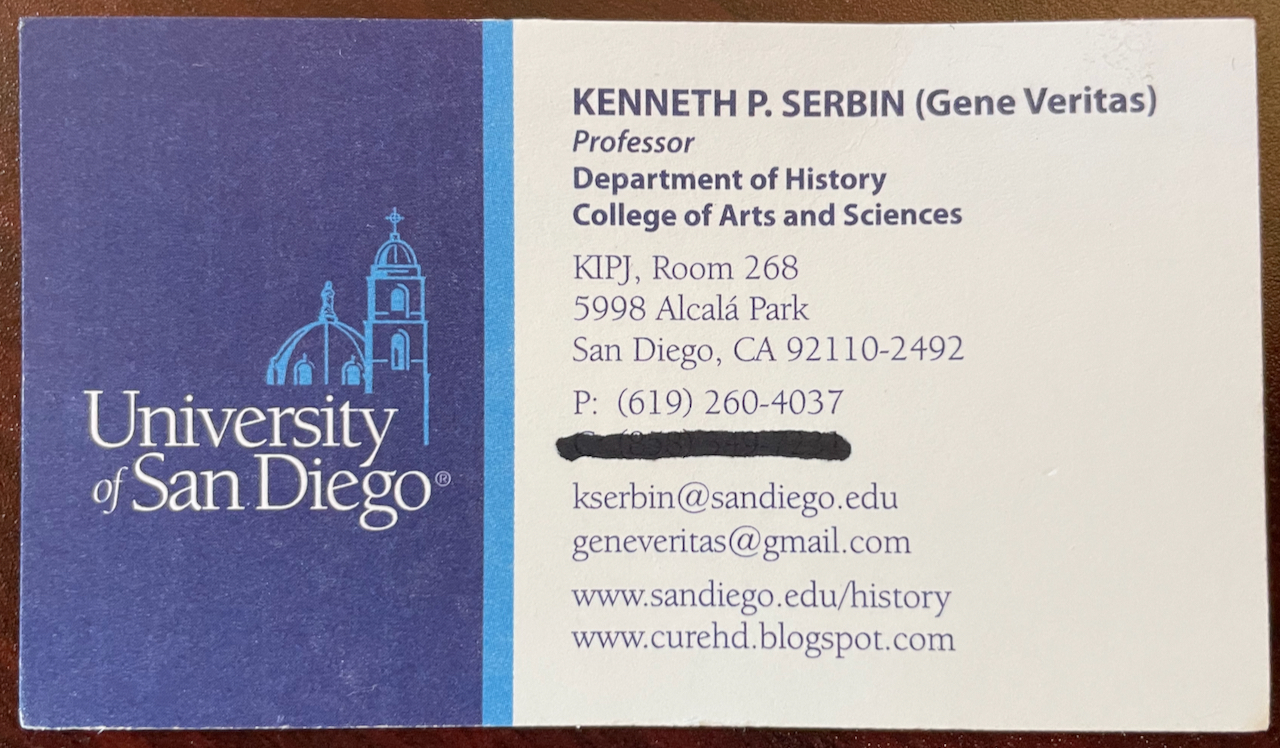
Business card of Kenneth P. Serbin (aka Gene Veritas) shared at scientific conferences and with anyone interested in learning about the HD cause (photo by Gene Veritas)


In early 2020, before the coronavirus pandemic exploded in the U.S., Dr. Burns and I collaborated in a screening at USD of the short documentary Dancing at the Vatican, which features HDdennomore. In late 2020 I helped promote the launch of the film online.


This year, I fulfilled one of the long-term goals outlined in my 2012 coming-out essay: shifting my academic focus from my beloved Brazil to the history of the quest for HD therapies.


With support from USD and The Griffin Foundation, I submitted the project for funding to the National Science Foundation. Although I was not granted funding initially, the foundation’s program officers encouraged me to reapply.


PTC’s helpful infusion of new capital


We all anxiously await effective therapies. Over the past ten years, I have increased my attention to the intensification of the efforts by labs and biopharma companies to achieve success.


The last several years of such efforts have felt like an emotional roller coaster for the HD community, though that’s not unusual for a difficult endeavor like drug development, which involves both positive and negative clinical trial results and cumulative learning.


Last month, I reported on the abrupt shutdown of the firm Triplet Therapeutics, Inc., which had explored a much-awaited proposed therapy. I also noted that the U.S. Food and Drug Administration (FDA) had requested that PTC Therapeutics, Inc., provide further information before allowing a clinical trial of its HD drug, PTC518.


But there was also potential good news.


Despite the FDA-imposed delay in a U.S. trial, PTC has reached a financing deal with the investment firm Blackstone, based on PTC’s plans to expand its drug pipelines to other diseases. The deal, which in the best-case scenario could infuse $1 billion of investment, puts “PTC in a strong position to continue to execute our mission,” Emily Hill, PTC’s chief financial officer, stated in an October 27 press release.


PTC518, a so-called splicing molecule, is also classified as a small molecule drug. It is thus taken as a pill – in contrast with riskier, less convenient delivery methods used by other HD programs, which include brain surgery and spinal injections. Early next year, PTC will furnish an update on the PTC518 trial. The trial continues in several European countries and Australia.


Roche diversifies its approach


In March 2021, Roche reported disappointing news: its gene silencing drug tominersen (an antisense oligonucleotide, or ASO) failed to improve symptoms in volunteers in the firm’s GENERATION HD1 Phase 3 (large-scale testing of effectiveness and safety) trial. This September, Roche announced GENERATION HD2, a less ambitious, Phase 2 (effectiveness, dosage, and safety) retesting of tominersen to start in early 2023.


In its presentation of GENERATION HD2 at the annual Huntington Study Group annual meeting in Tampa, FL, on November 3, Roche revealed that it has expanded its pursuit of HD therapies by embarking on two preclinical (nonhuman) projects.


Whereas tominersen targeted both the normal and abnormal (expanded) huntingtin gene, Roche will now seek to develop a drug that aims at just the abnormal gene. (Wave Life Sciences already reported in September that it had successfully targeted the abnormal gene in an early stage clinical trial, although yet without evidence of impacting symptoms.)


Like PTC’s program, Roche’s second preclinical program will aim at developing a splice modifier that would be taken orally.


“The medical need in the HD community is clear and we recognize that a range of different therapeutic approaches are likely to be required,” Mai-Lise Nguyen, of Roche’s Global Patient Partnership, Rare Diseases, wrote me in a November 3 e-mail.


A slide from the Roche presentation at the 2022 Huntington Study Group meeting illustrating the firm's three approaches to attacking Huntington's disease (slide courtesy of Roche)


Another ten years?


After the major disappointment in the shutdown of Triplet, I was heartened to learn of Blackstone’s massive investment in PTC, which indicates that both firms see PTC’s potential treatments as viable and profitable.


I was also encouraged to see how Roche, in the words of its Huntington Study Group presentation (see photo below), has augmented its HD research portfolio, reflecting a “commitment to advance scientific understanding and drug development in HD through continued collaborations” with HD organizations.


With the ingenuity of HD scientists and the dedication of HD family members to participation in research, the march towards potential therapies continues. I hope to chronicle continuing progress over the coming years not only free of the “HD closet,” but, thanks to new therapies, free of significant HD impacts, as well.


A slide from the Roche presentation demonstrating the commitment and collaborations involved in the quest for HD therapies (slide courtesy of Roche)